Discussion Overview
The discussion revolves around a problem involving two individuals, Mike and Bill, traveling towards each other at different speeds and starting times. Participants explore how to determine the time at which Bill catches up with Mike, considering various methods such as ratios and equations of motion. The scope includes mathematical reasoning and problem-solving techniques.
Discussion Character
- Mathematical reasoning
- Debate/contested
- Homework-related
Main Points Raised
- One participant asks for a formula to determine when Bill meets Mike, suggesting the use of a ratio method or another simple approach.
- Another participant emphasizes the need to find the distance first and questions the core of the problem regarding the timing of Bill's pursuit.
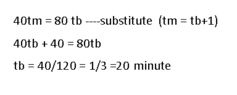
- Several participants derive equations based on the distances traveled by Mike and Bill, indicating that they need to relate their travel times.
- There is confusion among participants regarding the wording of the problem, with some suggesting that it may be improperly stated, leading to different interpretations of the meeting time.
- One participant asserts that the answer of 9:15 am is incorrect based on their calculations, proposing that they should meet at 9:00 am instead.
- Another participant agrees with the assertion that the answer of 9:15 am is wrong and asks for clarification on how to apply the LCM method to the problem.
- Participants engage in correcting each other's mathematical steps and reasoning, indicating a collaborative effort to arrive at a solution.
Areas of Agreement / Disagreement
There is no consensus on the correct answer to the problem, with some participants arguing for 9:00 am as the meeting time while others maintain that 9:15 am is correct based on the initial information provided. The discussion remains unresolved regarding the final answer.
Contextual Notes
Participants express uncertainty about the wording of the problem and the implications of the speeds and start times. There are unresolved mathematical steps and differing interpretations of the problem's conditions.