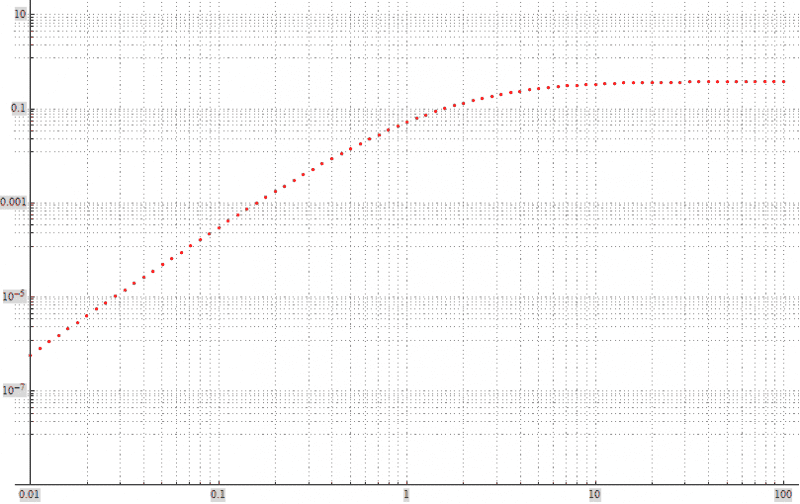
What type of transfer function is represented by this plot?

  • Thread starter Thread starter guest1234
  • Start date Start date
  • Tags Tags
    Function
Click For Summary
The plot in question is identified as representing a transfer function, specifically resembling a second-order high-pass filter. One participant suggests that the function is 1-e^{-x}, which aligns with their observations of an exponential decay in a log-log scale. There is a discussion about the vertical axis labeling, questioning why the logarithmic lines increase by a factor of 100 instead of 10, indicating potential confusion or error in the plot's presentation. The context of the plot relates to a thermally averaged cross section, which adds to the technical nature of the discussion. Overall, the conversation centers around identifying the characteristics and implications of the transfer function depicted in the plot.
guest1234
Messages
38
Reaction score
1
Hey all

What's could the function be on the plot (see the attachment)?

plot.png
 
Mathematics news on Phys.org
guest1234 said:
Hey all

What's could the function be on the plot (see the attachment)?

View attachment 82060

I know! I know! Pick me! :smile:

Where did you get it, and what do you think it is?
 
For some reason your response led me to think that the answer is obvious... :biggrin: So I plotted 1-e^{-x} and it turns out that it's the answer I'm looking for. Never seen an (inverse or whatever it's called) exponential decay plot in log-log scale before ..
As for the irrelevant 'where did you get it' -- it's thermally averaged cross section.
 
guest1234 said:
For some reason your response led me to think that the answer is obvious... :biggrin: So I plotted 1-e^{-x} and it turns out that it's the answer I'm looking for. Never seen an (inverse or whatever it's called) exponential decay plot in log-log scale before ..
As for the irrelevant 'where did you get it' -- it's thermally averaged cross section.

Glad I could help :smile:

To me it looks like a 2nd order high-pass filter transfer function. The vertical axis does look strange, though. How come each set of 10 logarithmic lines on the vertical axis is x100 instead of x10? Is that on purpose? What would the labels for each of the 10 minor gridlines be on the vertical axis...?
 
Here is a little puzzle from the book 100 Geometric Games by Pierre Berloquin. The side of a small square is one meter long and the side of a larger square one and a half meters long. One vertex of the large square is at the center of the small square. The side of the large square cuts two sides of the small square into one- third parts and two-thirds parts. What is the area where the squares overlap?

Similar threads

  • · Replies 3 ·
Replies
3
Views
1K
  • · Replies 17 ·
Replies
17
Views
3K
  • · Replies 9 ·
Replies
9
Views
2K
Replies
2
Views
2K
  • · Replies 7 ·
Replies
7
Views
2K
  • · Replies 9 ·
Replies
9
Views
2K
  • · Replies 1 ·
Replies
1
Views
1K
  • · Replies 1 ·
Replies
1
Views
2K
  • · Replies 1 ·
Replies
1
Views
2K
  • · Replies 5 ·
Replies
5
Views
1K