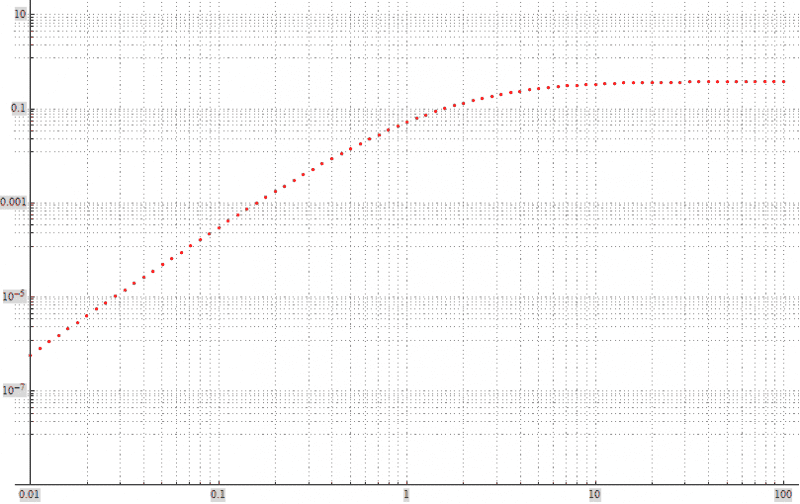
What type of transfer function is represented by this plot?

  • Context: Graduate 
  • Thread starter Thread starter guest1234
  • Start date Start date
  • Tags Tags
    Function
Click For Summary

Discussion Overview

The discussion revolves around identifying the type of transfer function represented by a plot shared in the thread. Participants explore various interpretations of the plot, including its mathematical representation and characteristics, while considering its application in a specific context.

Discussion Character

  • Exploratory, Technical explanation, Debate/contested

Main Points Raised

  • One participant suggests that the function could be represented by the equation 1-e^{-x}, indicating it resembles an exponential decay plot in log-log scale.
  • Another participant proposes that the plot looks like a 2nd order high-pass filter transfer function, questioning the vertical axis scaling and the labeling of the logarithmic lines.
  • There is a mention of the plot being related to a thermally averaged cross section, although the relevance of this context is debated.

Areas of Agreement / Disagreement

Participants express differing views on the interpretation of the plot, with no consensus on the exact type of transfer function it represents. Multiple competing interpretations remain unresolved.

Contextual Notes

Participants raise questions about the vertical axis scaling and the labeling of gridlines, indicating potential ambiguities in the plot that may affect interpretation.

guest1234
Messages
38
Reaction score
1
Hey all

What's could the function be on the plot (see the attachment)?

plot.png
 
Mathematics news on Phys.org
guest1234 said:
Hey all

What's could the function be on the plot (see the attachment)?

View attachment 82060

I know! I know! Pick me! :smile:

Where did you get it, and what do you think it is?
 
For some reason your response led me to think that the answer is obvious... :biggrin: So I plotted 1-e^{-x} and it turns out that it's the answer I'm looking for. Never seen an (inverse or whatever it's called) exponential decay plot in log-log scale before ..
As for the irrelevant 'where did you get it' -- it's thermally averaged cross section.
 
guest1234 said:
For some reason your response led me to think that the answer is obvious... :biggrin: So I plotted 1-e^{-x} and it turns out that it's the answer I'm looking for. Never seen an (inverse or whatever it's called) exponential decay plot in log-log scale before ..
As for the irrelevant 'where did you get it' -- it's thermally averaged cross section.

Glad I could help :smile:

To me it looks like a 2nd order high-pass filter transfer function. The vertical axis does look strange, though. How come each set of 10 logarithmic lines on the vertical axis is x100 instead of x10? Is that on purpose? What would the labels for each of the 10 minor gridlines be on the vertical axis...?
 

Similar threads

  • · Replies 3 ·
Replies
3
Views
1K
  • · Replies 7 ·
Replies
7
Views
2K
  • · Replies 5 ·
Replies
5
Views
2K
  • · Replies 12 ·
Replies
12
Views
2K
  • · Replies 1 ·
Replies
1
Views
1K
  • · Replies 7 ·
Replies
7
Views
3K
  • · Replies 10 ·
Replies
10
Views
1K
  • · Replies 14 ·
Replies
14
Views
2K
  • · Replies 1 ·
Replies
1
Views
2K
  • · Replies 14 ·
Replies
14
Views
2K