What's the best/strongest material for RC car models?

Click For Summary

Discussion Overview

The discussion centers around identifying the best materials for constructing parts of remote-controlled (RC) car models, particularly in the context of durability during high-speed crashes and jumps. Participants explore various material options and design considerations, focusing on the balance between performance, cost, and manufacturing feasibility.

Discussion Character

  • Debate/contested
  • Technical explanation
  • Exploratory

Main Points Raised

  • One participant suggests that materials like titanium and carbon fiber could be better alternatives to steel, but questions the cost-effectiveness of titanium given its yield strength compared to steel.
  • Another participant emphasizes the importance of improving part geometry rather than solely changing materials to enhance strength and durability.
  • There are discussions about the specific parts failing, with one participant noting that drive shafts typically fail due to buckling rather than fracturing, suggesting a need for larger diameters or hollow shafts.
  • Some participants propose using high-impact nylon and polycarbonate as effective materials for RC cars, although they may not have the aesthetic appeal of metal parts.
  • Concerns are raised about the brittleness of certain materials, with suggestions to consider aluminum for tie rod ends if they are currently plastic.
  • One participant expresses skepticism about the buckling of axles, attributing failures to bending from side loading, while another supports the buckling theory and discusses design implications.

Areas of Agreement / Disagreement

Participants do not reach a consensus on the best material or approach. Multiple competing views exist regarding material choices, design strategies, and the nature of the failures being discussed.

Contextual Notes

Participants mention various materials and their properties, but there is uncertainty regarding the specific conditions under which parts fail. The discussion also highlights the need for more detailed information about the parts in question to provide tailored recommendations.

Imbuter2000
Messages
3
Reaction score
0
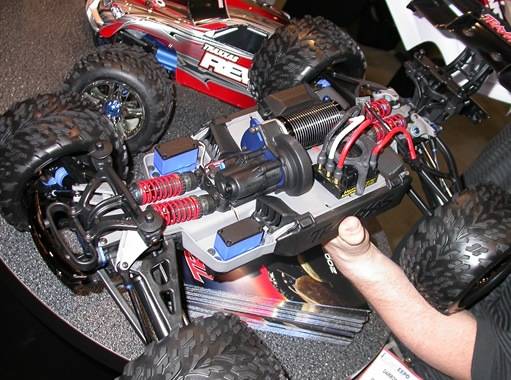
I like to play and abuse RC car models like this:
4_0.jpg


However, when making big jumps or high-speed crashes (they can even reach 90mph), even steel parts gets damaged and needs to be substituted. See these damaged/broken parts for example:
http://img169.imageshack.us/img169/4286/cimg1700.jpg

Is there, in theory, a material better than steel for these parts, that could be mass produced with a price to consumer <$1000 for all the critical parts of these cars (let's say 200 grams or 1/2 oz)?
 
Last edited by a moderator:
Engineering news on Phys.org
Well considering your opening statement mentioned "abusing" these machines, perhaps some mechanical sympathy would be the first way to improve durability.

I used to toy with RC cars for a while, there were a lot of titanium and carbon fibre components around then. That one of yours looks like a lot of plastic, GRP, steel and aluminium, so yes there are better materials around. It's a question of cost, how far do you want to go?
 
brewnog said:
Well considering your opening statement mentioned "abusing" these machines, perhaps some mechanical sympathy would be the first way to improve durability.

I used to toy with RC cars for a while, there were a lot of titanium and carbon fibre components around then. That one of yours looks like a lot of plastic, GRP, steel and aluminium, so yes there are better materials around. It's a question of cost, how far do you want to go?
It's the E-Revo Bushless #5608 that is already the most expensive RTR (not modified) electric RC car available on the market (650 euro), but I can spend other 1000 euro for parts.
The problem is that I'm not finding much better parts than stock on the market.
I only found some titanium parts but I'm not convinced that titanium worth the cost because it has a yield strengh of around 600-800 MTa comparable to medium-low grade steel.
 
Hi imbuter. Welcome to the board. The cars look amazing, can I try?

As http://www.eng-tips.com/viewthread.cfm?qid=251252&page=1"have mentioned, the first thing to do in trying to improve the strength of a part that's breaking is to improve the geometry, not change material. If you can give more details on what part is breaking, how/where it breaks, and show the part installed on the vehicle (so we can see what kind of room there is to change dimensions) it would go a long way in determining if there's a better design for the part.
 
Last edited by a moderator:
There are always tricks one can play with materials, especially heat treatments to steels to improve strength. Like already mentioned though, it would be much easier if you told us what parts are made of currently and how they are failing. Not every part can be modified in this way and may need to be redesigned for higher loads.

In this case, Ti buys you nothing other than to say the parts are made from Ti.
 
Let's begin with the parts showed in the second picture of my first message that opens this thread.
Keeping the same dimensions, what material would you suggest?
 
if I'm correct the parts shown on the picture are part of the steering setup ?

they only get Stress applied along their axis then ; which implies they were put under too much pressure -> they bend

Any material I can think of will resist pulling equally or better than compressing. This said you might want to consider varying the geometry of the part ( as implied before ) so that it can withstand more compression before bending as the pulling forces are not the ones causing the failure of the part.

I have not found any burst strength data but maybe you are luckier ; that is if you just want to stick with only changing the material.
 
What are the ball joints currently made from? They look like they have a brittle fracture. Are they plastic?
 
Maurice Dakar said:
if I'm correct the parts shown on the picture are part of the steering setup ?

The parts shown in the picture are a drive shaft and tension rod for the suspension. Typical failure of drive shafts is not fracturing but buckling. They can be improved by using a shaft with a larger out diameter. This will increase rotational inertia but the shafts can be made hollow. This adds a lot of cost.

The bent tie rod is most likely caused by a side impact along the length of the rod itself. A common way of preventing this type of failure is to use plastic parts that can absorb impact and have little to no plastic deformation.

I've played with RC cars for a few years, mostly the monster trucks and stuff. I've always found with off road stuff the more plastic and the lighter the weight, the better. Most people like shiny things so manufacturers include metal in places where it shouldn't be.

Materials like high impact nylon and polycarbonate are the best materials for RC cars. However, they usually look like crap when they are machined.
 
  • #10
I find it hard to believe that these axles are really experiencing buckling. I would think that they are really being bent due to side loading like mentioned by Topher. You can try the plastic route like Topher mentioned so that they experience very little plastic deformation or you can easily make them out of something that can be hardened like a tool steel. Those parts would be very easy to machine. The only drawback there is a bit of added weight and the possibility for brittle fracture.The axles would be best helped by the change in geometry.

I would look at making the tie rod ends out of aluminum if they are currently plastic.
 
  • #11
FredGarvin said:
I find it hard to believe that these axles are really experiencing buckling. I would think that they are really being bent due to side loading like mentioned by Topher.

Uh, what? I mentioned that they were experiencing buckling which could be initiated by side loading.

If you look at the design of the axles in the suspension arms you will see that when the arms are parallel, there is zero lash in the dog bones. This is because if you include lash you then need to extend diff. cups which then causes them to fail due to increased wear and stress. The spindle portion of the axles are not tightly retained in the bearing carriers which allows them to move around a bit. If you have a situation where the suspension arms are parallel and you have a large side load on the wheel (not hard to do) you can very easily have a good situation for buckling. Combine this with the fact that the original condition of the drive shafts that come with kits. You can almost always measure more than a few thou of run out at the center of the shaft.
 

Similar threads

  • · Replies 5 ·
Replies
5
Views
2K
  • · Replies 1 ·
Replies
1
Views
10K
  • · Replies 14 ·
Replies
14
Views
7K
  • · Replies 65 ·
3
Replies
65
Views
12K