What's wrong with my solution? -- Area moment of inertia

Click For Summary

Homework Help Overview

The discussion revolves around the application of the parallel axis theorem in calculating the area moment of inertia for a composite shape. The original poster expresses confusion regarding their solution and seeks assistance in identifying potential errors.

Discussion Character

  • Exploratory, Assumption checking, Problem interpretation

Approaches and Questions Raised

  • The original poster attempts to apply the parallel axis theorem but is uncertain about their calculations. Some participants question the necessity of subtracting moments of inertia and suggest verifying the accuracy of input values. Others provide references to external resources for clarification.

Discussion Status

The discussion is ongoing, with participants exploring different interpretations of the problem. Some guidance has been offered regarding the use of the parallel axis theorem and the importance of checking calculations, but no consensus has been reached on the specific errors in the original poster's approach.

Contextual Notes

There is mention of potential confusion regarding the application of the theorem to different areas of the composite shape, as well as the original poster's initial unfamiliarity with forum posting etiquette.
mobsaleh
Messages
3
Reaction score
1
Homework Statement
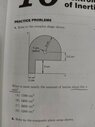
Area moment of inertia is to be calculated for a composite shape
Relevant Equations
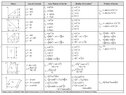
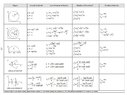
For rectangle: Ix = bh^3/3. For a semi-circle Ix = pi/8*a^4
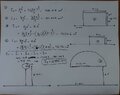
I used the parallel axis theorem to solve the question but my answer is still wrong. Any ideas where I slipped? I can't seem to figure out the problem?
 
Physics news on Phys.org
Sorry I'm new here. I didn't know how to attach earlier in my original question
 

Attachments

  • 20220215_190815.jpg
    20220215_190815.jpg
    42.7 KB · Views: 152
  • 20220215_190827.jpg
    20220215_190827.jpg
    23 KB · Views: 117
  • 2.JPG
    2.JPG
    52.6 KB · Views: 151
  • 1..JPG
    1..JPG
    47.8 KB · Views: 143
  • Like
Likes   Reactions: Delta2
It seems to me that you only need to add three moments of inertia; no need to subtract anything. You have expressions for all the colored shapes that make up the object. For the green and red areas you need to use the parallel axis theorem but not for the blue area. Other than that, you need to make sure that all the input numbers are correct. I would use a spreadsheet instead of a calculator for this.
Inertia.png
 
  • Like
Likes   Reactions: Delta2 and Lnewqban

Similar threads

Replies
2
Views
2K
  • · Replies 40 ·
2
Replies
40
Views
6K
  • · Replies 28 ·
Replies
28
Views
2K
  • · Replies 13 ·
Replies
13
Views
3K
  • · Replies 11 ·
Replies
11
Views
1K
Replies
11
Views
3K
Replies
25
Views
2K
  • · Replies 12 ·
Replies
12
Views
2K
  • · Replies 5 ·
Replies
5
Views
4K
  • · Replies 21 ·
Replies
21
Views
2K