- 1,256
- 0
Ah okay, I had though they were essentially direct competitors. Is the Dreamliner aimed at smaller, shorter flights than the A380?
Ivan Seeking said:This has a direct impact on my income so this is great news for me personally as well as everyone at Boeing.
Borek said:According to Boeing it will use up to 20% fuel less plus it will be much quieter than other planes.
Wallace said:Ah okay, I had though they were essentially direct competitors. Is the Dreamliner aimed at smaller, shorter flights than the A380?
I thought the 787 only had secondary nozzle chevrons because of the large bypass ratio. I can't tell from the videos that Ivan linked to.minger said:Notice the chevrons on the jet nozzle. That is very state-of-the-art right now with a lot of work being to done to understand exactly how they even work. For acoustic reasons btw.
I always thought they were! I thought they were going with a kind of hybrid delta wing configuration. I never looked into it though.minger said:Also, did anyone notice as the plane flew over the camera, the change in perspective gave the eerie illusion that the wings were being swept back?
Lower emissions, greater range with less fuel consumption, quieter (in both the cabin and surrounding areas).minger said:p.s. As far as the differences between the 707 and 787. Well the 707 was like a 180 passenger airline, where the 787 is almost twice that. Sure, similar shape, way different scale. Lots of difference there.
chaoseverlasting said:So what really are the advantages of the 787?
minger said:Notice the chevrons on the jet nozzle. That is very state-of-the-art right now with a lot of work being to done to understand exactly how they even work. For acoustic reasons btw.
Also, did anyone notice as the plane flew over the camera, the change in perspective gave the eerie illusion that the wings were being swept back?
p.s. As far as the differences between the 707 and 787. Well the 707 was like a 180 passenger airline, where the 787 is almost twice that. Sure, similar shape, way different scale. Lots of difference there.
FredGarvin said:I thought the 787 only had secondary nozzle chevrons because of the large bypass ratio. I can't tell from the videos that Ivan linked to.
Cyrus said:So.....why don't I just upgrade the engines on my existing airplanes and save hundreds of millions of dollars?
In other words, I want to see the Cd of this airplane in a wind tunnel compared to other airplanes. If it is indeed 20% lower, I'll buy Boeings marketing ploy. Otherwise, they should just say it has 20% more efficient engines and thank whoever makes the engines. This is exactly what boeing does when selling their hummingbird helicopter. Its engine has a very low SFC, but they attribute it to its 'optimum speed rotors'...woooo optimum speed rotors yeah sure...
minger said:Even if the Cd is the same, it has a bigger cross sectional area. In order to be bigger and consume less fuel, I would imagine the Cd would be lower. We have MUCH better tools today to help with design, which helps with that.
I have had the chance to see a lecture from one of the head gurus at Boeing. They do have predictive models but they are still working on aspects of it. It had some really good insight into the design of the chevrons. One thing we went into a fair amount of detail on was the fact that, as bypass ratio increased, chevrons on the jet nozzle became less effective and chevrons on the bypass duct took over. One of the major tradeoffs apart from performance of the engine, was that the chevrons always slightly increased higher frequencies while helping to attenuate the lower.minger said:They've found the chevrons to reduce acoustical waves, but don't really (that I know of) successful numerical models. From what I know they experimentally found that x number of chevrons reduced noise while y increased. If they were angled at a they reduced and b they increased.
I was recently at a conference a NASA rep was presenting some stuff on it (among other aeroacoustic research). Pretty cool stuff. They may be there for another reason, but that one I do know of.
I see a bunch of differences in the wing planform and the way the engines are hung. I see a bit in the fuselage, especially in the front.Cyrus said:I don't see much difference in aerodynamic shape between those two pictures.
tmyer2107 said:I recently flew on one of Continental's new airplanes. Wasn't near as noisy and had much less turbulence than anything else I've flown in. Also had outlets at every seat and tvs in the seat in front of you, it made for a much more enjoyable flight. I would definitely pay a few extra dollars to fly in that plane again rather than another flight on another airline. I think that is going to be the biggest advantage for the 787. It will attract customers to the airlines that have them because they know they will have a more comfortable, enjoyable experience.
Cyrus said:They all look like the same ole B-707 from 1960!
mugaliens said:In this case, looks are definitely deceiving...
jimmysnyder said:These airport delays are getting out of hand. This flight was two years late.

Cyrus said:How so? In what way is it aerodynamically different than any other school bus they make?
http://img682.imageshack.us/img682/9573/jglt.jpg
Yeah, not impressed by the 787 so far...
Hooray for substandard improvements in technology! Hey, at least it has a fancy paint job...
Cyrus said:Anyone remember this brilliant idea?
http://flyingelectrons.com/page7/page18/files/page18_2.jpg
Boeing decided it would be a good idea to cruise right at the edge of ma 1, i.e where drag is the absolute highest. I talked with a former Boeing engineer who told me the entire airplane was a marketing gimmick they had no intentions of making.
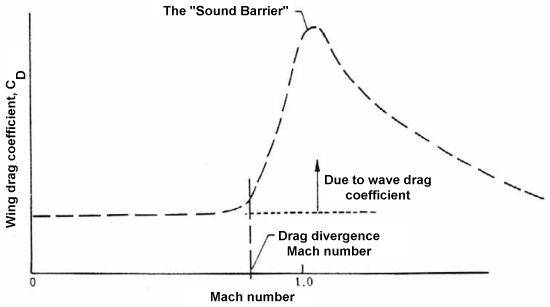
Hmmmm, let's make an airplane cruise at that peak...brilliant idea.
Ivan Seeking said:The answer from Cyrus is "I don't know"?
Ivan Seeking said:It is pretty tough to fake 20% better mileage.
Of course I'm sure none of the buyers have anyone who knows what they're doing. God knows that none would have a newby college grad to keep them straight.
Borek said:What is specific productivity?
Cyrus said:It is defined as:
[tex]SP = \frac{(\mbox{Max Payload})x\mbox{(Transport speed)}}{\mbox{Max T/o Weight}}[/tex]
Prime motivation for sales. Fill the seats on popular longer runs and save a pile of money on fuel. And yes, that kind of efficiency is impossible to fake. A higher-capacity plane can also help relieve congestion in the skies and on the ground. If I were operating an airline and a manufacturer offered me a new plane that could cut fuel costs by 20% on runs like NY to LA, NY to LV, LA to Honolulu, etc, I'd sure have some orders in place. You're still going to have fees to pay at airports, catering costs, etc, but if you can make fewer flights, spreading the costs over the same number of passengers (or more passengers, perhaps) AND save 20% on fuel, that's a game-changer. I hope that Boeing gets the plane certified soon and starts cranking them out - a little bright spot in the economic gloom.Ivan Seeking said:It is pretty tough to fake 20% better mileage.
Of course I'm sure none of the buyers have anyone who knows what they're doing. God knows that none would have a newby college grad to keep them straight.
mugaliens said:Yeah!
Observation: The chase plane wasn't exactly in the safest location, wingtip vortex-wise! Would have been tragic to get off the ground only to loose a wingtip...