Where Can I Find Comet Lovejoy in the Sky Right Now?

  • Thread starter Thread starter davenn
  • Start date Start date
  • Tags Tags
    Charts Comet
Click For Summary

Discussion Overview

The discussion revolves around the visibility and observation of Comet Lovejoy, including its current position in the sky, visual characteristics, and tips for viewing. Participants share personal experiences, equipment used, and challenges faced while trying to observe the comet.

Discussion Character

  • Exploratory
  • Technical explanation
  • Debate/contested
  • Experimental/applied

Main Points Raised

  • Some participants note that Comet Lovejoy is currently well placed in the sky and was recently at peak magnitude of M4.2.
  • There is a discussion about the comet's blue/green color, attributed to gases like cyanogen and diatomic carbon, though some participants express uncertainty about the specifics.
  • Participants share personal observations, with some successfully seeing the comet with the naked eye and others relying on binoculars or telescopes.
  • One participant mentions creating finder charts to assist less experienced observers in locating the comet.
  • There are mixed reports about visibility, with some noting it was easily visible while others faced challenges due to weather conditions.
  • Participants discuss the difficulty of focusing on objects due to age-related vision changes and the challenges of astrophotography.
  • Some participants express excitement about the comet's visibility, while others share frustrations with cloudy weather impacting their viewing opportunities.

Areas of Agreement / Disagreement

Participants generally agree on the visibility of Comet Lovejoy and its characteristics, but there are differing experiences regarding visibility conditions and the effectiveness of various observational techniques. The discussion remains unresolved regarding the specifics of the comet's color and the best methods for observing it.

Contextual Notes

Some participants mention limitations in their observational capabilities due to weather conditions and personal vision issues, which may affect their experiences and reports.

Who May Find This Useful

Astronomy enthusiasts, amateur astronomers, and individuals interested in comet observation may find this discussion useful for tips on viewing Comet Lovejoy and understanding its characteristics.

davenn
Science Advisor
Gold Member
Messages
9,725
Reaction score
11,821
Comet Lovejoy is well placed in the sky for the next week or so... it has just gone past peak magnitude of M4.2 around 4 days ago ( 9th Jan). But it is still a bright and easy object particularly with binoculars
Visually ( from a dark site) or in binoculars, its a bright fuzzy blob ... sort of similar looking to a globular cluster ... It takes a good telescope or a photo to pick the blue/green colour.

As of today 14 Jan it is passing through Taurus

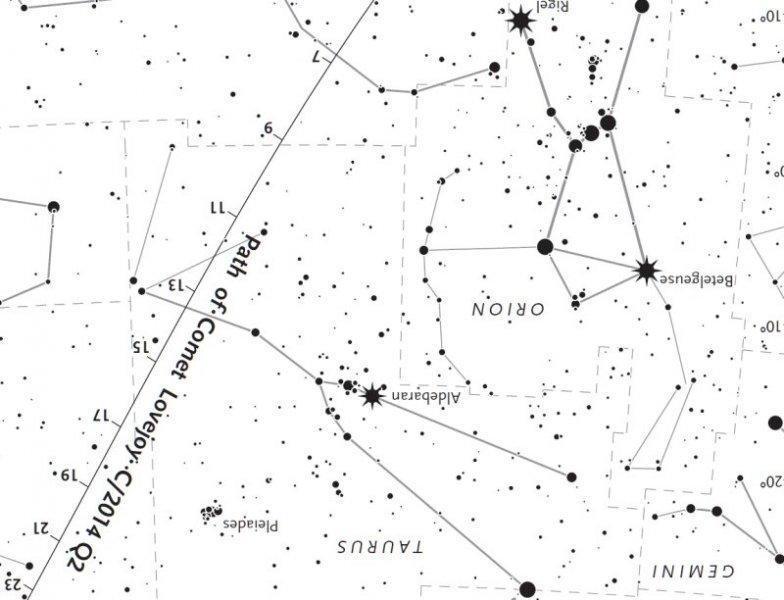
Here's a couple of finder charts with appropriate orientations for the northern hemisphere ...
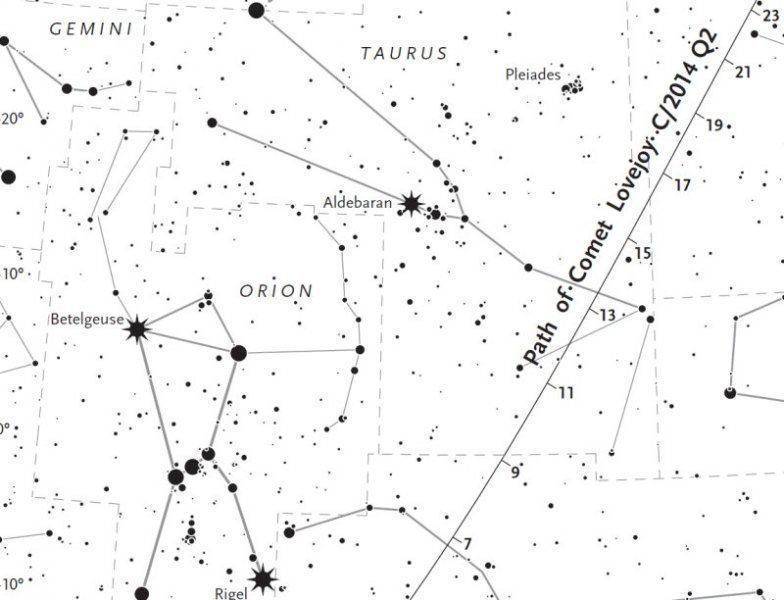
Lovejoy NthrnHemis1.jpg

and the southern hemisphere ...

Lovejoy SthrnHemis1.jpg
cheers
Dave
 
  • Like
Likes   Reactions: Garth
Astronomy news on Phys.org
davenn said:
the blue/green colour.
I give up. Anything known or suspected causing the color?
 
yup

actually its not an uncommon colour in comets

"The green color is due to two gases emanating from the comet: cyanogen and diatomic carbon, which both fluoresce green when UV sunlight strikes them"

so I'm told ;)

Finally a clear nite here after 5 nites of cloud, have the car packed with telescope and camera gear and am heading out to a dark site
hopefully get some reasonable pixcheers
Dave
 
davenn said:
cyanogen and diatomic carbon
They'll drum me out of the ACS for this. Cross your fingers the weather breaks for my neck of the woods. I haven't seen sun, moon, stars for close to two weeks.
 
Bystander said:
I haven't seen sun, moon, stars for close to two weeks.

:( not good mate

OK just got home from a trip to a dark site
here's a quick pic before I go to bed it's after midnite ... no processing other than cropping and resizing for the forum
400mm, f6.3, 30 sec @ 1600 ISO

2015_01_14_2779a.jpg


cheers
Dave
 
  • Like
Likes   Reactions: mic* and Bystander
I want to go out in the next couple of nights to see it, and I might send some less experienced friends out to look, so I've made some maps that I think will help them find it better than than pro maps davenn provided.

It's passing south of the Pleiades, which shouldn't be hard to locate, but it's dim enough at 5.0 and dropping that I've included a zoomed in version of the most proximal stars as a star-hopping aid.
 

Attachments

  • comet-lovejoy.png
    comet-lovejoy.png
    29.5 KB · Views: 535
  • comet-lovejoy-zoom.png
    comet-lovejoy-zoom.png
    16.1 KB · Views: 592
  • Like
Likes   Reactions: davenn
Hi Dave

It was in its correct location as indicated for the 14th ( I'm in Australia) It was easily naked eye visible from the dark site I was at

so if you get clear skies go for it ! :)

cheers
Dave
 
davenn said:
It was easily naked eye visible from the dark site I was at
A mag 5.0 object would be at the limit of my my half-century-old eyes.

But I have my 6" scope at a friend's farm, so I will see if I can make my way up there this weekend.
 
DaveC426913 said:
A mag 5.0 object would be at the limit of my half-century-old eyes.

LOL I know the feeling ... I'm 55, but my main problem is double visioning ... prismed lenses in my glasses help a lot
the worse thing is I cannot focus really close up and trying to make sure objects are in focus through the camera is extremely difficult :(

seeing how bright it was last nite I would estimate it to be M 4.5 - 5.0. Haven't seen any official figures as yet

the 6" scope will give you a great view ... it was huge in 7x50 bino's last nite

D
 
  • #10
so Dave,
did you get a chance to see it ? hope so

OK, that pic above was a single 30 sec exposure
This one is a combination 7 x 30 sec exposures, I use a program called DSS ... Deep Sky Stacker
It takes all your individual images, aligns the stars within them and produces rendition that can then be worked on in photoshop etc

lovejoy1a 1200x784b.jpg


cheers
Dave
 
  • Like
Likes   Reactions: mic*
  • #11
davenn said:
so Dave,
did you get a chance to see it ? hope so
I went out for a constitutional* down by the lake last night, but wouldn't you know it, a bank of high clouds rolled by just as I got to a good observing site.

I'll try again tonight, but holy snarpin' arses it's cold out there.

*cigar
 
  • #12
ok on the cold
tis really hot down in this part of the world

good luck for tonite's viewing :)
 
  • #13
:( Full overcast.
 
  • #14
crap :(

only thing in your advantage is that its climbing higher into the sky

for me its heading towards the NW horizon I am looking at going out tonite again, even tho I have to be up early in the morning
Its going to be about the last chance to get to see and photo it before our weather craps out over the next few days

Dave
 
  • #15
Thank you for your finder chart.

I saw it last night with binoculars, it was just a blob. I possibly saw the tail but nothing like Comet Lovejoy's Tail . (APOD 17.01.15)

Garth
 
  • Like
Likes   Reactions: davenn
  • #16
Hi there Garth
Well done ! :)

I went out again on Friday nite. Still a very easy naked eye object around Mag 4.5. Huge blob in the bino's couldn't see any tail visually
That only came out in the photos

its takes serious photography and post processing to produce a tail looking like the one in your link :)

cheers
Dave
 

Similar threads

  • · Replies 8 ·
Replies
8
Views
3K
  • · Replies 1 ·
Replies
1
Views
3K
  • · Replies 1 ·
Replies
1
Views
4K