Where does photon interference happen

  • Context: Graduate 
  • Thread starter Thread starter zonde
  • Start date Start date
  • Tags Tags
    Interference Photon
Click For Summary
SUMMARY

Photon interference occurs primarily at the beam splitter in a Mach-Zehnder interferometer, as established by quantum mechanics interpretations. However, recent experiments, such as those documented in the NIST publication on two-photon interference, demonstrate that interference can also be observed after the beam splitter under specific conditions, such as "postponed compensation." The discussion highlights the distinction between the Hong-Ou-Mandel (HOM) experiment and the standard two-photon interference experiment, asserting that conclusions drawn from one cannot be universally applied to the other.

PREREQUISITES
  • Understanding of Mach-Zehnder interferometer principles
  • Familiarity with two-photon interference and downconversion processes
  • Knowledge of quantum mechanics interpretations related to photon behavior
  • Awareness of the Hong-Ou-Mandel (HOM) experiment
NEXT STEPS
  • Research the principles of the Mach-Zehnder interferometer in detail
  • Study the NIST publication on two-photon interference for experimental insights
  • Examine the differences between the Hong-Ou-Mandel experiment and standard two-photon interference setups
  • Explore the concept of "postponed compensation" in quantum optics experiments
USEFUL FOR

Physicists, quantum optics researchers, and students studying quantum mechanics who are interested in photon behavior and interference phenomena.

zonde
Gold Member
Messages
2,960
Reaction score
224
If we look at http://en.wikipedia.org/wiki/Mach%E2%80%93Zehnder_interferometer" I think it's fair to say that any interpretation of QM says that there are appear no photons (in idealized case) at detector 2 as there are no detections. Basically that means that photon interference takes place at beam splitter.

As I see this approach conflicts with results of this experiment:
http://physics.nist.gov/Divisions/Div844/publications/migdall/psm96_twophoton_interference.pdf"
where interference is observed after "postponed compensation" that takes place after beam splitter.

To make reasoning more straightforward let's say we use photon pair from donwconversion process where signaling photon goes through interferometer but idler is detected just for tracking purposes. So the setup is like this:
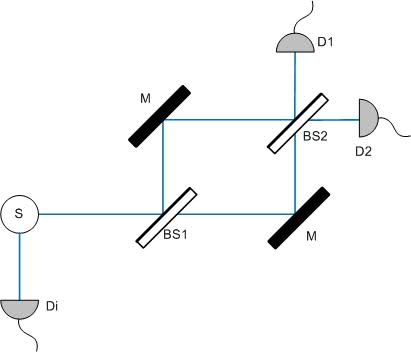
2j2b774.jpg

Will we see 100% coincident detections between Di and D2 with ideal detectors and ideal source (all photons are paired up)?
 
Last edited by a moderator:
Physics news on Phys.org
Here are valid links in place of those broken ones:
https://en.wikipedia.org/wiki/Mach-Zehnder_interferometer
https://journals.aps.org/prl/abstract/10.1103/PhysRevLett.77.1917
And another similar paper https://arxiv.org/abs/quant-ph/0304030

These two-photon interference experiments demonstrate the passive role of first beamsplitter in SA type experiment but they extend these results to HOM experiment and claim that in case of HOM experiments beamsplitter has passive role as well.
In my question I was relying on correctness of this conclusion but my insight on the topic is that this conclusion is just wrong. HOM and SA experiments are very different despite some similarities in setup so that conclusions from modified SA experiment can not be extended to HOM experiment.
 
  • Like
Likes   Reactions: Greg Bernhardt

Similar threads

  • · Replies 2 ·
Replies
2
Views
2K
  • · Replies 3 ·
Replies
3
Views
1K
  • · Replies 32 ·
2
Replies
32
Views
3K
  • · Replies 4 ·
Replies
4
Views
2K
  • · Replies 14 ·
Replies
14
Views
2K
  • · Replies 7 ·
Replies
7
Views
2K
  • · Replies 3 ·
Replies
3
Views
3K
  • · Replies 76 ·
3
Replies
76
Views
7K
  • · Replies 41 ·
2
Replies
41
Views
7K
  • · Replies 1 ·
Replies
1
Views
1K