Which angle has a larger cosine value?

  • Context: MHB 
  • Thread starter Thread starter mathdad
  • Start date Start date
  • Tags Tags
    Angle
Click For Summary

Discussion Overview

The discussion revolves around comparing the cosine values of two expressions involving angles B and θ, specifically cos(B - π/2) and cos(θ + π/2). Participants are examining the correctness of their calculations and the interpretation of the problem statement, which involves trigonometric identities and potential quadrant considerations.

Discussion Character

  • Debate/contested
  • Mathematical reasoning

Main Points Raised

  • One participant calculates cos(B - π/2) to be approximately 0.557 and cos(θ + π/2) to be approximately 0.731, concluding that cos(θ + π/2) is greater.
  • Another participant questions the interpretation of the values given for cos(B) and cos(θ), suggesting a possible misrepresentation in the problem statement.
  • There is a repeated inquiry about the correctness of the textbook's answer, which states that cos(B - π/2) is greater than cos(θ + π/2).
  • Participants express uncertainty about the quadrant in which angles B and θ terminate, which may affect the cosine values.
  • Clarifications are sought regarding the notation used in the problem statement, particularly whether the expressions represent angle values or cosine values.

Areas of Agreement / Disagreement

Participants do not reach a consensus on the correctness of the calculations or the textbook's answer. Multiple competing interpretations of the problem statement and the values involved remain unresolved.

Contextual Notes

There is ambiguity regarding the definitions of cos(B) and cos(θ) as well as the quadrant locations of the angles, which may influence the cosine values being compared.
mathdad
Messages
1,280
Reaction score
0
We are given the following:

Let B = beta

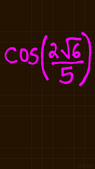
cos B = cos (2_/6)/5

cos θ = cos 3/4

Which angle is larger:

cos (B - π/2) or cos (θ + π/2)?

I found cos (B - π/2) to be about 0.557.

I found cos (θ + π/2 to be about 0.731.

So, 0.731 > 0.557.

My answer is cos (θ + π/2) > cos (B - π/2).

Book's answer is cos (B - π/2) > cos (θ + π/2).

Why is my answer wrong?
 
Mathematics news on Phys.org
what is this value supposed to be?

(2_/6)/5
 

Attachments

  • sDraw_2018-03-16_12-06-55.png
    sDraw_2018-03-16_12-06-55.png
    7.4 KB · Views: 112
recheck the problem ... are you sure it's not

$\cos{\beta} = \dfrac{2\sqrt{6}}{5}$ and $\cos{\theta} = \dfrac{3}{4}$

instead of

$\cos{\beta} = \cos\left(\dfrac{2\sqrt{6}}{5}\right)$ and $\cos{\theta} = \cos\left(\dfrac{3}{4}\right)$

?
 
Yes, you are right. So, why is the textbook right? Why is my answer wrong?
 
RTCNTC said:
Yes, you are right. So, why is the textbook right? Why is my answer wrong?

one more note regarding the problem statement ...

Which angle is larger:

cos (B - π/2) or cos (θ + π/2)?

$\cos\left(\beta - \dfrac{\pi}{2}\right)$ and $\cos\left(\theta + \dfrac{\pi}{2}\right)$ are not angle values ... maybe which value of cosine is larger?

one more question, does the problem statement say anything about which quadrant(s) $\beta$ and $\theta$ terminate?
 
Last edited by a moderator:
skeeter said:
one more note regarding the problem statement ...
$\cos\left(\beta - \dfrac{\pi}{2}\right)$ and $\cos\left(\theta + \dfrac{\pi}{2}\right)$ are not angle values ... maybe which value of cosine is larger?

one more question, does the problem statement say anything about which quadrant(s) $\beta$ and $\theta$ terminate?

I need to get back to you. I will look in the textbook.
 

Similar threads

  • · Replies 7 ·
Replies
7
Views
3K
  • · Replies 2 ·
Replies
2
Views
2K
Replies
3
Views
2K
  • · Replies 6 ·
Replies
6
Views
1K
  • · Replies 1 ·
Replies
1
Views
2K
  • · Replies 5 ·
Replies
5
Views
3K
  • · Replies 1 ·
Replies
1
Views
2K
  • · Replies 1 ·
Replies
1
Views
2K
  • · Replies 2 ·
Replies
2
Views
2K
  • · Replies 2 ·
Replies
2
Views
2K