Which Force is Represented by the Gradient of the Ball-Wall Collision Graph?

Click For Summary
SUMMARY

The gradient of the momentum versus time graph for a rubber ball colliding with a wall represents the force exerted by the wall on the ball, confirming option C as the correct answer. The discussion clarifies that the gradient indicates the rate of change of momentum, which aligns with Newton's second law, F = dp/dt. When the ball contacts the wall, its momentum is positive, and the gradient is negative, indicating the direction of the force exerted by the wall on the ball. This understanding is crucial for interpreting momentum graphs in physics.

PREREQUISITES
  • Understanding of Newton's second law (F = dp/dt)
  • Familiarity with momentum concepts in physics
  • Ability to interpret graphs, specifically momentum vs. time graphs
  • Basic knowledge of forces and their interactions
NEXT STEPS
  • Study the implications of momentum conservation in collisions
  • Learn about impulse and its relationship to momentum changes
  • Explore graphical analysis of force and momentum in different collision scenarios
  • Investigate real-world applications of momentum and force in sports physics
USEFUL FOR

Students of physics, educators teaching mechanics, and anyone interested in understanding the dynamics of collisions and forces in motion.

PhysicsIsKillingMe
Messages
2
Reaction score
0
Problem goes: A rubber ball, traveling in a horizontal direction, strikes a vertical wall. It rebounds at right angles to the wall. The graph below illustrates the variation of the ball’s momentum p with time t when the ball is in contact with the wall.
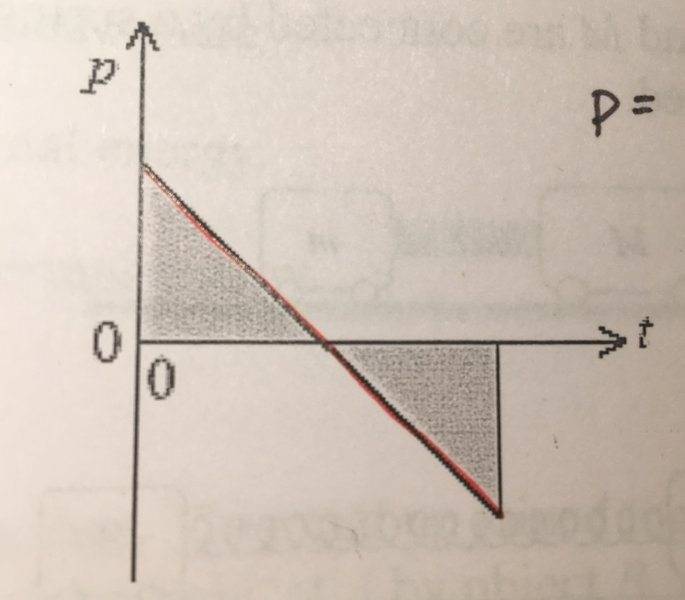
upload_2018-7-24_14-58-39.jpeg


Which of the following statements is true?

A) The shaded area is equal to the force exerted by the wall on the ball.
B) The shaded area is equal to the force exerted by the ball on the wall.
C) The gradient is equal to the force exerted by the wall on the ball.
D) The gradient is equal to the force exerted by the ball on the wall.

The right answer is C. I understand how the gradient in any momentum vs time graph is the force, but I don’t understand why it’s by the wall on the ball instead of the ball on the wall.
 

Attachments

  • upload_2018-7-24_14-58-39.jpeg
    upload_2018-7-24_14-58-39.jpeg
    27.3 KB · Views: 1,699
Physics news on Phys.org
Is the ball's momentum positive or negative, when touching the wall at the first time (at ##t=0## in the graph)?
 
The gradient is negative, i.e. away from the wall (the ball's initial momentum is positive, i.e. towards the wall). If it was ball on wall, the gradient would be the same but with opposite sign, i.e. positive. More generally, the force acting on on an object is equal to the rate of change of momentum of the object. So in any graph like that (momentum of an object vs. time), the gradient of the line is the force acting on the object.
 
  • Like
Likes   Reactions: PhysicsIsKillingMe and PeroK
The most straightforward reasoning is to go to Newton's second law, dp/dt = F, where F by definition is the force on the body. Hence, the derivative of the momentum of the ball is equal to the total force acting on the ball, which in this case is provided by the wall.
 

Similar threads

Replies
1
Views
2K
Replies
10
Views
1K
Replies
9
Views
4K
  • · Replies 7 ·
Replies
7
Views
5K
  • · Replies 9 ·
Replies
9
Views
5K
  • · Replies 4 ·
Replies
4
Views
5K
  • · Replies 4 ·
Replies
4
Views
6K
  • · Replies 2 ·
Replies
2
Views
3K
Replies
3
Views
4K
  • · Replies 2 ·
Replies
2
Views
3K