Which Formula Best Suits a Hollow Gondola?

  • Thread starter Thread starter solarmidnightrose
  • Start date Start date
  • Tags Tags
    Formula
Click For Summary
SUMMARY

The discussion centers on determining the appropriate formula for calculating the rotational inertia of a hollow gondola, specifically using the "hoop about a diameter" formula and the parallel axis theorem. The user initially attempted to apply the formula I=mr² but was corrected and guided towards incorporating the height of the axis into their calculations. The key takeaway is that understanding the axis of rotation and making reasonable assumptions about mass distribution are critical for accurate calculations of rotational inertia in this context.

PREREQUISITES
  • Understanding of rotational inertia and its significance in physics.
  • Familiarity with the "hoop about a diameter" formula.
  • Knowledge of the parallel axis theorem and its application.
  • Basic principles of torque and angular motion.
NEXT STEPS
  • Research the derivation and applications of the parallel axis theorem.
  • Learn how to calculate rotational inertia for composite objects using integration.
  • Explore the implications of torque in rotational systems and how to apply Newton's laws of motion.
  • Study the effects of mass distribution on the dynamics of pendulum systems.
USEFUL FOR

Physics students, mechanical engineers, and anyone involved in the design and analysis of rotating systems, particularly in amusement ride engineering.

solarmidnightrose
Messages
28
Reaction score
10
Homework Statement
I've been trying to calculate the rotational inertia of this rotating gondola on this ride at this theme park.

However, they do not directly give me a specific formula to use-because with different objects, there are different formulae that you use to determine the rotational inertia of an object

mass of gondola = 6 tonne (6000kg)
radius = 3m


I will attach a picture of what it looks like
Relevant Equations
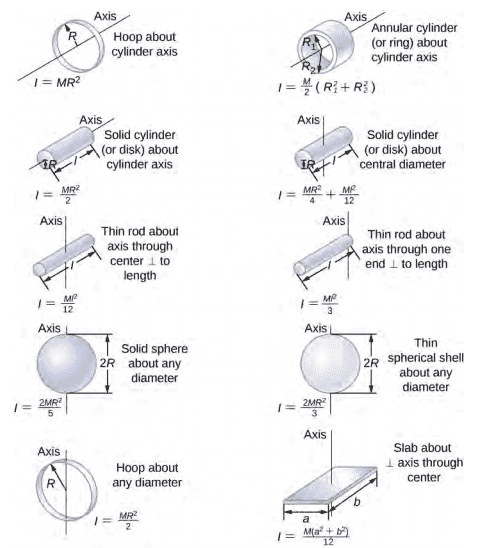
I have attached a picture of different possible formulae's
Picture of gondola:
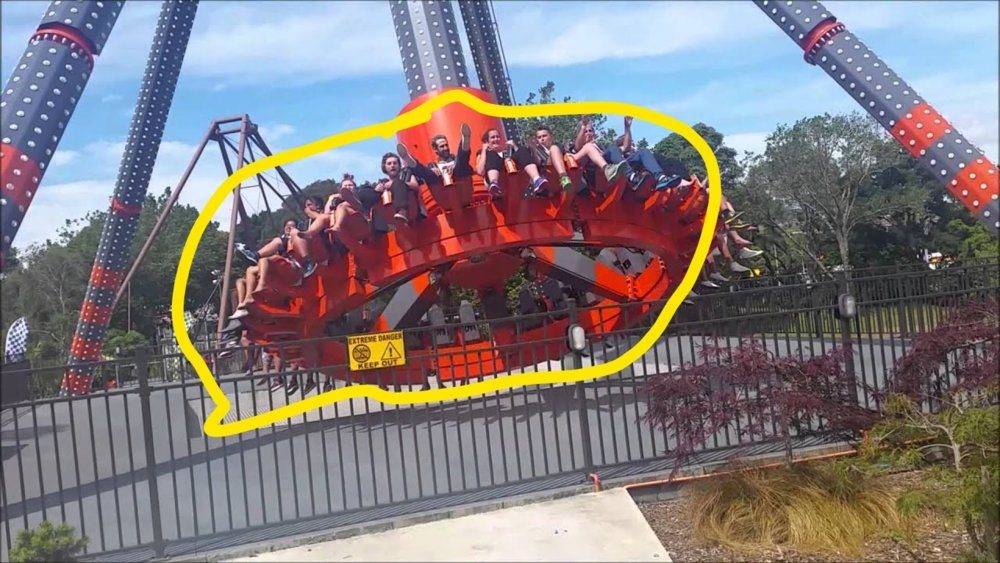
244604


Formulae:
244603


Initially, I used the equation: I=mr^2
I=(6000)x(3)^2​
T=54,000kgm^2
(but apparently this is incorrect)

So, basically, I don't know which formula would suit best for the gondola (the picture above). I would consider the gondola a hollow object as the mass is concentrated on the outer edges.
 
Physics news on Phys.org
solarmidnightrose said:
which formula would suit best for the gondola
The key question is what axis is it rotating about? I am unfamiliar with this equipment, but it looks like it swings like a pendulum from somewhere up above. If so, you need to know how high that is. You would then apply the "hoop about a diameter" formula, and using the parallel axis theorem add a term mh2 where h is the height of the axis.
 
The assumption that all the weight is in a ring is massive.
It will affect the torque required to drive the system, and the velocity of the driven system.
Furthermore, If all the mass were in the ring it would have to be very precisely balanced.
 
haruspex said:
The key question is what axis is it rotating about? I am unfamiliar with this equipment, but it looks like it swings like a pendulum from somewhere up above.
Yes, you're assumption/idea of the ride is correct :) (sorry, I should have provided a video)
video: (I believe only the first 10 seconds is enough)

Anyways, if I take into consideration the axis that the gondola is rotating about then that would be the arm/pendulum-tube that the gondola is attached to? (I've circled this part in blue) Is this correct?-I just want some confirmation please.
244611

haruspex said:
If so, you need to know how high that is. You would then apply the "hoop about a diameter" formula, and using the parallel axis theorem add a term mh2 where h is the height of the axis.
The length of the pendulum tube is 15m.
Would it be alright to say that the 'height' of the axis (i.e. the pendulum tube) is 15m?

If I use the "hoop about a diameter formula", then I would:
  1. substitute the mass/radius of the gondola into the "hoop about a diamter formula"
  2. add the (mh^2) to the above answer.
My attempt at your suggestion:
244612

@haruspex , am I doing this correctly? have I substituted the correct values into the formula? have I even done the right thing by adding "mh^2" to "hoop about a diameter formula"?

Thanks for your help/input; very kind.
 
tkyoung75 said:
The assumption that all the weight is in a ring is massive.
Thanks for that, @tkyoung75 .
My teacher was telling us that for this report that many assumptions would have to be made in order to help explain the physics concepts behind these rides at theme parks.

So, since this rotational inertia of this gondola must be HUGE, then is that why an external torque provider such as a motor would be used in rides such as this to get it spinning in the first place? If so, then that would really help my report.

Thanks for your help :)
 
solarmidnightrose said:
So, basically, I don't know which formula would suit best for the gondola (the picture above).
The formulas you posted are all different special cases of the general and always applicable ##I=\int \rho(\vec{r})r^2dV## (and it would be a good exercise to see if you can derive some of them from this general formula).

You'll solve this problem by making a reasonable assumption about what ##\rho## might be, identifying the axis of rotation, and then evaluating the integral.
 
Nugatory said:
The formulas you posted are all different special cases of the general and always applicable ##I=\int \rho(\vec{r})r^2dV## (and it would be a good exercise to see if you can derive some of them from this general formula).

You'll solve this problem by making a reasonable assumption about what ##\rho## might be, identifying the axis of rotation, and then evaluating the integral.
I'm sorry, but my teenage brain is screaming/crying looking at that integral.

Also, what is this 'roh' in the integral?

I apologise @Nugatory if I come off as rude, but this is something that I haven't been taught yet. Do you think it's possible to learn all this derivative-stuff/integration in a couple of hours (6hrs max)? If yes, then "yay!".

If no, then I'm screwed.
 
What do you have to do to change the direction?

solarmidnightrose said:
So, since this rotational inertia of this gondola must be HUGE, then is that why an external torque provider such as a motor would be used in rides such as this to get it spinning in the first place? If so, then that would really help my report.

This about Newtons laws of motion.
 
tkyoung75 said:
What do you have to do to change the direction?
Apply an unbalanced torque to cause it to accelerate angularly-i.e. spin/rotate. (Newtons II Law).

tkyoung75 said:
This about Newtons laws of motion.
Oh okay, that's cool.

Thanks-I believe I get this idea of rotational inertia better now.

It's just that I have a hard time trying to actually calculate the rotational inertia (I guess you could say I'm not very mathematically strong).
 
  • #10
Do you know the basic formula for inertia?
 
  • #11
tkyoung75 said:
Do you know the basic formula for inertia?
Is it I=mr^2? (rotational inertia)
 
  • #12
That is the one I had in mind. Do you know how to add them together, if you have a mass in the centre and a mass on the outside?
 
  • #13
tkyoung75 said:
That is the one I had in mind. Do you know how to add them together, if you have a mass in the centre and a mass on the outside?
No, I have no idea.

But I have a feeling its got something to do with Centre of Mass? (which is something I can do-calculate the CoM; but I don't know if that's relevant).

An earlier post mentioned something about the Parallel Axis Theorem-(but I have never come across this before) and I am not sure how important I need to know this in order to find the rotational inertia of the gondola in this ride.
 
  • #14
solarmidnightrose said:
Yes, you're assumption/idea of the ride is correct :) (sorry, I should have provided a video)
video: (I believe only the first 10 seconds is enough)

Anyways, if I take into consideration the axis that the gondola is rotating about then that would be the arm/pendulum-tube that the gondola is attached to? (I've circled this part in blue) Is this correct?-I just want some confirmation please.
View attachment 244611

The length of the pendulum tube is 15m.
Would it be alright to say that the 'height' of the axis (i.e. the pendulum tube) is 15m?

If I use the "hoop about a diameter formula", then I would:
  1. substitute the mass/radius of the gondola into the "hoop about a diamter formula"
  2. add the (mh^2) to the above answer.
My attempt at your suggestion:
View attachment 244612
@haruspex , am I doing this correctly? have I substituted the correct values into the formula? have I even done the right thing by adding "mh^2" to "hoop about a diameter formula"?

Thanks for your help/input; very kind.

Yes, that looks about right... except, watching the video to the end I see there is a long section of tube above the axle, possibly with a counterweight on the end. This could easily add 50%; hard to know without more data.

Also I see there is some rotation about the tube axis, but this is small by comparison and does not add to the above since it relates to an orthogonal rotation.
 
  • #15
solarmidnightrose said:
Parallel Axis Theorem-(but I have never come across this before)
So Google it.
 
  • Like
Likes solarmidnightrose
  • #16
Well if you had two masses each traveling in the same direction and they hit a wall at the same speed at the same with force F, what would the total force be?
 
  • #17
haruspex said:
Yes, that looks about right... except, watching the video to the end I see there is a long section of tube above the axle, possibly with a counterweight on the end. This could easily add 50%; hard to know without more data.

Also I see there is some rotation about the tube axis, but this is small by comparison and does not add to the above since it relates to an orthogonal rotation.
I am so thankful for your help
haruspex said:
So Google it.
haha, yeah I did.
 

Similar threads

  • · Replies 12 ·
Replies
12
Views
4K
  • · Replies 4 ·
Replies
4
Views
2K
  • · Replies 2 ·
Replies
2
Views
1K
  • · Replies 6 ·
Replies
6
Views
2K
  • · Replies 7 ·
Replies
7
Views
3K
  • · Replies 1 ·
Replies
1
Views
2K
  • · Replies 1 ·
Replies
1
Views
2K
  • · Replies 3 ·
Replies
3
Views
758
Replies
8
Views
3K
  • · Replies 8 ·
Replies
8
Views
2K