Which is the correct Expression for Drift Velocity of Electrons in a conductor ?

Click For Summary
SUMMARY

The correct expression for drift velocity of electrons in a conductor is given by Vd = eE/m x (Tau), as stated by MIT Professor Walter Lewin and supported by HyperPhysics. The alternative expression Vd = eE/2m x (Tau) found in some textbooks is not fully valid, as it fails to account for the instantaneous velocity during electron collisions. The relaxation time (Tau) must be considered, as it significantly affects the drift velocity calculation.

PREREQUISITES
  • Understanding of basic electromagnetism concepts
  • Familiarity with electron mobility and relaxation time
  • Knowledge of classical mechanics, particularly velocity definitions
  • Basic comprehension of Ohm's Law and its implications
NEXT STEPS
  • Research the relationship between drift velocity and electric field strength in conductors
  • Study the concept of relaxation time (Tau) in electron dynamics
  • Explore the differences between average and instantaneous velocity in physics
  • Examine the derivation of drift velocity equations in solid-state physics
USEFUL FOR

Students of physics, electrical engineers, and anyone studying the behavior of electrons in conductive materials will benefit from this discussion.

nishantve1
Messages
74
Reaction score
1
i am really really confused . I know what Drift velocity is but the problem is I have three Sources which tell absolutely different expression for drift velocity and I cat relate . please tell which is right .
This website and MIT Profs. Walter Lewin In his Lectures says Vd = eE/m x (Tau)
http://hyperphysics.phy-astr.gsu.edu/hbase/electric/ohmmic.html

And my book says Vd = eE/2m x (Tau)
Thats Ridiculous Heres the proof
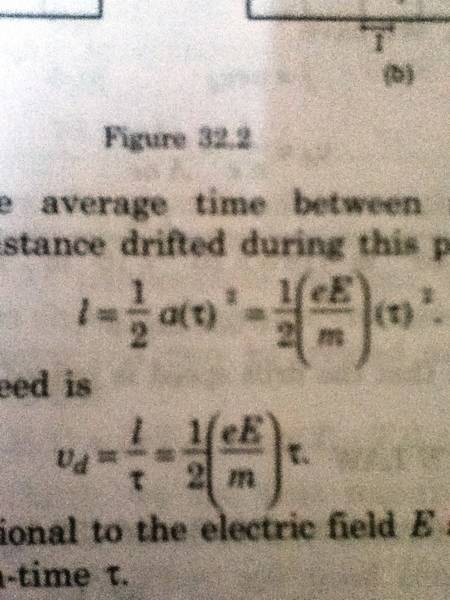
kPo9L.jpg


What the heck is goin on ?
 
Physics news on Phys.org
Actually the second expression is not fully valid...if you take into consideration the time between two successfull collisions of an electron, then the time will be negligible annd the so called relaxation time will tend to 0. So you can't take average velocity in this case and you are bound to take the instantaneous velocity i.e, v=dl/dt.So the second one is not fully correct...by any case...is this book the second part of H.C.Verma ?
 

Similar threads

  • · Replies 1 ·
Replies
1
Views
3K
  • · Replies 4 ·
Replies
4
Views
1K
  • · Replies 3 ·
Replies
3
Views
4K
  • · Replies 5 ·
Replies
5
Views
4K
  • · Replies 2 ·
Replies
2
Views
18K
  • · Replies 4 ·
Replies
4
Views
15K