Which method is easier and why?

4 replies · 2K views · last reply
mathdad
Messages
1,280
Reaction score
0
I found the following problem in Section 1.3 of my Precalculus textbook by David Cohen.

Factor x^6 - y^6 as a difference of squares and then as a difference of cubes.

1. Which method is easier and why?

2. Can someone get me started?
 
Attachments
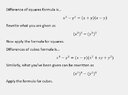
  • Typed worked example: difference of squares x^2 - y^2 = (x+y)(x-y) used to rewrite (x^3)^2 - (y^3)^2, and difference of cubes x^3 - y^3 = (x-y)(x^2+xy+y^2) used to rewrite (x^2)^3 - (y^2)^3, with instruction lines between.
    differenceof.jpg
    14.4 KB · Views: 185
RTCNTC said:
I found the following problem in Section 1.3 of my Precalculus textbook by David Cohen.

Factor x^6 - y^6 as a difference of squares and then as a difference of cubes.

1. Which method is easier and why?

2. Can someone get me started?

you can apply either way. but next steps become simpler if you apply difference of square

$x^6-y^6= (x^3+y^3)(x^3-y^3)$ 1st term is sum of cubes and second is difference of cubes and you get

$x^6-y^6= (x^3+y^3)(x^3-y^3)= (x+y)(x^2-xy+y^2)(x-y)(x^3+xy+y^2)$

had you chosen difference of cubes you would have got

$x^6-y^6 = (x^2-y^2)(x^4+x^2y^2+y^4)$

factoring $x^4+x^2y^2+y^4 = (x^4+2x^2y^2+y^4)- x^2y^2 = (x^2+y^2)^2 - (xy)^2 = (x^2+y^2+xy)(x^2+y^2-xy)$

above may not be straight forward but doable
 
kaliprasad said:
you can apply either way. but next steps become simpler if you apply difference of square

$x^6-y^6= (x^3+y^3)(x^3-y^3)$ 1st term is sum of cubes and second is difference of cubes and you get

$x^6-y^6= (x^3+y^3)(x^3-y^3)= (x+y)(x^2-xy+y^2)(x-y)(x^3+xy+y^2)$

had you chosen difference of cubes you would have got

$x^6-y^6 = (x^2-y^2)(x^4+x^2y^2+y^4)$

factoring $x^4+x^2y^2+y^4 = (x^4+2x^2y^2+y^4)- x^2y^2 = (x^2+y^2)^2 - (xy)^2 = (x^2+y^2+xy)(x^2+y^2-xy)$

above may not be straight forward but doable

Nice work in every sense.