Which Z Value Should Be Used for Camera Motion?

Click For Summary

Discussion Overview

The discussion revolves around determining the appropriate Z value for a camera's position in a project focused on understanding camera motion in space and the corresponding cable lengths for each post. Participants explore the implications of different Z values and the calculations required for the camera's position in relation to the posts.

Discussion Character

  • Exploratory
  • Technical explanation
  • Homework-related
  • Mathematical reasoning

Main Points Raised

  • One participant is uncertain whether to use a Z value of 15 or 25 meters for the camera's position, impacting the calculations for cable lengths.
  • Another participant explains the distance formula needed to calculate the length of cable released from each post based on the camera's position.
  • A participant expresses confusion about finding the initial position C(t) of the camera and notes a discrepancy in their calculations, suggesting they may have overlooked details in the question.
  • There is a suggestion that the camera's position C(t) is not explicitly given, but it is sufficient to determine the cable lengths based on the camera's distance from the posts.
  • One participant mentions a specific calculation for the distance from the SW ground corner to the NE post top, indicating potential difficulties with perpendicular lengths and dot products.
  • Another participant provides a specific formula for calculating the cable length released from the SW post based on the camera's coordinates.

Areas of Agreement / Disagreement

Participants do not reach a consensus on which Z value to use for the camera's position, and multiple views on the calculations and interpretations of the problem remain. The discussion reflects uncertainty and varying interpretations of the problem details.

Contextual Notes

Participants express confusion regarding the initial position of the camera and the implications of straight cable assumptions. There are unresolved mathematical steps related to the calculations of distances and cable lengths.

wonder1
Messages
6
Reaction score
0
Hi all,

i am having a problem with question 3, as its not clear if i should use the Z value for the camera as 15 or 25 m or... Could you suggest me. Cheers

The goal of this project is to obtain some understanding of the camera’s motion in space.
Also, based on the camera’s motion, we will obtain an understanding of the type of engine
necessary to operate the camera’s cables.

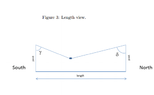
Some general observations: The camera must be able to reach the ground for maintenance
(calibration during a game), but most of the time the camera will hover 15 to 25 metres above
the playing field. The position of the camera at time t will be denoted by C(t). In our model
we will assume that the cables are always stretched on a straight line (although in reality there
is a small amount of curving due to gravity).

Part 1: Motion in Cartesian coordinates
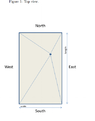
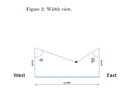
We introduce a coordinate system where the origin (0, 0, 0) coincides with the SW post. The
x-axis goes from the origin in the direction of the SE post. The y-axis goes from the origin to
the NW post. The z-axis goes straight up from the origin. The position of the camera will be
represented by

C(t) = (x(t), y(t), z(t)).

1. What are the coordinates of the four corners of the playing field?

2. What are the coordinates of the top of each post?

3. The position of the camera in space completely determines the amount of cable that each
post has released. Compute the length of each cable as a function of x, y, and z. (That
is, find the distance from the camera to the top of each post.)

View attachment 5603View attachment 5604View attachment 5605View attachment 5606
 

Attachments

  • a.png
    a.png
    13.8 KB · Views: 130
  • d.png
    d.png
    3.8 KB · Views: 123
  • f.png
    f.png
    5.9 KB · Views: 133
  • s.png
    s.png
    3.6 KB · Views: 146
Last edited:
Physics news on Phys.org
Hello and welcome to MHB, wonder! (Wave)

What you are being asked for question 3, is simply the distance from the camera to the top of each post. The distance formula for determining the distance $d$ between two points in 3Space, let's call them $P_1\left(x_1,y_1,z_1\right),\,P_2\left(x_2,y_2,z_2\right)$ is given by:

$$d=\sqrt{\left(x_2-x_1\right)^2+\left(y_2-y_1\right)^2+\left(z_2-z_1\right)^2}$$

So, assuming you have already correctly found the coordinates for the top of each post, and using the given position $C(t)$ of the camera at time $t$, can you now state the amount of cable that each post will have released at time $t$?
 
Hi Mark,

Thank you for your help.

I have found the coordinates of the top of poles, however I am having a hard time understanding what it means with finding the initial position C(t) of the camera at time t.. because when i substituted the values i got 80 and i know its wrong.

If i knew the Z value of camera i could work it out, i feel like i have overlooked something in question details but i don't know what it is.

i just re-read it initially all the cables are straight: does that mean at C (t) is the camera in the center of all the cables?
 
Last edited:
We aren't given the initial position of the camera, all we know is that $C(t)$ represents the position of the camera at time $t$. However, this is all we need to answer question 3. We are simply being asked to give the amount of cable that has been released from each post, which is equal to the camera's distance from the top of each post.
 
I am sorry mark but i am just stuck. I have found the length between the the SW ground corner to at the Pole top of the NE to be 228.03 thinking i could work out a perpendicular length but i don't think its right and i tried using dot-point product but its not making sense.
 
I suspect you are overthinking this...:D

Let's begin with the SW post...the top of this post has coordinates:

$$(0,0,80)$$

At time $t$, the camera has coordinates:

$$(x(t),y(t),z(t))$$

And so the amount of cable $d_{SW}$ released from the SW post at time $t$ is:

$$d_{SW}=\sqrt{\left(x(t)-0\right)^2+\left(y(t)-0\right)^2+\left(z(t)-80\right)^2}=\sqrt{x^2(t)+y^2(t)+\left(z(t)-80\right)^2}$$

Can you do the same thing for the other 3 posts?
 
;) ;)

That's fantastic Thank you Mark. Yes, I can do to the other poles.
 

Similar threads

  • · Replies 2 ·
Replies
2
Views
4K
  • · Replies 3 ·
Replies
3
Views
2K
  • · Replies 25 ·
Replies
25
Views
3K
Replies
1
Views
1K
  • · Replies 1 ·
Replies
1
Views
2K
  • · Replies 11 ·
Replies
11
Views
4K
  • · Replies 3 ·
Replies
3
Views
2K
  • · Replies 2 ·
Replies
2
Views
2K
Replies
24
Views
3K
  • · Replies 18 ·
Replies
18
Views
19K