White dwarf mass-radius relationship

Click For Summary
SUMMARY

The discussion focuses on the mathematical challenges associated with deriving the mass-radius relationship for white dwarfs. The user seeks assistance in combining equations effectively, particularly in manipulating the density equation, ρ_c = M/V, where V is the volume of a sphere (V = 4/3 π R³). Key advice includes isolating R and breaking down numerical constants into their prime factors to simplify calculations. The user expresses difficulty with the exponent 5/3 and is advised to show their work for better guidance.

PREREQUISITES
  • Understanding of basic physics concepts, specifically the mass-radius relationship in astrophysics.
  • Familiarity with the equations of state for stellar objects, particularly white dwarfs.
  • Proficiency in algebra, including manipulation of exponents and fractions.
  • Knowledge of spherical volume calculations and density equations.
NEXT STEPS
  • Study the derivation of the mass-radius relationship for white dwarfs using the Chandrasekhar limit.
  • Learn about the equations of state for degenerate matter in white dwarfs.
  • Practice algebraic manipulation of equations involving exponents and fractions.
  • Explore numerical methods for solving complex equations in astrophysics.
USEFUL FOR

Students and researchers in astrophysics, particularly those studying stellar evolution and the properties of white dwarfs, as well as anyone interested in advanced mathematical techniques in physics.
PeteWheatstraw
Messages
6
Reaction score
0
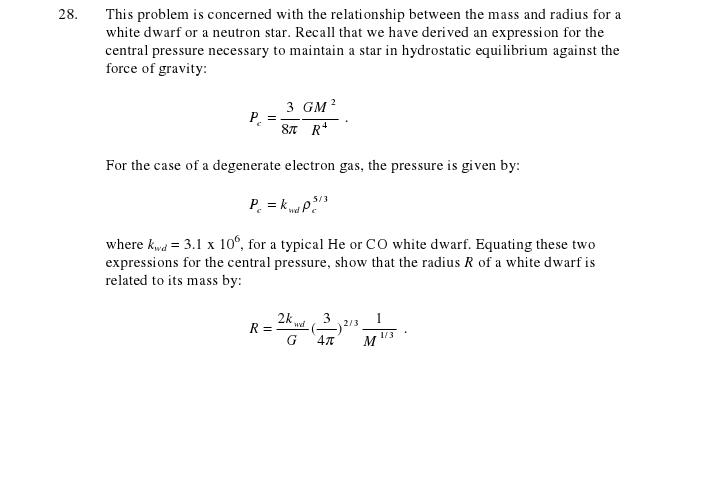
instead of typing it out, here is the problem

whitedwarf_zps675b25b5.png


I know what to do, my math just isn't good enough to combine the equations properly. Been at it a few hours, brain hurts, please help!
 
Physics news on Phys.org
Hello PeteWheatstraw,

Welcome to Physics Forums!
PeteWheatstraw said:
instead of typing it out, here is the problem

whitedwarf_zps675b25b5.png


I know what to do, my math just isn't good enough to combine the equations properly. Been at it a few hours, brain hurts, please help!
As part of the forum rules, you need to show your work. If you get stuck, you need to show us where you're stuck. But you at least need to show what you've done so far, in order for help.

But for what it's worth (very general advice), start by substituting mass over volume for the density \rho_c, where the volume is the the volume of a sphere, \frac{4}{3} \pi R^3, and the mass is M.

After rearranging to isolate R, apart from the other variables, you'll end up with a bunch of numerical constants, many of which are under exponents. Break these numbers into their prime factors (e.g., 8 → 2·2·2), multiply out the exponents if necessary (e.g., 35/3 → [3·3·3·3·3]1/3) and regroup things so that you can get the numbers to be under the exponents that you want (e.g., [3·3·3·3·3]1/3 → 3·[3·3]1/3 → 3·32/3).
 
Last edited:
Thanks for the tips.

some how I end up with (I'd type it all out but it's late)...

2∏R/3G=1/M^-1/3

and I'm stuck, and I know its wrong in the 1st place...I'll try again in the morning. Really my issue is I have no idea what to do with the 5/3 exponent and when to do it.

Thanks again though.
 

Similar threads

  • · Replies 7 ·
Replies
7
Views
6K
  • · Replies 5 ·
Replies
5
Views
2K
  • · Replies 2 ·
Replies
2
Views
2K
  • · Replies 8 ·
Replies
8
Views
2K
  • · Replies 7 ·
Replies
7
Views
6K
  • · Replies 9 ·
Replies
9
Views
2K
  • · Replies 2 ·
Replies
2
Views
2K
  • · Replies 3 ·
Replies
3
Views
13K
  • · Replies 5 ·
Replies
5
Views
3K
Replies
12
Views
2K