Redwaves
- 134
- 7
- Homework Statement
- What are the eigenvalue and eigenvectors
##m_a = m_b = m_c##
- Relevant Equations
- ##\frac{d^2x_a}{dt^2} + \frac{2kx_a}{m} - \frac{kx_b}{m}##
##\frac{d^2x_b}{dt^2} + \frac{3kx_b}{m} - \frac{kx_a}{m} - 2\frac{kx_c}{m}##
##\frac{d^2x_c}{dt^2} + \frac{2kx_c}{m} - \frac{2kx_b}{m}##
Hi,
I have to find the eigenvalues and eigenvectors for a system of 3 masses and 4 springs. At the end I don't get the right eigenvalues, but honestly I don't know why. Everything seems fine for me. I spent the day to look where is my error, but I really don't know.
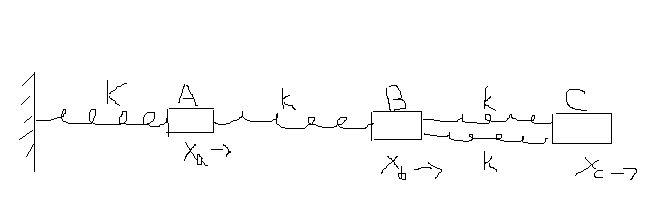
##m_a = m_b = m_c##
I got these motion equations
##\frac{d^2x_a}{dt^2} + \frac{2kx_a}{m} - \frac{kx_b}{m} = 0##
##\frac{d^2x_b}{dt^2} + \frac{3kx_b}{m} - \frac{kx_a}{m} - 2\frac{kx_c}{m} = 0##
##\frac{d^2x_c}{dt^2} + \frac{2kx_c}{m} - \frac{2kx_b}{m} = 0##
Then, after plugging the solution ##x(t) = X_{ni} cos(\omega_n + \alpha_n)##
I get this matrix
##\begin{pmatrix}
-\omega_n^2 +\frac{2k}{m} & -\frac{k}{m} & 0\\
- \frac{k}{m} & -\omega_n^2 +\frac{3k}{m} & -\frac{2k}{m} \\
0 & -\frac{2k}{m} &-\omega_n^2 +\frac{2k}{m}
\end{pmatrix}##
Next, I have to find that ##det(A)## = 0
##(-\omega_n^2 + \frac{2k}{m})[(-\omega_n^2 + \frac{3k}{m})^2 -(\frac{2k}{m})^2 - (\frac{k}{m})^2 ] = 0##
thus,
I have ##\omega_1^2 = \frac{2k}{m}, \omega_2^2 = -\frac{k}{m}(-3 -\sqrt{5}), \omega_3^2 = -\frac{k}{m}(-3 +\sqrt{5})##
However the correct eigenvalues are
I have ##\omega_1^2 = \frac{2k}{m}, \omega_2^2 = \frac{5-\sqrt{21}}{2}\frac{k}{m}, \omega_3^2 = \frac{5+\sqrt{21}}{2}\frac{k}{m}##
I have to find the eigenvalues and eigenvectors for a system of 3 masses and 4 springs. At the end I don't get the right eigenvalues, but honestly I don't know why. Everything seems fine for me. I spent the day to look where is my error, but I really don't know.
##m_a = m_b = m_c##
I got these motion equations
##\frac{d^2x_a}{dt^2} + \frac{2kx_a}{m} - \frac{kx_b}{m} = 0##
##\frac{d^2x_b}{dt^2} + \frac{3kx_b}{m} - \frac{kx_a}{m} - 2\frac{kx_c}{m} = 0##
##\frac{d^2x_c}{dt^2} + \frac{2kx_c}{m} - \frac{2kx_b}{m} = 0##
Then, after plugging the solution ##x(t) = X_{ni} cos(\omega_n + \alpha_n)##
I get this matrix
##\begin{pmatrix}
-\omega_n^2 +\frac{2k}{m} & -\frac{k}{m} & 0\\
- \frac{k}{m} & -\omega_n^2 +\frac{3k}{m} & -\frac{2k}{m} \\
0 & -\frac{2k}{m} &-\omega_n^2 +\frac{2k}{m}
\end{pmatrix}##
Next, I have to find that ##det(A)## = 0
##(-\omega_n^2 + \frac{2k}{m})[(-\omega_n^2 + \frac{3k}{m})^2 -(\frac{2k}{m})^2 - (\frac{k}{m})^2 ] = 0##
thus,
I have ##\omega_1^2 = \frac{2k}{m}, \omega_2^2 = -\frac{k}{m}(-3 -\sqrt{5}), \omega_3^2 = -\frac{k}{m}(-3 +\sqrt{5})##
However the correct eigenvalues are
I have ##\omega_1^2 = \frac{2k}{m}, \omega_2^2 = \frac{5-\sqrt{21}}{2}\frac{k}{m}, \omega_3^2 = \frac{5+\sqrt{21}}{2}\frac{k}{m}##
Last edited: