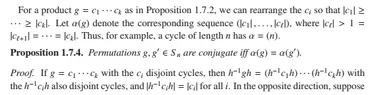
Why are these cycles disjoint and of equal length?
- Context: Undergrad
- Thread starter Hill
- Start date
Click For Summary
SUMMARY
The discussion explains why conjugation in group theory produces cycles that are disjoint and of equal length. It establishes that conjugation is an isomorphism preserving the order of elements, meaning the order of a cycle equals its length. The cycle notation of the conjugated element ##h^{-1} c h## contains exactly those elements ##x## for which ##h^{-1}(x)## appears in the original cycle ##c##. Since ##h^{-1}## is a bijection, it maps disjoint subsets to disjoint subsets, ensuring the conjugated cycles remain disjoint and maintain their original lengths.
PREREQUISITES
- Basic group theory concepts including group isomorphisms and conjugation
- Cycle notation and properties of permutations
- Understanding of element order in permutation groups
- Bijection properties and their effect on set mappings
NEXT STEPS
- Study the proof that conjugation is an isomorphism in group theory
- Explore the classification of permutations by cycle structure
- Learn about centralizers and normalizers in permutation groups
- Investigate applications of conjugation in symmetric groups and group actions
USEFUL FOR
Mathematics students, abstract algebra learners, and researchers working with permutation groups or studying the structural properties of group elements through conjugation.
Similar threads
- · Replies 5 ·
- · Replies 4 ·
- · Replies 2 ·
- · Replies 5 ·
- · Replies 4 ·
- · Replies 5 ·
- · Replies 2 ·
- · Replies 3 ·
- · Replies 1 ·
- · Replies 31 ·