Why Aren't Splitting Patterns & Integrations for Red & Blue Protons Different?

Join the discussion
Ask a follow-up here, or get your own question answered by working scientists, mathematicians and engineers — people, not an autocomplete.
Real named experts · corrections over time · the nuance an AI answer skips
3 replies · 4K views
MermaidWonders
Messages
112
Reaction score
0
View attachment 8839

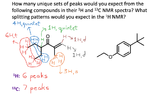
For the colourfully-annotated compound above, why aren't the splitting patterns and integrations for the red and blue set of protons "pentet, 6 H" and "octet, 4 H", respectively?
 

Attachments

  • Screen Shot 2019-03-03 at 16.25.08.png
    Screen Shot 2019-03-03 at 16.25.08.png
    26.1 KB · Views: 149
Mathematics news on Phys.org
MermaidWonders said:
For the colourfully-annotated compound above, why aren't the splitting patterns and integrations for the red and blue set of protons "pentet, 6 H" and "octet, 4 H", respectively?

Never mind. I see why.
 
topsquark said:
I'm curious. Would you be willing to share your solution?

-Dan

Hi,

Sorry for the super late reply. Just saw this.

When I first came across that question, I was very confused as to why my professor had put "6 H, t" and "4 H, quintet" for the splitting patterns and peak integrations for the red and blue set of protons, respectively (as in the screenshot), so I tried to look at that question in a "different" way. If we start by looking at the red protons branching out from either of the 2 carbons, we see that there are 2 protons coming off of the adjacent carbon (whether you are looking at the top or bottom adjacent carbon). Because all 6 of the red protons are chemically-equivalent, it makes sense for the splitting pattern to be a triplet according to the n + 1 rule, where n = 2 for the adjacent C. Next, if we look at the blue set of protons, we are in a similar situation. All 4 of the blue protons are chemically-equivalent, and a quintet splitting pattern comes from the fact that the "top" OR "bottom" adjacent C (the C's with red protons branching off of it) gives n = 3 AND the other adjacent C (the one with a green proton branching off of it) gives n = 1, so together, n + 1 = 4 + 1 = 5 --> quintet.

Hope what I said sort of makes sense. I'm really no expert in organic chemistry myself, but at least this is the process I had to go through to understand that solution! :(