Math Amateur
Gold Member
MHB
- 3,920
- 48
- TL;DR
- I need help in order to fully understand the concept of the set of Borel sets ...
I am reading Sheldon Axler's book: Measure, Integration & Real Analysis ... and I am focused on Chapter 2: Measures ...
I need help in order to fully understand the set of Borel sets ... ...
The relevant text reads as follows:
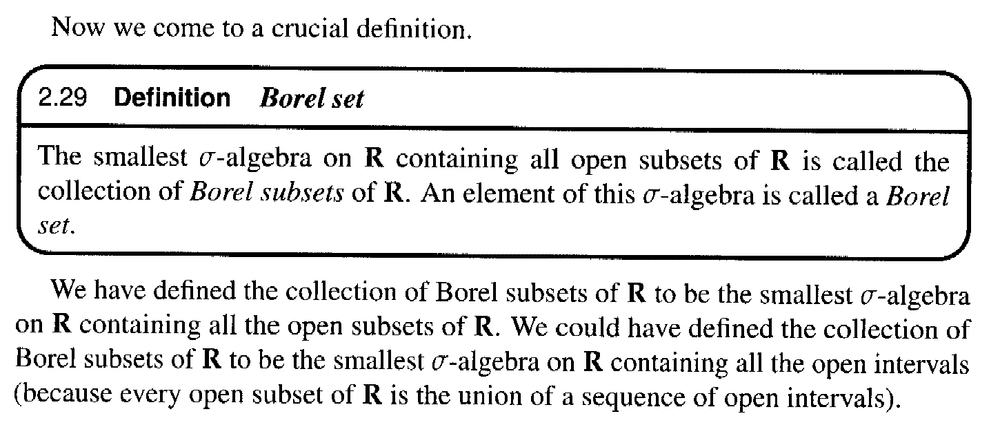
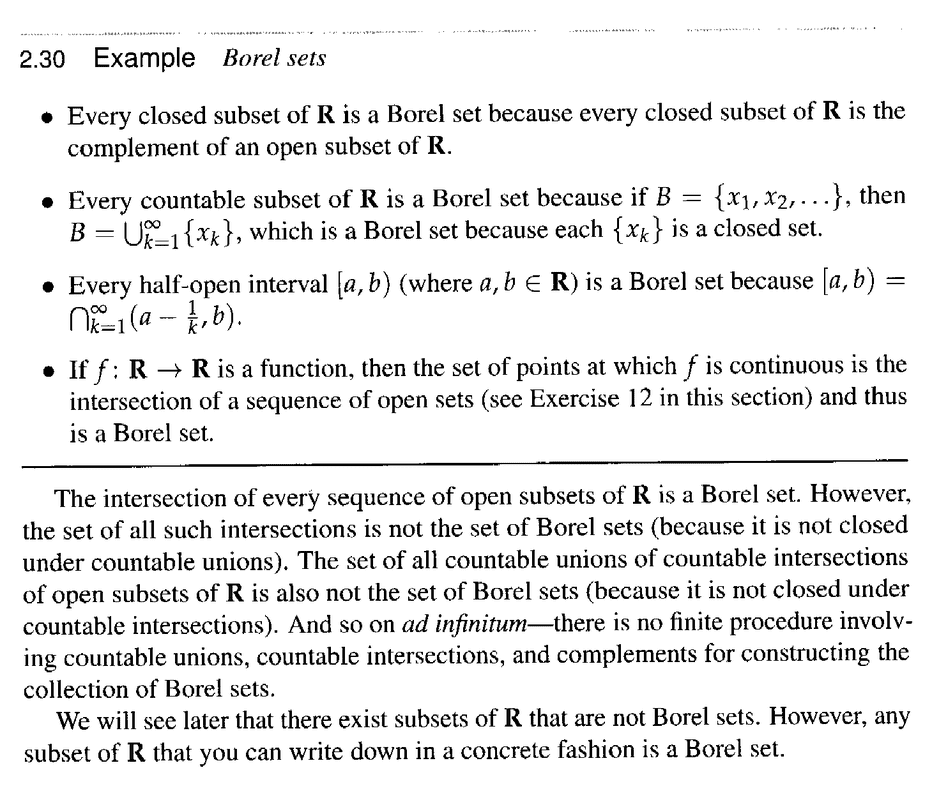
My questions related to the above text are as follows:QUESTION 1
In the above text by Axler we read the following:
" ... ... However, the set of all such intersections is not the set of Borel sets (because it is not closed under countable unions). ... ..."Can someone please explain why exactly that the set of all such intersections is not the set of Borel sets ... ? Why exactly is such a set not closed under countable unions and why is this relevant?
QUESTION 2
In the above text by Axler we read the following:
" ... ... The set of all countable unions of countable intersections of open subsets of ##\mathbb{R}## is also not the set of Borel sets (because it is not closed under countable intersections). ... ... "Can someone please explain why exactly that the set of all countable unions of countable intersections of open subsets of ##\mathbb{R}## is not the set of Borel sets ... ? Why exactly is such a set not closed under countable intersections and why is this relevant?
Help with the above two questions will be much appreciated ...
Peter
I need help in order to fully understand the set of Borel sets ... ...
The relevant text reads as follows:
My questions related to the above text are as follows:QUESTION 1
In the above text by Axler we read the following:
" ... ... However, the set of all such intersections is not the set of Borel sets (because it is not closed under countable unions). ... ..."Can someone please explain why exactly that the set of all such intersections is not the set of Borel sets ... ? Why exactly is such a set not closed under countable unions and why is this relevant?
QUESTION 2
In the above text by Axler we read the following:
" ... ... The set of all countable unions of countable intersections of open subsets of ##\mathbb{R}## is also not the set of Borel sets (because it is not closed under countable intersections). ... ... "Can someone please explain why exactly that the set of all countable unions of countable intersections of open subsets of ##\mathbb{R}## is not the set of Borel sets ... ? Why exactly is such a set not closed under countable intersections and why is this relevant?
Help with the above two questions will be much appreciated ...
Peter