Why can proteins be considered as bionanomachines when

  • Thread starter Thread starter rwooduk
  • Start date Start date
  • Tags Tags
    Proteins
Click For Summary

Discussion Overview

The discussion revolves around the characterization of proteins as "bionanomachines" in cellular processes, exploring the roles proteins play in mechanisms such as translocation and enzymatic activity. Participants examine the implications of this analogy and the nature of work performed by proteins in biological systems.

Discussion Character

  • Exploratory
  • Debate/contested
  • Technical explanation

Main Points Raised

  • Some participants express confusion about the term "machine" in relation to proteins, questioning whether the actual work is done by proteins or other entities.
  • Others argue that proteins, particularly enzymes, perform essential work in biological processes, such as catalyzing reactions and facilitating DNA replication.
  • A participant mentions the ATP-ADP cycle as a source of energy that enables work to be performed, suggesting that anything that does work can be likened to a machine.
  • One participant describes the conformational changes of secondary active transporters as crucial for transporting substances across membranes, indicating that these changes are integral to the function of proteins.
  • A later reply compares proteins to components of a machine, likening them to pistons in an engine, while acknowledging a lack of deep biological knowledge.
  • Another participant explains the "Brownian Ratchet" mechanism in protein translocation, detailing how chaperone proteins facilitate the directional movement of unfolded proteins across membranes, emphasizing the energy dynamics involved.
  • Further elaboration on motor proteins highlights their role in protein degradation and DNA processing, noting that these proteins can generate significant force through ATP hydrolysis.
  • One participant expresses newfound interest in the intersection of biology and physics, suggesting that biological processes can be understood through a mechanical lens.

Areas of Agreement / Disagreement

Participants do not reach a consensus on the characterization of proteins as machines, with multiple competing views on the nature of work performed by proteins and the appropriateness of the analogy. The discussion remains unresolved regarding the implications of these analogies.

Contextual Notes

Limitations include varying definitions of "work" and "machine," as well as differing interpretations of the roles proteins play in cellular processes. The discussion also reflects a range of familiarity with biological concepts among participants.

Who May Find This Useful

Readers interested in biophysics, molecular biology, and the mechanical aspects of biological systems may find this discussion relevant.

rwooduk
Messages
757
Reaction score
59
... something else (?) does the work.

For example:
YIOOYys.jpg


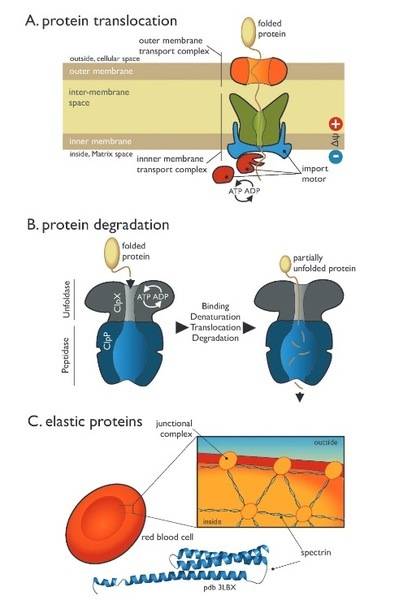
For translocation the protein get unfolded and refolded when it gets to the other side of the membrane, but shouldn't the thing doing the work be considered the "machine". In our class the title was "The role of proteins as 'machines' in cellular processes" but in the above diagram they don't seem to be doing work.

Unless it is unfolding and refolding itself, or the thing doing the tranlocation is a protein itself. I'm a bit confused by the wording of machines to the protein.

If anyone could shed some light it would be appreciated.
 
Biology news on Phys.org
Proteins have a role in a vast range of biological activity.
For example many of them are enzymes and are necessary catalysts for other chemistry to occur.
Some proteins play a specific role in DNA replication.
I think both of those can be considered as having performed work.
 
  • Like
Likes   Reactions: rwooduk
rootone said:
Proteins have a role in a vast range of biological activity.
For example many of them are enzymes and are necessary catalysts for other chemistry to occur.
Some proteins play a specific role in DNA replication.
I think both of those can be considered as having performed work.

Many thanks for the reply. I see, but could you (or anyone) suggest a reason for the above image being under the heading "The role of proteins as 'machines' in cellular processes"?
 
One thing shown in the diagram is the ATP-ADP cycle.
This chemistry is basically delivering fuel (energy) to some process.
Where energy is being supplied to some process in order for it happen, then work is being performed.
Anything which does work is analagous to a machine, but as with any analogy it's just an attempt at visualisation, and not a good idea to think of it too literally.
 
Last edited:
  • Like
Likes   Reactions: rwooduk and Ryan_m_b
A secondary active transporter undergoes major conformational changes to transport something, changing from an outward facing to inward facing state, in the former case accepting the ligand and in the latter case expelling it into the cell (or out of it, the process can be reversed). The actual change in configuration of the protein allows the passage of say, an ion or a sugar.

Conformational fluctuations are also a component of enzyme function. The hypothesis for one enzyme I studied is that it anchors the components in place and/or maneuvers them into position, thus facilitating the reaction.
 
  • Like
Likes   Reactions: rwooduk
I think i see where this is going, the proteins are effectively part of a machine / mechanism. Analogous to pistons being part of an engine.

Thanks for the replies, I don't understand some of what you are saying as I'm really not a biologist but it gives me something to work from, thanks.
 
In terms of protein translocation, it takes work to move a protein directionally across a membrane against its concentration gradient (such a process is associated with an increase in free energy of the system). In some cases, this process occurs via a "Brownian Ratchet" mechanism. Unfolded proteins (but not folded proteins) are free to diffuse either way across the membrane though the Sec61 pore, but on one side of the membrane, there are chaperone proteins (called BiP) that strongly bind the unfolded protein and prevent them from going back across. This essentially makes transport occur through the membrane in only one direction. After the protein is all the way through the pore, the chaperones help fold the protein so that it can stay in the appropriate membrane compartment and perform its function. The process works because binding and unbinding of the chaperones to the unfolded protein is coupled to ATP hydrolysis (which provides the energy to power the process). Here, although work is being done (moving a substrate against its concentration gradient), the system is not working in an analogous way to macroscopic motors. See the diagram below from this review article for a picture of the "Brownian Ratchet" mechanism.
bb410021.f3.jpe
In the case of protein degradation by ClpXP and other similar proteases, the analogy to macroscopic motors is more apt. In these proteins, the motor protein binds to ATP and the conversion of ATP to ADP + Pi changes the shape of the motor protein. This change in shape causes the motor protein to pull its substrate through a small pore in the top of the motor, which mechanically unfolds the protein. These motors are capable of generating quite a bit of force. Other motor proteins, such as DNA helicases work in a similar way, burning fuel (ATP) in order to pull DNA through a central pore. In bacteria, instead of using the "Browinian ratchet" mechanism above to move unfolded proteins through the Sec61 channel, the bacteria use a molecular motor called SecA that burns ATP in order to push the unfolded protein through the Sec61 channel.
 
Last edited:
  • Like
Likes   Reactions: rwooduk
Ygggdrasil said:
In terms of protein translocation, it takes work to move a protein directionally across a membrane against its concentration gradient (such a process is associated with an increase in free energy of the system). In some cases, this process occurs via a "Brownian Ratchet" mechanism. Unfolded proteins (but not folded proteins) are free to diffuse either way across the membrane though the Sec61 pore, but on one side of the membrane, there are chaperone proteins (called BiP) that strongly bind the unfolded protein and prevent them from going back across. This essentially makes transport occur through the membrane in only one direction. After the protein is all the way through the pore, the chaperones help fold the protein so that it can stay in the appropriate membrane compartment and perform its function. The process works because binding and unbinding of the chaperones to the unfolded protein is coupled to ATP hydrolysis (which provides the energy to power the process). Here, although work is being done (moving a substrate against its concentration gradient), the system is not working in an analogous way to macroscopic motors. See the diagram below from this review article for a picture of the "Brownian Ratchet" mechanism.
bb410021.f3.jpe
In the case of protein degradation by ClpXP and other similar proteases, the analogy to macroscopic motors is more apt. In these proteins, the motor protein binds to ATP and the conversion of ATP to ADP + Pi changes the shape of the motor protein. This change in shape causes the motor protein to pull its substrate through a small pore in the top of the motor, which mechanically unfolds the protein. These motors are capable of generating quite a bit of force. Other motor proteins, such as DNA helicases work in a similar way, burning fuel (ATP) in order to pull DNA through a central pore. In bacteria, instead of using the "Browinian ratchet" mechanism above to move unfolded proteins through the Sec61 channel, the bacteria use a molecular motor called SecA that burns ATP in order to push the unfolded protein through the Sec61 channel.

Thanks! It's very clever indeed. Biology on my physics course has never really interested me but it's little things like this that give me hope that there are some interesting "physicsy" mechanical biological processes out there.
 
Have a look into modern biophysics research, I think you'll find that biology is a vast repository of great physics and physics-like problems.
 

Similar threads

  • · Replies 31 ·
2
Replies
31
Views
7K
  • · Replies 8 ·
Replies
8
Views
3K
  • · Replies 1 ·
Replies
1
Views
3K
  • · Replies 6 ·
Replies
6
Views
6K
Replies
1
Views
3K
  • · Replies 8 ·
Replies
8
Views
4K
  • · Replies 1 ·
Replies
1
Views
8K
  • · Replies 25 ·
Replies
25
Views
2K
  • · Replies 10 ·
Replies
10
Views
3K
  • · Replies 6 ·
Replies
6
Views
11K