Why do I observe ice formation on the exterior of this pipeline?

  • Thread starter Thread starter Boon Jie
  • Start date Start date
  • Tags Tags
    Formation Ice
Click For Summary
SUMMARY

The discussion centers on the phenomenon of ice formation on the exterior of a pipeline connecting a compressor to a reactor, attributed to adiabatic expansion and pressure differentials. Participants confirm that a small opening in the pressure control valve allows for continuous mass transfer, leading to a temperature drop and subsequent ice formation. The suggestion to insert a regular valve to eliminate the small opening is presented as a solution to prevent this issue. The conversation emphasizes the importance of understanding adiabatic processes and their implications in this context.

PREREQUISITES
  • Understanding of adiabatic processes in thermodynamics
  • Familiarity with pressure control valves and their functions
  • Knowledge of gas laws, specifically PV=nRT
  • Basic principles of heat transfer and phase changes
NEXT STEPS
  • Research the principles of adiabatic expansion in gas dynamics
  • Study the design and function of pressure control valves in industrial applications
  • Learn about the effects of pressure differentials on temperature in gas systems
  • Explore methods to prevent condensation and ice formation in pipelines
USEFUL FOR

Engineers, process technicians, and anyone involved in the design and maintenance of industrial piping systems, particularly those working with gas transfer and temperature management.

Boon Jie
Messages
3
Reaction score
1
Hi all,

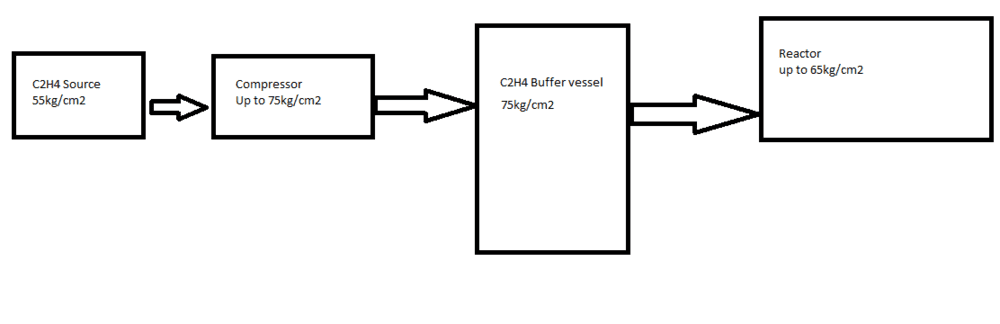
1579164290780.png

I would like to ask why is there ice formation on the exterior of the pipes between compressor to reactor when there is no flow passing through
or what kind of phenomenon is this?

My colleagues have suggested PV=nRT and adiabatic process as the possible reasons but I still feel that something is amiss

It could be the small opening of the pressure control valve that let's pressure sip from buffer vessel into reactor that causes the pressure differential and maybe temperature drop(?)

Else, I'm not sure how this freezing outside pipeline occurs

Please advise,
Thank you
 
Engineering news on Phys.org
Boon Jie said:
It could be the small opening of the pressure control valve
There should be no opening at all. Insert a regular valve to close off the supply altogether and the phenomenon should disappear.

Colleagues are correct about this adiabatic expansion issue.
 
  • Informative
Likes   Reactions: Boon Jie
Apparently they do have a small opening the valve in the form of a bypass line, as a sort of pressure regulation using the small opening...because the reactor pressure will drop because of reaction, the small opening acts as continual supply of C2H4 as to maintain/ increase pressure in the reactor

But adiabatic expansion only applies to no heat / mass transfer, which in this case there is continual mass transfer across the valve/ pipeline from buffer vessel to the reactor
 
Adiabatic expansion means no heat transfer; the mass flows from high p to low p and expands.
 

Similar threads

  • · Replies 16 ·
Replies
16
Views
3K
  • · Replies 2 ·
Replies
2
Views
2K
  • · Replies 4 ·
Replies
4
Views
9K