Why Do Pluto and Charon Share the Same Diffraction Spike Orientation?

  • Context: Undergrad 
  • Thread starter Thread starter Imager
  • Start date Start date
Click For Summary
SUMMARY

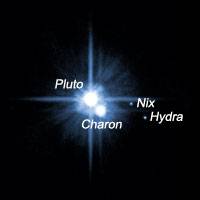
The discussion centers on the observation of diffraction spikes in images of Pluto and Charon taken by the Hubble Space Telescope in 2006. Both celestial bodies exhibit the same orientation of vertical and horizontal diffraction spikes, attributed to the telescope's optical design rather than atmospheric effects. The phenomenon is confirmed to be a result of the secondary mirror's support structure, which creates these diffraction patterns. The term "diffraction spike" is the correct terminology for the observed effect, rather than "twinkle."

PREREQUISITES
  • Understanding of optical physics, specifically diffraction phenomena.
  • Familiarity with telescope design and components, particularly secondary mirrors.
  • Basic knowledge of astronomical imaging techniques.
  • Awareness of the Hubble Space Telescope's capabilities and imaging methods.
NEXT STEPS
  • Research the principles of diffraction in optics.
  • Study the design and function of the Hubble Space Telescope's secondary mirror.
  • Explore the effects of atmospheric conditions on astronomical imaging.
  • Learn about image processing techniques used in astrophotography.
USEFUL FOR

Astronomy enthusiasts, optical engineers, astrophotographers, and anyone interested in the imaging techniques of space telescopes.

Imager
Gold Member
Messages
112
Reaction score
61
Below is a shot of Pluto and Charon from Hubble in 2006. I was wondering why the vertical and horizontal planes appear brighter in the same direction for both objects?
I thought the increased "twinkle" at perpendicular angles was normal effect from objects and didn't have any particular orientation. That made me think it was odd both these objects had the same orientation to their brighter “twinkle”. Is it something to do with the optics of a telescope?

Also, is there actual name for this effect, other than twinkle?
hs-2006-29-a-small_web.jpg


Link:http://hubblesite.org/newscenter/archive/releases/solar-system/pluto/2006/29/
 
Astronomy news on Phys.org
This is not an effect of the atmosphere. Those lines are from the telescope (from the support structure of the secondary mirror), and the telescope is the same for both objects: Diffraction spike.
 
  • Like
Likes   Reactions: Imager

Similar threads

Replies
17
Views
4K
  • · Replies 125 ·
5
Replies
125
Views
8K
  • · Replies 12 ·
Replies
12
Views
31K
  • · Replies 3 ·
Replies
3
Views
2K
  • · Replies 28 ·
Replies
28
Views
3K
  • · Replies 7 ·
Replies
7
Views
5K
  • · Replies 1 ·
Replies
1
Views
2K
  • · Replies 7 ·
Replies
7
Views
9K
Replies
21
Views
4K
  • · Replies 94 ·
4
Replies
94
Views
14K