Why do so many galaxies in a cluster have near zero velocity

  • Context: Graduate 
  • Thread starter Thread starter Earnest Guest
  • Start date Start date
  • Tags Tags
    Galaxies Velocity Zero
Click For Summary
SUMMARY

The discussion centers on the phenomenon of galaxies within the Coma Cluster exhibiting near zero velocity relative to the cluster's core, which is approximately 7,000 km/s. Participants clarify that galaxies can appear to have zero velocity if their motion is perpendicular to the line of sight, resulting in no observable red or blue shift. This understanding is crucial for interpreting velocity charts of galaxy clusters, as it highlights the importance of perspective in measuring galactic motion.

PREREQUISITES
  • Understanding of redshift and blueshift in astrophysics
  • Familiarity with the concept of galaxy clusters
  • Knowledge of the Coma Cluster and its characteristics
  • Basic principles of motion in three-dimensional space
NEXT STEPS
  • Research the dynamics of galaxy clusters and their gravitational interactions
  • Explore the concept of redshift and blueshift in greater detail
  • Study the Coma Cluster's structure and its significance in cosmology
  • Learn about observational techniques in astrophysics, particularly regarding galaxy motion
USEFUL FOR

Astronomers, astrophysics students, and anyone interested in the dynamics of galaxy clusters and the interpretation of astronomical velocity data.

Earnest Guest
Messages
66
Reaction score
6
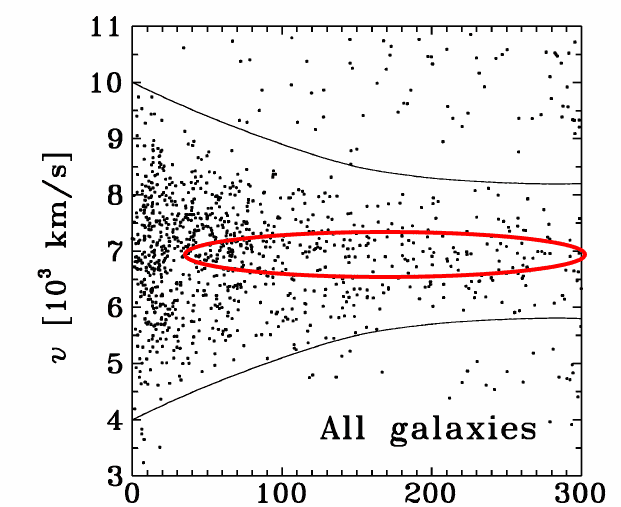
I'm looking at a velocity chart of the Coma Cluster:
Coma Cluster.png


And the question occurred to me: why are there so many galaxies that have a zero velocity (relative to the core of the Coma Cluster which is roughly 7,000 km s-1)? At a distance of a Mpc or two you would expect to find galaxies at the peak of their red or blue shift if they were in orbit. How can they be traveling at the same speed as the core at these distances and still be part of the cluster? What am I missing?
 
Space news on Phys.org
Earnest Guest said:
At a distance of a Mpc or two you would expect to find galaxies at the peak of their red or blue shift if they were in orbit.

Only if the motion is in the direction of the line of sight. If the motion is perpendicular to the line of sight, there is no red or blue shift (apart from that induced by time dilation).
 
  • Like
Likes   Reactions: jim mcnamara
Orodruin said:
Only if the motion is in the direction of the line of sight. If the motion is perpendicular to the line of sight, there is no red or blue shift (apart from that induced by time dilation).
Got it. I was thinking about and edge on galaxy, but a cluster is like a sphere: there are galaxies that will be going clockwise (or counter-clockwise) as we see it from Earth and those galaxies will appear to move at the same speed as the core. Thanks!
 

Similar threads

  • · Replies 2 ·
Replies
2
Views
3K
  • · Replies 6 ·
Replies
6
Views
2K
  • · Replies 31 ·
2
Replies
31
Views
4K
  • · Replies 1 ·
Replies
1
Views
3K
  • · Replies 24 ·
Replies
24
Views
8K
Replies
21
Views
4K
  • · Replies 2 ·
Replies
2
Views
3K
Replies
6
Views
4K
Replies
1
Views
2K
  • · Replies 29 ·
Replies
29
Views
6K