Why do some hurdles come with adjustable bases?

  • Thread starter Thread starter berkeman
  • Start date Start date
Join the discussion
Ask a follow-up here, or get your own question answered by working scientists, mathematicians and engineers — people, not an autocomplete.
Real named experts · corrections over time · the nuance an AI answer skips
19 replies · 3K views
Messages
69,681
Reaction score
25,440
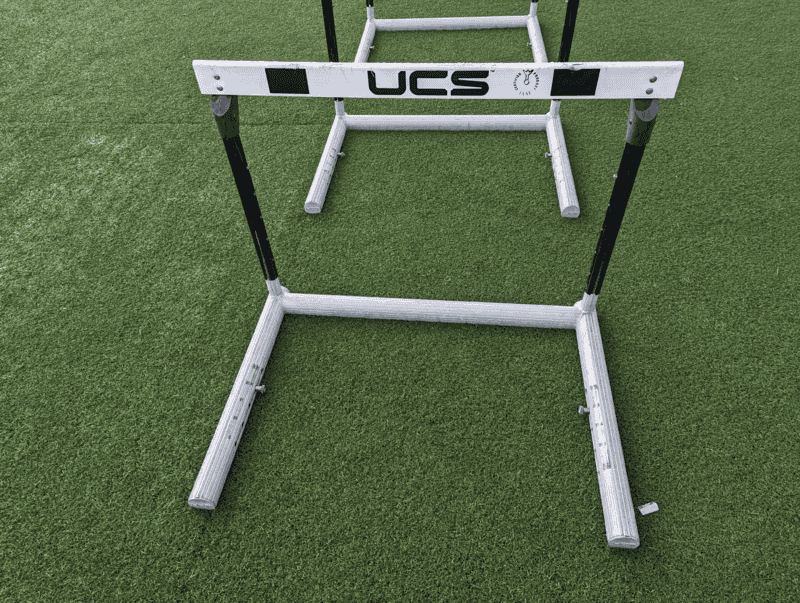
I saw these hurdles at a track meet I was working a couple weeks ago, and I'm wondering what the adjustable bases are used for. Most hurdles come with adjustable height settings, but these are the first ones I've seen with adjustable bases.
1701721951890.png


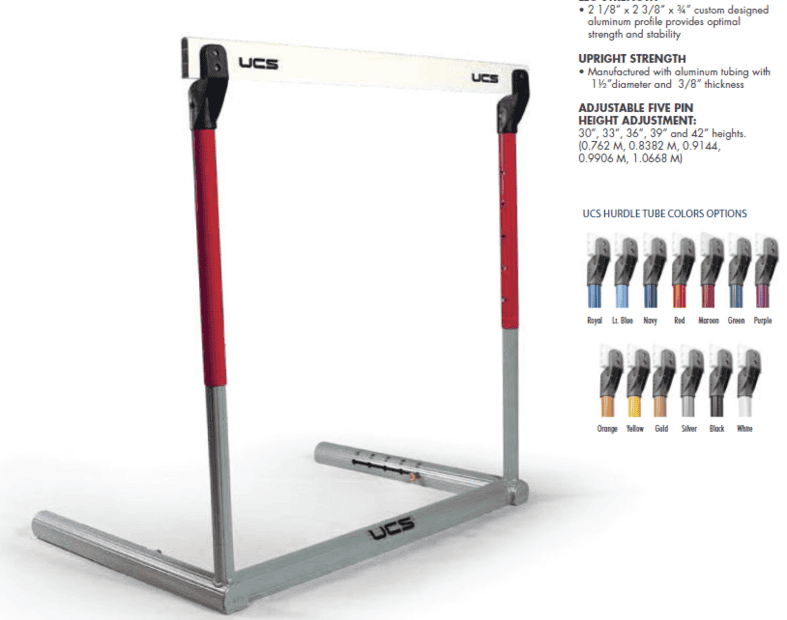
From Google searching, I think they are the UCS 5000 series, but the "technical specs" document for them does not seem to explain what the base adjustment would be used for. Any ideas?

https://www.ucsspirit.com/products/...ate-5000-series-hurdle-with-weight-selector-1

https://www.specucsspirit.com/_files/ugd/35e5db_0feee22e0c654228878f54a3ed76e1d4.pdf
1701721926877.png
 
Engineering news on Phys.org
Seems like it would be the weight selector in the title on the website. I assume the pin is connected to some heavy block inside the base tubes that can be moved closer to or farther from the uprights, making it easier/harder to knock over the hurdle. Weird it isn't in the technical spec since it seems be a non-cosmetic distinguishing feature.
 
Reply
  • Informative
Likes   Reactions: phinds and berkeman
Haborix said:
Seems like it would be the weight selector in the title on the website.
Thanks! I missed that, and I think you are right. When the crews were setting up the hurdles, there was only mention of the height, not a weight selection. I'll have to ask one of the USATF officials the next time I'm at one of their meets.
 
Reply
  • Like
Likes   Reactions: phinds
Haborix said:
Weird it isn't in the technical spec since it seems be a non-cosmetic distinguishing feature.

Just guessing: could be competition specs define these things, but for training they use some other settings to avoid injuries - if it is easier to knock the hurdle it is probably easier to not fall while working on a passing technique.
 
Reply
  • Like
Likes   Reactions: phinds and berkeman
Borek said:
for training they use some other settings to avoid injuries
Yeah, many of the injuries I see are from crashing during hurdles races or pole vault fails. Although it's surprising how often high jumpers manage to spike themselves going over the bar...
 
Last edited:
Many decades ago when I ran hurdles in High School, the goal was to minimize wasted energy by only jumping high enough to barely clear the hurdle. In practice this meant you hit them often. Hitting hurdles, just a tiny bit, is good. We all had skin abrasions on one of our knees constantly. If you missed and hit one hard, it was the low hurdles that really hurt, the high setting wasn't hard to just knock over. And no, of course, they weren't adjustable.
 
Reply
  • Like
Likes   Reactions: berkeman
If you hit them its with your leading heel, which is really not good and uncommon, or with your trailing knee, which can be hard to avoid and not a big deal. It's easy for form to break down and not have your rear leg high enough. The front leg is easy.
 
Okay, I just got a great reply back from my USATF friend:
Ryan said:
You are correct! USATF rule 168.5 defines hurdle construction specifications, which defines a 3.6 to 4.0kg horizontal force required to push over the hurdle.

The taller the hurdle, the less horizontal force is needed, so some (expensive) hurdles like these have a counterweight you can move forward or backwards based on the height of the hurdle to achieve the right push-over force.

In reality no one actually measures this or checks the counterweight settings unless it's a national championship, so most schools just use fixed-weight hurdles.
 
Reply
  • Informative
Likes   Reactions: phinds and Haborix
Would it work if they used disposable foam bars at least for training? Not styrofoam but the expanded poly type?
 
Swamp Thing said:
Would it work if they used disposable foam bars at least for training? Not styrofoam but the expanded poly type?
I don't know, but it's common in USATF age group pole vault warmups to use a stretched rubber ribbon thing...
 
Swamp Thing said:
Would it work if they used disposable foam bars at least for training? Not styrofoam but the expanded poly type?
There's some educational value in getting your knee slammed when you are otherwise fully engaged in exercion. Plus, I don't think the foam would last long in those environments.

It's not such a big problem really, it's not a lot of force require to tip the high ones. They don't pay basketball on foam courts. They don't play baseball with foam balls.
 
Reply
  • Like
Likes   Reactions: BillTre, berkeman and Swamp Thing
DaveE said:
There's some educational value in getting your knee slammed when you are otherwise fully engaged
Gee, thanks coach. Good thing the medic is on-site, somewhere... :wink:
 
Reply
  • Haha
  • Like
Likes   Reactions: BillTre and Haborix
There has to be a meme somewhere of medical staff saying "I wish they'd stop saying that" when someone yells "No pain, no gain!"
 
berkeman said:
Gee, thanks coach. Good thing the medic is on-site, somewhere... :wink:
Apparently you went to a fancier high school than I did. I suppose someone could have found a band-aid in the locker room if you asked.
 
Reply
  • Like
Likes   Reactions: BillTre and berkeman