Why Do Vector Components Give Different Displacement Results?

  • Thread starter Thread starter Acez
  • Start date Start date
  • Tags Tags
    Displacement
Click For Summary

Homework Help Overview

The discussion revolves around calculating displacement using vector components in a physics context. The original poster presents a discrepancy between their calculated displacement and the provided answer, prompting questions about the correctness of their approach and the handling of vector directions.

Discussion Character

  • Exploratory, Assumption checking, Problem interpretation

Approaches and Questions Raised

  • The original poster attempts to use the horizontal and vertical component method to determine displacement but questions whether their approach is correct. Other participants suggest modifying the directions of certain vectors and redrawing them to clarify the calculation process.

Discussion Status

Some participants have provided guidance on adjusting vector directions and recalculating components, while others have confirmed the correctness of the original poster's final answer. There appears to be ongoing exploration of different approaches to vector addition and subtraction.

Contextual Notes

Participants discuss the implications of reversing vector directions when subtracting vectors and the need for careful consideration of component calculations based on vector operations. There is a mention of specific values and directions that may influence the calculations, but no consensus on a single method has been reached.

Acez
Messages
5
Reaction score
0
Solving displacement using compoenents
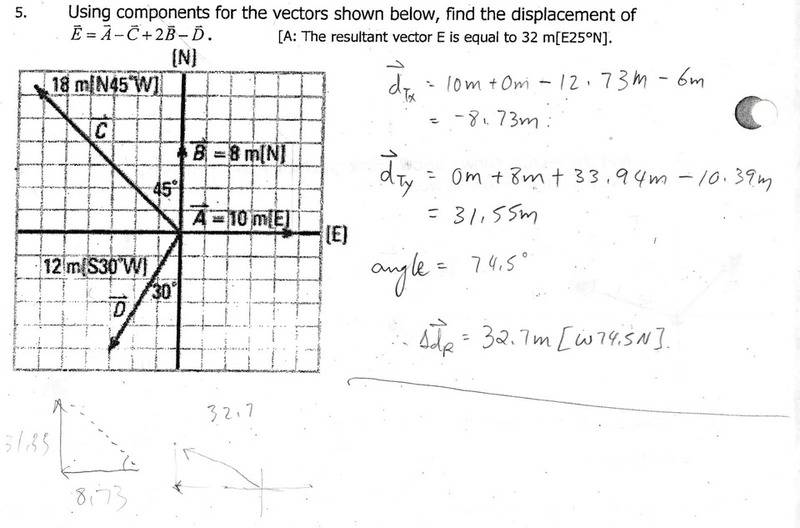
Homework Statement


x3wmj6.jpg


Homework Equations


I decided to use the horizontal and vertical component method to solve for the displacement of E and got the answer 32.7m [W74.5N] (above). However the answer provided by the question states that the resultant vector E is actually 32m [E25N] (above)


The Attempt at a Solution


Please refer to the above pic.

Am I using the correct approach to solve for the resultant vector E/displacement of E=A-C+2B-D?

Please help
 
Last edited:
Physics news on Phys.org
Double B, and change the directions of C and D. Redraw the vectors.
 
is the method i am using right though?

EDIT: so first, I have to reverse C and D, redraw vectors and then perform the component calculation from there?
 
In the solution you have taken 8, but it should be 16.
If you reverse the directions of C and D( - C, -D), their x-components of these vectors add up to A adds to
 
thanks i got the right answer now

for future references, could you tell me if the following approaches will be correct?

If i am adding vectors (i.e. A+B+C+D...) i do not need to reverse anything, I will just have to perform components calculation as usual

If I am subtracting vectors (i.e. A-B or 2A-B), I will have to reverse the direction of vectors accordingly and apply any multiplication to a vector (i.e. doubling or tripling) as necessary
 
Yes.
 
thank you very much~!
 

Similar threads

  • · Replies 4 ·
Replies
4
Views
3K
Replies
13
Views
2K
  • · Replies 13 ·
Replies
13
Views
2K
  • · Replies 1 ·
Replies
1
Views
2K
  • · Replies 14 ·
Replies
14
Views
3K
  • · Replies 16 ·
Replies
16
Views
2K
  • · Replies 6 ·
Replies
6
Views
1K
  • · Replies 9 ·
Replies
9
Views
16K
  • · Replies 13 ·
Replies
13
Views
3K
  • · Replies 1 ·
Replies
1
Views
4K