Why do we use BRST in Yang Mills and where does it come from?

  • Context: Graduate 
  • Thread starter Thread starter formodular
  • Start date Start date
Click For Summary

Discussion Overview

The discussion revolves around the origin and significance of BRST transformations in the context of Yang-Mills theory, particularly within the framework of gauge-fixed actions and the Faddeev-Popov method. Participants explore the theoretical implications, the necessity of BRST symmetry, and its relationship to other quantization methods.

Discussion Character

  • Exploratory
  • Technical explanation
  • Conceptual clarification
  • Debate/contested

Main Points Raised

  • One participant questions the origin and purpose of BRST transformations, noting their complexity and the mixing of bosons and fermions.
  • Another participant asserts that BRST symmetry is an inherent feature of the gauge-fixed action, regardless of whether it is desired.
  • A participant suggests that the existence of BRST can be predicted by counting fields and analyzing loop contributions, seeking a simpler explanation for this observation.
  • Concerns are raised about the necessity of BRST in establishing a symmetry of the action that allows for the creation of a state space, particularly in the context of non-Abelian gauge theories.
  • One participant highlights the connection between BRST symmetry and the Slavnov-Taylor identities, which generalize the Ward-Takahashi identities, emphasizing its role in proving renormalizability and gauge invariance.
  • References to literature, including Srednicki and works by Kugo and Ojima, are provided to support various claims about the complexity and necessity of BRST in gauge theories.
  • There is a discussion about the relationship between Gupta-Bleuler quantization and BRST, with one participant expressing confusion about how they relate, particularly in the Abelian case.

Areas of Agreement / Disagreement

Participants express differing views on the necessity and implications of BRST symmetry, with some asserting its inherent presence in gauge-fixed actions while others question its purpose and seek deeper understanding. The discussion remains unresolved regarding the broader implications and connections between BRST and other quantization methods.

Contextual Notes

Participants note the complexity of extending the Gupta-Bleuler formalism from Abelian to non-Abelian gauge theories and the challenges associated with understanding BRST symmetry in this context. There is also mention of the limitations of the current understanding of the relationship between BRST and other quantization approaches.

formodular
Messages
34
Reaction score
18
Hi!

Where does the BRST transformation come from and why?

Peskin brings them into the Yang Mills Faddeev Popov gauge fixed action

brst2.png

as a symmetry of the action after shifting ##A## (treating it as the outcome of a Gaussian integral over some field ##B##)

brst3.png

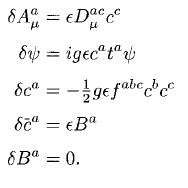
but the symmetry transformations are very complicated, mixing bosons and fermions (SUSY?):
brst.png


Why you want it and why it takes this form is mysterious.

This source tells you:

"Since we have more fields than gauge fields ##A##, to maintain the general idea of gauge covariance for physics, it is natural to look for a symmetry that encodes the definition of the gauge symmetry acting on ##A##, but also generalizes it in a consistent way on the new fields. This symmetry must interchange the gauge fields and the ghosts, in order to ensure the compensations between these fields in closed loops for any choice of gauge. Such a symmetry between fields of different statistics is the BRST symmetry."

Can this be expanded/explained more simply with more details (or even just explaining what it means fully), and can we say why we choose the transformations as written above, as it is very interesting!
 
Last edited:
Physics news on Phys.org
I recommend the treatment in Srednicki's text, ch.74.

First of all, BRST symmetry is a symmetry of the gauge-fixed action. Whether we want it or not is irrelevant; it's there.

Then, having discovered that it is there, we can use it to derive properties of correlation functions of fields, known as the Slavnov-Taylor identities, which are generalizations of the Ward-Takahashi identities of QED.
 
Thank you.

Three points on that:

1. Yes Srednicki is good, you can say I am just asking why he does what he does in that chapter.

2. The passage I quoted seems to tell us that we can predict BRST will exist by counting the number of fields. Furthermore we could also predict it by looking at loops. Hopefully somebody can explain this (read: dumb it down) so it becomes obvious :DD

3. If we ignore this and take the perspective that BRST is just there whether we like it or not, the question still becomes - why do we even want it!?

One thought, which someone may understand nicely:

If we think of Gupta-Bleuler quantization of covariant Abelian Maxwell, we imposed the Lorentz gauge condition ##\partial^{\mu} A_{\mu}## on the space of states. Notice this condition is related to gauge invariance symmetry of the action.

Since the Lorentz Gauge condition is a scalar it should satisfy Klein-Gordon, and it does. This apparently means the state space is invariant under time evolution.

If we try to re-create this in the Non-Abelian case we find the scalars do not satisfy Klein-Gordon because of the curvature terms, so the state space defined by the Gupta-Bleuler method is not invariant under time evolution.

On this alone it seems we need to find a new symmetry of the action and then use this to derive some new condition generalizing ##\partial^{\mu} A_{\mu}## and then make it hold on the space of states.

If you then simply analyze the ghost Faddeev-Popov Yang-Mills action, term by term, looking for some symmetry, you can derive the BRST transformations explicitly, as in Srednicki.

The shocking thing, which perhaps illustrates my flawed understanding of Gupta-Bleuler, is that the charge (derived in Srednicki) corresponding to the BRST current, in the Abelian case, reproduces the Fourier space version of Gupta-Bleuler. That is shocking, no?

So we want BRST because we want a symmetry of the action which we can use to create a state space. Why it takes either the GB or BRST form is now a bit confusing, as it seems one is a Fourier expansion of the other in the Abelian case, hinting at something deeper!

I seem to be missing the bigger picture but closer, hope someone sees it :smile:
 
BRST is a global symmetry of the gauge-fixed action, including the Faddeev-Popov ghosts, and it's crucial to prove the manifest renormalizability as well as the gauge invariance of the S-matrix elements due to the corresponding Slavnov-Taylor identities. See, Weinberg, QT of Fields II for a complete proof (using the method by Zinn-Justin).

The extension of the Gupta-Bleuler formalism working in Abelian gauge symmetries to the non-Abelian case is pretty complicated and makes also heavy use of the BRST symmetry. The method is very well explained in the following papers by Kugo et al:

T. Kugo and I. Ojima, Manifestly Covariant Canonical Formulation of the Yang-Mills Field Theories. I, Progress of Theoretical Physics, 60 (1978), p. 1869–1889.
http://dx.doi.org/10.1143/PTP.60.1869

T. Kugo and O. Ojima, Manifestly Covariant Canonical Formulation of Yang-Mills Field Theories. II: SU (2) Higgs-Kibble Model with Spontaneous Symmetry Breaking, Progress of theoretical physics, 61 (1979), p. 294–314.
http://dx.doi.org/10.1143/PTP.61.294

T. Kugo and I. Ojima, Manifestly Covariant Canonical Formulation of Yang-Mills Field Theories. III—Pure Yang-Mills Theories without Spontaneous Symmetry Breaking, Progress of Theoretical Physics, 61 (1979), p. 644–655.
http://dx.doi.org/10.1143/PTP.61.644

One learns a lot on gauge theories following the operator method, but it's very hard to understand without first looking the more straight-foward path-integral formulation, which is much more natural in understanding, why you have to introduce the Faddeev-Popov ghosts and why BRST symmetry has to mix bosons and fermions (similar to SUSY).

For the proof of renormalizability you get away in a much simpler way by using the socalled background-field gauge. There you work with simple Ward-Takahashi identities rather than the more complicated Slavnov-Taylor identities of BRST symmetry for more general gauges. This is, because in the background-field gauge you get a gauge invariant quantum action, and the proof becomes as simple as for the Abelian case (QED).
 
  • Like
Likes   Reactions: A. Neumaier and dextercioby

Similar threads

  • · Replies 4 ·
Replies
4
Views
2K
  • · Replies 17 ·
Replies
17
Views
3K
  • · Replies 13 ·
Replies
13
Views
4K
  • · Replies 29 ·
Replies
29
Views
8K
  • · Replies 1 ·
Replies
1
Views
2K
  • · Replies 1 ·
Replies
1
Views
2K
  • · Replies 2 ·
Replies
2
Views
4K
  • · Replies 2 ·
Replies
2
Views
3K
  • · Replies 7 ·
Replies
7
Views
3K
  • · Replies 2 ·
Replies
2
Views
5K