Why Does a Capacitor Block DC Voltage in a Circuit?

  • Thread starter Thread starter mmmboh
  • Start date Start date
  • Tags Tags
    Capacitor Voltage
Click For Summary
SUMMARY

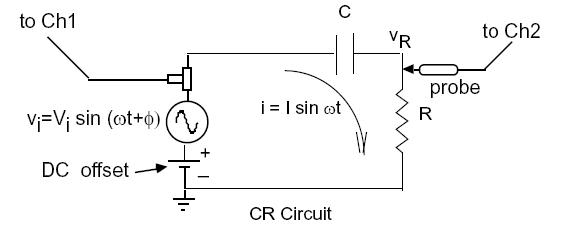
The discussion centers on the behavior of capacitors in DC circuits, specifically addressing why a capacitor blocks DC voltage. It is established that a capacitor's impedance is defined by the formula 1/(ωC), where ω represents angular frequency and C is capacitance. At zero frequency (DC), the impedance becomes infinite, resulting in no DC current flow. Consequently, the entire DC voltage drop occurs across the capacitor, leaving no voltage across the series resistor, as observed in channel 2 of the circuit.

PREREQUISITES
  • Understanding of capacitor behavior in electrical circuits
  • Knowledge of AC and DC voltage concepts
  • Familiarity with impedance and its mathematical representation
  • Basic circuit analysis skills
NEXT STEPS
  • Study the relationship between frequency and impedance in capacitors
  • Learn about the role of capacitors in AC circuits
  • Explore the concept of reactance and its effect on circuit behavior
  • Investigate practical applications of capacitors in filtering and signal processing
USEFUL FOR

Electronics students, electrical engineers, and hobbyists interested in understanding capacitor functionality in circuits.

mmmboh
Messages
401
Reaction score
0
Hi, I have this circuit:

241.jpg


And when I change the DC offset voltage the wave in channel one moves up and down and the wave in channel 2 doesn't do anything except for flatten out a bit in certain areas (although I'm not sure that's relevant), my question is why? I know channel 2 is the voltage across the resistor, so is the change in DC voltage appearing solely across the capacitor? It appears the capacitor blocks voltage, but why?

Help would be great! :)
 
Physics news on Phys.org
The capacitor blocks the DC current. (Its impedance is 1/(wC) so zero frequency means infinite impedance.) No DC current, no DC voltage across the series resistor, the signal in CH2 has no DC component. The DC voltage drops solely across the capacitor, as you said.


ehild
 

Similar threads

  • · Replies 3 ·
Replies
3
Views
2K
Replies
3
Views
2K
Replies
3
Views
2K
Replies
1
Views
2K
Replies
3
Views
2K
Replies
5
Views
3K
  • · Replies 8 ·
Replies
8
Views
2K
  • · Replies 4 ·
Replies
4
Views
4K
  • · Replies 4 ·
Replies
4
Views
2K
  • · Replies 4 ·
Replies
4
Views
2K