How Do You Calculate Capacitance in a DC Circuit with a Fully Charged Capacitor?

  • Thread starter Thread starter Lambda96
  • Start date Start date
  • Tags Tags
    Capacitor Circuit
Join the discussion
Registration is free. Ask a follow-up in this thread, or start your own.
3 replies · 2K views
Lambda96
Messages
233
Reaction score
77
Homework Statement
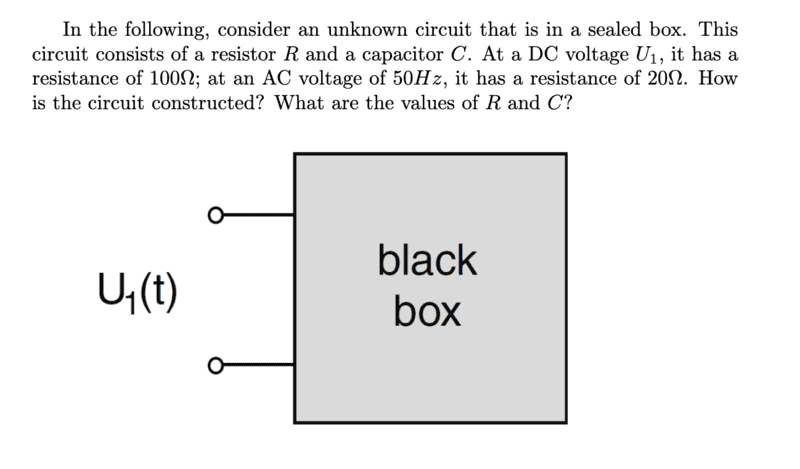
What does the circuit look like and what are the values of resistor ##R## and capacitance ##C##?
Relevant Equations
none
Hi,

I am not sure if I have calculated the task correctly
Bildschirmfoto 2023-06-07 um 12.53.12.png

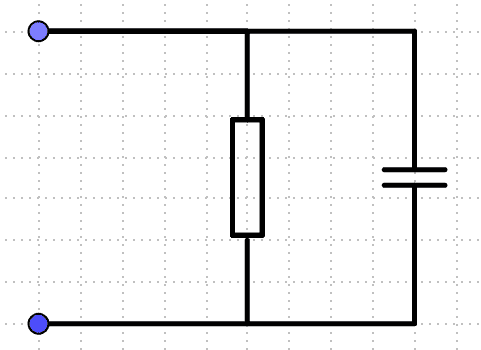
I have now assumed that the capacitor does not need to be charged and is therefore fully charged. In a DC circuit, a capacitor acts like an infinitely large resistor or like an open switch, so I assumed that it is a parallel circuit and that it looks like this.
Bildschirmfoto 2023-06-11 um 11.59.27.png


The resistor then has the following value ##R=100 \Omega##.

Using the impedance and the value for ##R##, I can then calculate the value for ##C##.

The value for the impedance in parallel circuit is

$$|Z|=\frac{1}{\sqrt{R^-2+\omega^2 C^2}}$$

##C## can then be calculated as follows

$$C=\frac{R^2-Z^2}{R \omega z}$$

If I now substitute all the values into the above formula, I get the following ##C=9.7 \cdot 10^{-4}F##.
 
Physics news on Phys.org
Lambda96 said:
ƒHomework Statement: What does the circuit look like and what are the values of resistor ##R## and capacitance ##C##?
Relevant Equations: none

Hi,

I am not sure if I have calculated the task correctly

View attachment 327711
I have now assumed that the capacitor does not need to be charged and is therefore fully charged. In a DC circuit, a capacitor acts like an infinitely large resistor or like an open switch, so I assumed that it is a parallel circuit and that it looks like this.

View attachment 327712

The resistor then has the following value ##R=100 \Omega##.

Using the impedance and the value for ##R##, I can then calculate the value for ##C##.

The value for the impedance in parallel circuit is

$$|Z|=\frac{1}{\sqrt{R^-2+\omega^2 C^2}}$$

##C## can then be calculated as follows

$$C=\frac{R^2-Z^2}{R \omega z}$$

If I now substitute all the values into the above formula, I get the following ##C=9.7 \cdot 10^{-4}F##.
It looks like you used frequency, ƒ, rather than angular frequency. Remember, ##\omega=2\pi f ## .

LaTeX tip:
To write ##R^{-2}## rather than ##R^-2##, place the ##-2## in braces { }, e.g. ##\{ -2 \}## .
 
Reply
  • Like
Likes   Reactions: Lambda96 and berkeman
Thanks SammyS for your help and for looking over my calculation, thanks also for the tip on how to write ##R^{-2}## in latex 👍 👍👍

You are right, unfortunately I used the frequency of ##50Hz## in the calculation instead of ##\omega=2 \pi 50Hz##. Then the result for ##C## is as follows, ##C=0.015 F##
 
Lambda96 said:
Thanks SammyS for your help and for looking over my calculation, thanks also for the tip on how to write ##R^{-2}## in latex 👍 👍👍

You are right, unfortunately I used the frequency of ##50Hz## in the calculation instead of ##\omega=2 \pi 50Hz##. Then the result for ##C## is as follows, ##C=0.015 F##
The decimal point is in the wrong place.

Simply divide your original answer by ##2\pi## .
 
Reply
  • Like
Likes   Reactions: Lambda96