Why does a smaller EDF thrust tube outlet increase thrust?

  • Thread starter Johan M
  • Start date
  • Tags Tags
    Thrust Tube
8 replies · 4K views · last reply
Johan M
Messages
5
Reaction score
4
TL;DR
My goal is to understand why EDF thrust increases when the outlet area of a thrust tube increases for static thrust. The formula I've seen for static thrust depends on outlet velocity and mass flowrate; mass flowrate is constant, and increased outlet area would decrease velocity wrt bernoulli, so I am uncertain why some RC forums say other wise
Hi everyone. I am tasked with making an EDF rocket for a university project. The end of the rocket has a set of flaps that redirect air to control the rockets trajectory, seen in the image. The 90mm EDF itself is located near region 1.
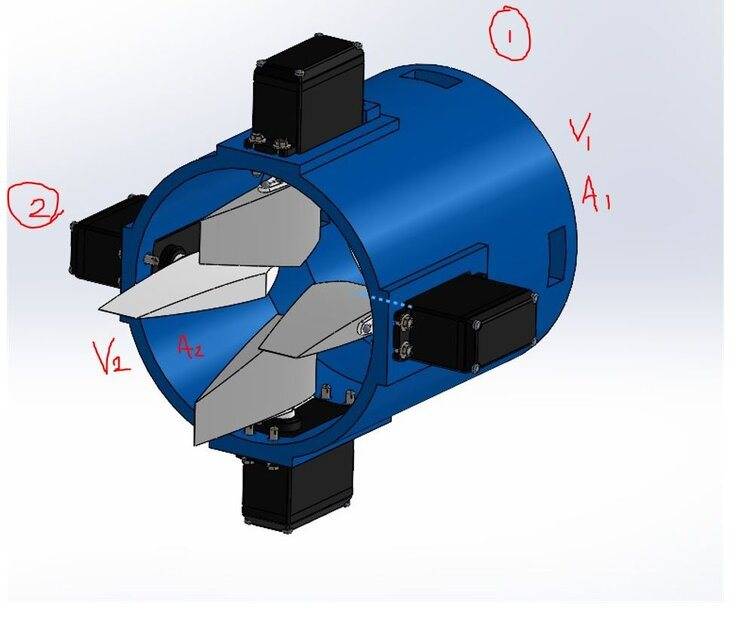
Solidworks render of a blue ducted fan housing with a cutaway showing a fan rotor, with labels V1 and A1 at the intake and V2 and A2 at the outlet, plus flap vanes and black servo motors.
. I would like to know why, the physics behind it, a smaller outlet area of a thrust tube results in a higher thrust. I have posted this question on a separate RC forum :https://www.rcgroups.com/forums/showthread.php?3931737-EDF-Thrust-tube-theory#post47447981 but I still felt uncertainty. One of the members stated: "Remember an exhaust nozzle increases the back pressure so the fan has to do more work. The energy going into the fan is unchanged so as the pressure rises the mass flow reduces''. I can see why the back pressure would increase through bernoulli, but I don't understand why the mass flow rate reduces; the smaller area and larger velocity work out to the same flowrate, also seen below:
Textbook figure of a ducted propeller showing a captured streamtube with inlet area A0, exit area Ae and propeller disc area A, plus a pressure plot along the axis.

From the same textbook of the above picture, the thrust formula below was found:
Textbook page on ducted propellers with equations 10.48 to 10.50: pressure jump across the disc, thrust Fdp = m-dot(Ve - V0) highlighted, and Fdp = Fp + Fd.

It seemed to solely depend on exit velocity (For static thrust I've seen V0 can be taken as zero). I would appreciate any advice in this regard, thanks.
 
A fan won't produce the same mass flowrate at a higher outlet pressure.
 
Dullard said:
A fan won't produce the same mass flowrate at a higher outlet pressure.
Hi Dullard thanks for the response. Can you please elaborate why it is such?
 
I'm probably under-qualified to elaborate. That's the way that fans work.

Some of the confusion may be the result of the fact that you're talking about a ducted fan (compressible fluid), but are using a textbook citation for a propellor (incompressible fluid).
 
Dullard said:
I'm probably under-qualified to elaborate. That's the way that fans work.

Some of the confusion may be the result of the fact that you're talking about a ducted fan (compressible fluid), but are using a textbook citation for a propellor (incompressible fluid).
No worries. I will do some research on it. I think of confused the terms in addition; I had thought a ducted fan and ducted propeller are the same
 
I understand that EDF is just another TLA, but what does EDF actually stand for ?
 
  • Like
Likes   Reactions: Johan M
Baluncore said:
I understand that EDF is just another TLA, but what does EDF actually stand for ?
I am not sure what TLA refers to, but an EDF is an electric ducted fan
 
  • Like
Likes   Reactions: Baluncore
Johan M said:
I am not sure what TLA refers to, but an EDF is an electric ducted fan
A TLA is a Three Letter Acronym, which is actually an initialism.
 
  • Haha
  • Like
Likes   Reactions: Tom.G and Johan M
Baluncore said:
A TLA is a Three Letter Acronym, which is actually an initialism.
Ah I see, not my finest moment I admit