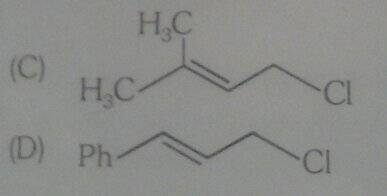
Why Does Compound C Exhibit a Higher Rate of Solvolysis Than Compound D?

  • Thread starter Thread starter orgmann
  • Start date Start date
  • Tags Tags
    Rate Relative
Click For Summary

Discussion Overview

The discussion centers around the rates of solvolysis of two compounds, C and D, in a 50% aqueous ethanol solution at 45°C. Participants explore the factors influencing the rates, including resonance effects and the nature of the solvent.

Discussion Character

  • Debate/contested
  • Technical explanation
  • Conceptual clarification

Main Points Raised

  • One participant claims that compound D should have a higher rate of solvolysis due to more resonance, yet observes that compound C exhibits a higher rate.
  • Several participants seek clarification on the definition of the solvent in the context of solvolysis, emphasizing that solvolysis involves a reaction with the solvent.
  • A participant clarifies that the solvent is a 50% ethanol and water mixture, which is intended to enhance the solubility of the unsaturated halides involved in the reaction.
  • Another participant suggests that the phenyl substituted structure may destabilize the carbon-chloride bond more effectively than the other compound, which lacks resonance.
  • There is a discussion about the reaction mechanisms, with one participant noting that the reaction may proceed via an Sn2 process due to the presence of a primary carbon, while also referencing their experiences with tertiary halides in alcohol/water mixtures.
  • One participant expresses a desire to see experimental results to confirm the theoretical discussions about the rates of solvolysis.

Areas of Agreement / Disagreement

Participants express differing views on which compound exhibits a higher rate of solvolysis, with some supporting the idea that resonance plays a significant role, while others question the definitions and mechanisms involved. The discussion remains unresolved regarding the comparative rates of solvolysis for compounds C and D.

Contextual Notes

There are uncertainties regarding the definitions of solvent and substrate, as well as the specific mechanisms (Sn1 vs. Sn2) that may apply to the compounds in question. The discussion also highlights the complexity of predicting reaction rates based on structural features.

orgmann
Messages
4
Reaction score
0
Among the following compounds I think D compound has more rate of solvolysis in 50% aq.ethanol at 45°C than compound C .
Due to more resonance.
But the compound C has more rate . Why?
1464179661611.jpg
 
Chemistry news on Phys.org
What is the solvent? 'Solvolysis implies rxn with solvent.
 
James Pelezo said:
What is the solvent? 'Solvolysis implies rxn with solvent.
Substrate is the only solvent
 
Sorry, I missed the solvent in the original post;i.e., 50%EtOH/HOH solution. Now, I'm not sure why you are defining the solvent as a substrate. Typically in chemistry, the substrate is the object (compound) of interest in the reaction process. These would be the unsaturated halides shown in the original post. The solvent (again, I missed in the original post) is the 50:50 EtOH/HOH mixture. The presence of the ethanol is there only to increase the solubility of the unsaturated halides as they react with the water. I tend to agree with your conclusion that the Phenyl substituted structure would function to destabilize the Carbon - Chloride bond more than the 1-Chloro-3-methyl-2-butene which shows no resonance. This is an interesting reaction and because the halogen is attached to a 1o-carbon, I'd assume it would proceed by an Sn2 process. I've run t-Butyl Chloride vs t-Butyl Bromide in a 50:50 Isopropyl Alcohol/Water mix and the t-BuBr rate > t-BuCl rate (k(t-BuBr) ~ 1.5 x 10⁻⁴ M⋅sec-1 vs. k(t-BuCl) ~ 1.25 x 10⁻⁵). However, the halogens are attached to 3o-carbons and does proceed by an Sn1 process. The tertiary halide reactions in alcohol/water solvent is a relatively well known reaction and easy to run, but an Sn2 would be more difficult to control (in my humble opinion). I'd like to see the results of an actual trial, but I still agree with the phenyl substituted unsaturated halide as being the faster b/c of resonance. Good question.
 

Similar threads

Replies
1
Views
29K
Replies
4
Views
3K
  • · Replies 1 ·
Replies
1
Views
3K
  • · Replies 1 ·
Replies
1
Views
7K
  • · Replies 4 ·
Replies
4
Views
3K
  • · Replies 3 ·
Replies
3
Views
4K
  • · Replies 1 ·
Replies
1
Views
3K
  • · Replies 6 ·
Replies
6
Views
5K
Replies
4
Views
2K
  • · Replies 4 ·
Replies
4
Views
5K