Why does d/dv(L) = constant imply velocity is constant?

2 replies · 1K views · last reply
zhuang382
Messages
9
Reaction score
2
Homework Statement
How do we deduce the conclusion of (3,2)? This is a topic inertial frame.
Relevant Equations
Law of inertia
I understand that d/dv(L) = constant, and L is only dependent on v, but how do we get to the fact that v = constant?
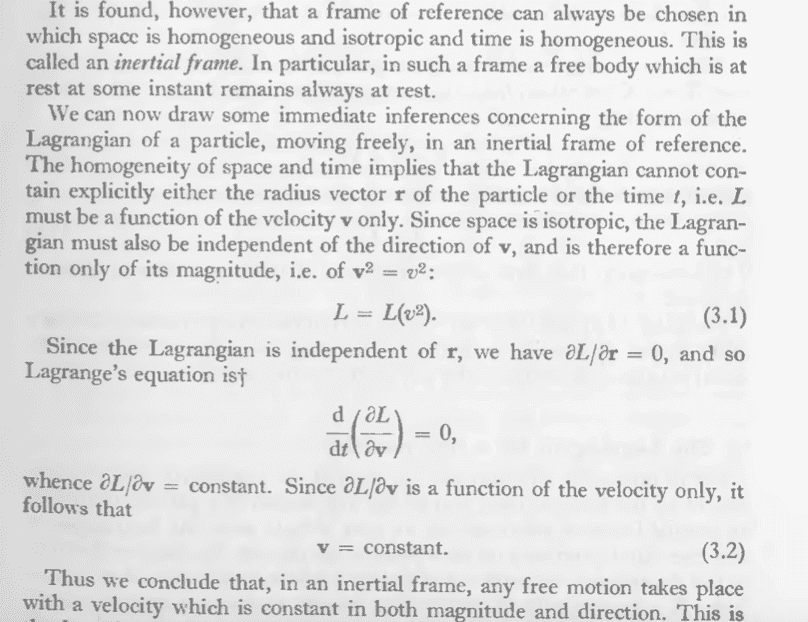
Printed page from a physics textbook on Lagrangian mechanics, showing equations 3.1 L = L(v^2), the Euler-Lagrange equation d/dt(dL/dv) = 0, and the conclusion v = constant (3.2) for free motion in an inertial frame.
 
Say
[tex]\frac{\partial L}{\partial v}=f(v)[/tex],

[tex]\frac{d}{dt}f(v)= \frac{df(v)}{dv}\frac{dv}{dt}=0[/tex]

Usually ##\frac{df(v)}{dv} \neq 0## so

[tex]\frac{dv}{dt}=0[/tex]
 
  • Like
Likes   Reactions: zhuang382