Why Does Ionization Energy Increase Across the Second Period?

  • Thread starter Thread starter Hrnmhmm
  • Start date Start date
  • Tags Tags
    Electron Period
Click For Summary
SUMMARY

The discussion centers on the increase of ionization energy across the second period of the periodic table, specifically comparing Nitrogen, Oxygen, Fluorine, and Neon. It is established that Oxygen has a lower first ionization energy (I.E.) of 1310 kJ/mol compared to Nitrogen's 1400 kJ/mol due to electron pair repulsion in the 2px orbital. Despite this, Fluorine and Neon exhibit the expected upward trend in ionization energy due to increased nuclear charge and orbital contraction, which outweighs the repulsion effects. The stability of half-filled orbitals is highlighted as a significant factor in these trends.

PREREQUISITES
  • Understanding of electron configurations and orbital filling
  • Familiarity with ionization energy concepts
  • Knowledge of Hund's rule and its implications
  • Basic principles of nuclear charge and electron repulsion
NEXT STEPS
  • Research "Ionization Energy Trends in the Periodic Table"
  • Study "Hund's Rule and Electron Configuration" in detail
  • Explore "Nuclear Charge Effects on Atomic Structure"
  • Investigate "Orbital Hybridization and Stability" in chemistry
USEFUL FOR

Chemistry students, educators, and anyone interested in understanding the principles of ionization energy and electron configurations in the periodic table.

Hrnmhmm
Messages
2
Reaction score
0
My level of knowledge on Chemistry is first year. I'm teaching myself about electron configurations using Google to find and compare sources.

In this webpage - http://www.chemguide.co.uk/atoms/properties/ies.htm
Jim Clark said:
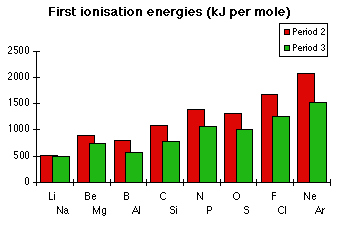
p2vp3.GIF


N ... 1s2, 2s2, 2px1, 2py1, 2pz1 ... 1st I.E. = 1400 kJ/mol
O ... 1s2, 2s2, 2px2, 2py1, 2pz1 ... 1st I.E. = 1310 kJ/mol

It's demonstrated that Oxygen has a lower first ionization energy than Nitrogen despite having more protons. The explanation given is that the 2px suborbital in Oxygen (2px2) contains one more electron than in Nitrogen (2px1), forming an electron pair, and their repulsion negates some positive charge.

If the only difference between Nitrogen and Oxygen is in the electron pair 2px, why do Fluorine and Neon continue the second period's upward trend of ionization energy as normal? Shouldn't the repulsion of the additional electron pairs 2py2 and 2pz2 also affect ionization energy in these elements, reversing the trend?
 
Last edited by a moderator:
Chemistry news on Phys.org


It seems half-filled orbital subshells are particularly stable.


Hrnmhmm said:
If the only difference between Nitrogen and Oxygen is in the electron pair 2px, why do Fluorine and Neon continue the second period's upward trend of ionization energy as normal?
No, it's not the only difference. With increasing nuclear charge, when going from left to right in a period, the orbitals contract. This contraction is due to the stronger attraction of the electrons by the nucleus and it will increase ionization energy. Comparing Nitrogen and Oxygen, by Hund's rule,
in Nitrogen the three p electrons will each occupy a separate p orbital. When going t O, the new electron has to go to an orbital already filled whence it experiences a stronger repulsion although the nuclear attraction has increased somewhat, too.
The effect of ionization in fluorine is also that of going from a doubly occupied orbital to a singly occupied one; the repulsion of the electrons being approximately comparable. Hence the only effect which makes a difference is the stronger nuclear-electronic attraction in F as compared to O.

Btw, none of the three p orbitals is singled out, it makes no sense to say e.g. in Oxygen the p_x orbital is doubly occupied while the p_y and p_z are singly occupied .
You can only say that one p orbital is doubly occupied and 2 only singly occupied.
 

Similar threads

  • · Replies 1 ·
Replies
1
Views
2K
  • · Replies 2 ·
Replies
2
Views
6K
  • · Replies 2 ·
Replies
2
Views
7K