Why Does Light Form a Cone When Refracted in a Swimming Pool?

Join the discussion
Ask a follow-up here, or get your own question answered by working scientists, mathematicians and engineers — people, not an autocomplete.
Real named experts · corrections over time · the nuance an AI answer skips
10 replies · 3K views
joelkato1605
Messages
19
Reaction score
2
Homework Statement
You are several meters under water (η = 1.33), swimming in a pool, and look skywards. Light from outside the pool will form a cone. Describe why and compute the
angle of the cone.
Relevant Equations
snell's law
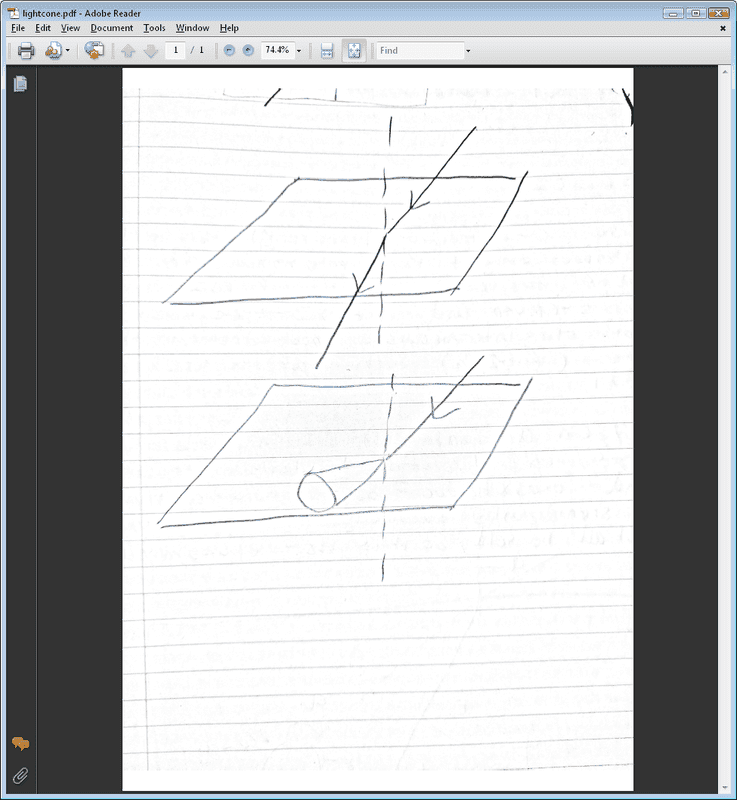
The first sketch is what I assumed would happen, where the light beams bends. And the second is meant to depict the light forming a cone, which I don't understand.

[Mentors provided help re-posting the image that was missing]
1605191601830.png
 

Attachments

Last edited by a moderator:

Physics news on Phys.org
Thanks for the reply I edited my question, however I'm not sure where to start with a solution.
 
joelkato1605 said:
The first sketch is what I assumed would happen, where the light beams bends. And the second is meant to depict the light forming a cone, which I don't understand.
:cool: What do they look like ? Snell has to do with angles. Which angles in the picture ?
 
BvU said:
:cool: What do they look like ? Snell has to do with angles. Which angles in the picture ?
The refractive index of air is 1, so 1*sin( theta initial)=1.33*sin(theta cone) then maybe assume theta inital =90?

I'm not really sure but that is all I can think of.
 
Draw a picture with an eye below the surface of the water.

Draw a ray of light from air to the eye, passing through the water. Draw another ray at a different angle of incidence. And another. And another.

What happens as you change the angle of incidence of the ray?

Look up "total internal reflection" - at what angle does it occur?

What happens when you get total internal reflection?
 
We have a picture :cool: !

Any description of what it represents ? Ah, yes:
joelkato1605 said:
The first sketch is what I assumed would happen, where the light beams bends. And the second is meant to depict the light forming a cone, which I don't understand.
Forget the second picture -- nobody understands it.

In the top picture, where are the angles we encounter in Snell's law ?

Now follow Frodo's advice
 
  • Like
Likes   Reactions: berkeman
So is it just the critical angle:
arcsin(1/1.33)?
 
Your diagram is not very good for doing an analysis. Where is the eye you were asked to put in? It's all about angles - how can you measure angles in your diagram?

Perhaps some was my error as, when I said draw a picture, I should have said draw a diagram.

You should have drawn a diagram like below where you are looking at a cross section through the experiment - it is a 2-dimensional diagram. Solve the problem in 2-D before generalising your solution to 3-D. Using the diagram:

1. Draw a ray of light going from B to the eye. Label the angle of incidence and the angle of refraction. To do that you will need to draw in the normal.

2. Draw a ray of light going from C to the eye. Label the angle of incidence and the angle of refraction.

3. Draw a ray of light going from D to the eye. Label the angle of incidence and the angle of refraction.

What do you notice is happening as the angle of incidence of the ray increases from B to C to D?

When you thoroughly understand what is happening in the diagram, think about what happens in 3-D.

diagram.png
 

Attachments

  • diagram.png
    diagram.png
    5 KB · Views: 251