Math Amateur
Gold Member
MHB
- 3,920
- 48
- TL;DR
- This thread involves a proof that the uniform metric is indeed a metric ...
I am reading D. J. H. Garling's book: "A Course in Mathematical Analysis: Volume II: Metric and Topological Spaces, Functions of a Vector Variable" ... ...
I am focused on Chapter 11: Metric Spaces and Normed Spaces ... ...
I need some help with an aspect of the proof of Theorem 11.1.11 ...
Garling's statement and proof of Theorem 11.1.11 reads as follows:
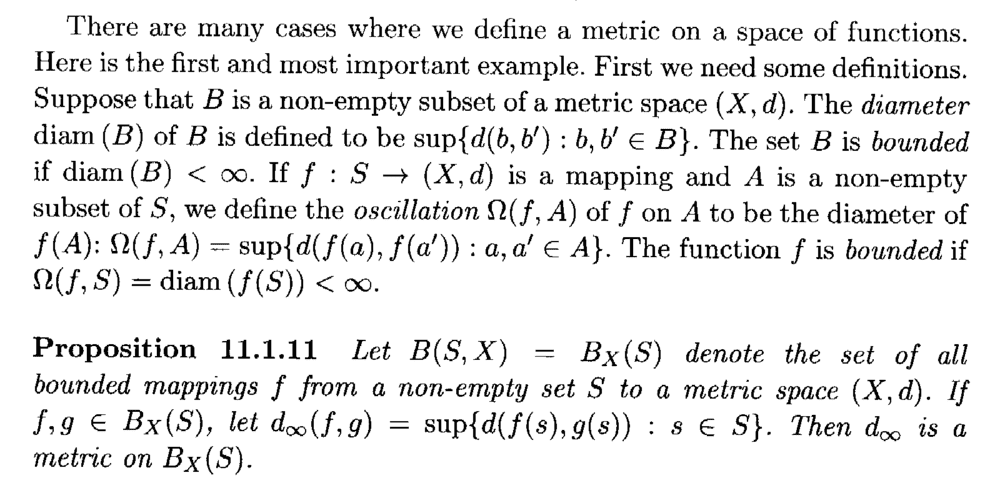
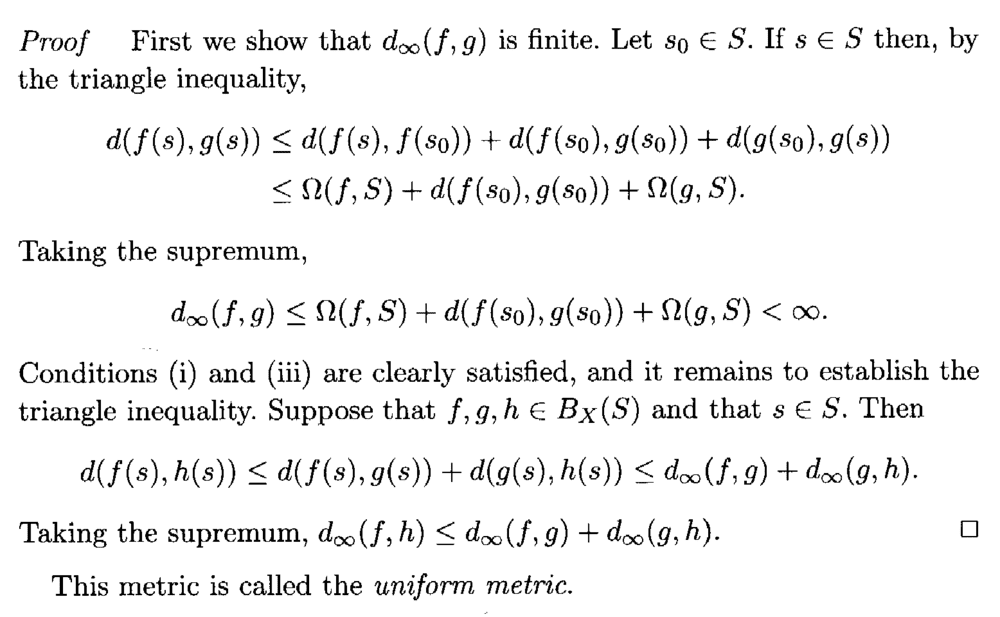
Near the end of Garling's proof above we read the following:
" ... ... Suppose that ##f,g,h \in B_X(S)## and that ##s \in S##. Then
##d(f(s), h(s)) \le d(f(s), g(s)) + d(g(s), h(s)) \le d_\infty (f, g) + d_\infty (g, h)## ... ... ... (1)
Taking the supremum, ##d_\infty (f, h) \le d_\infty (f, g) + d_\infty (g, h)##
... ... ... "Now (1) is true for arbitrary s and so it is true for all ##s## including the point for which ##d(f(s), h(s))## is a maximum ... if a maximum exists ...
But in the case where a maximum does not exist ... how do we know that taking the supremum preserves inequality (1) ...Hope someone can help ...
Peter
I am focused on Chapter 11: Metric Spaces and Normed Spaces ... ...
I need some help with an aspect of the proof of Theorem 11.1.11 ...
Garling's statement and proof of Theorem 11.1.11 reads as follows:
Near the end of Garling's proof above we read the following:
" ... ... Suppose that ##f,g,h \in B_X(S)## and that ##s \in S##. Then
##d(f(s), h(s)) \le d(f(s), g(s)) + d(g(s), h(s)) \le d_\infty (f, g) + d_\infty (g, h)## ... ... ... (1)
Taking the supremum, ##d_\infty (f, h) \le d_\infty (f, g) + d_\infty (g, h)##
... ... ... "Now (1) is true for arbitrary s and so it is true for all ##s## including the point for which ##d(f(s), h(s))## is a maximum ... if a maximum exists ...
But in the case where a maximum does not exist ... how do we know that taking the supremum preserves inequality (1) ...Hope someone can help ...
Peter