Why Does the Order of Transformations Affect the Graph of a Function?

Click For Summary

Discussion Overview

The discussion revolves around the order of transformations applied to functions in precalculus, particularly how this order affects the resulting graph of a function. Participants explore different approaches to understanding and applying transformations such as shifts, reflections, and their sequence.

Discussion Character

  • Conceptual clarification
  • Debate/contested
  • Mathematical reasoning

Main Points Raised

  • One participant expresses confusion about the correct order of transformations for functions, noting discrepancies between their understanding and their teacher's explanation.
  • Another participant argues against the teacher's approach, suggesting that the reflection should occur before the vertical shift in certain cases, citing the example of the function y = -f(x+2) - 1.
  • A later reply attempts to clarify the general rules for determining the order of transformations, emphasizing the application of functions to expressions within parentheses and following the standard order of operations.

Areas of Agreement / Disagreement

There is disagreement regarding the correct order of transformations, with some participants supporting the teacher's method while others advocate for a different approach. The discussion remains unresolved as participants explore various interpretations.

Contextual Notes

Participants reference specific examples to illustrate their points, but the discussion does not reach a consensus on the best method for determining the order of transformations. The rules mentioned may depend on individual interpretations and specific function forms.

modonnell121
Messages
2
Reaction score
0
Okay so I've done very well in college so far, and I thought I was at least decent at math, but I just started this precalculus class and I'm having an issue.

I basically don't know, and can't get a straight answer about how to handle functions that have multiple transformations going on. This is not a homework question, but it is a perfect example of my issue, so I'm posting it.
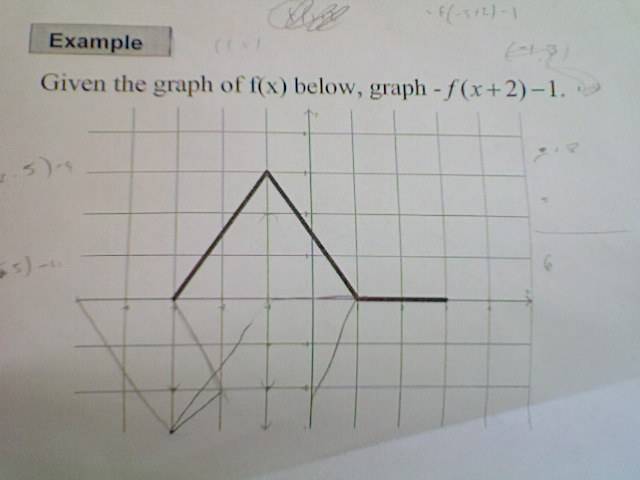
Photo%2520on%25202012-01-31%2520at%252012.16.jpg


My answer is the function sketched below and to the left of the printed one, except I would have shifted it down one but there is no room on the graph, as you can see. I must be that far off, huh? The teacher's answer is like mine but shifted up one unit. This is apparently because he reflected it after shifting, while I reflected first. In his email explaining why he did this he told me "It's always best to do the reflecting last as it is the last thing that happended to the function in the transformation process." WHAT?

How do I know the order, what do I DO? Please someone help me.
 
Mathematics news on Phys.org
I believe your teacher is wrong, and you are correct (unless I'm suffering from brain failure).

In the case of y= -f(x+2) -1 you must "reflect" f(x+2) before subtracting 1! This graph should be 1 below y= -f(x+2)!

If it was y= - [f(x+2) -1] you would "reflect" afterwords like your teacher did (ultimately shifting up 1, because y = - [f(x+2) -1] = -f(x+2) + 1).
 
Cool, I thought I was right. But can you explain how I determine the order to do the transformations in general?
 
modonnell121 said:
Cool, I thought I was right. But can you explain how I determine the order to do the transformations in general?

Sorry, didn't see your reply until today. There is a specific order of operations, with a few different rules to get used to.

For functions (such as f(x) or g(x)), you apply the function to whatever is within the parenthesis in the function declaration.

f(x) you apply the function f to x

f(x+2) you apply the function f to x+2. in other words you replace the value for x with x+2

IF f(x) = 2x THEN f(x+2) = 2(x+2)

IF f(x) = 2x+1 THEN f(x+2) = 2(x+2) + 1 etc.

Then you follow the standard order of operations.

IF y=f(x) + 1 you calculate f(x) then add in 1 to calculate y.

IF y=-f(x) + 1 you calculate -f(x) then add in 1 to calculate y.

IF y=-[f(x) + 1] you calculate f(x), add in 1, and THEN flip the sign to determine your y value.
 

Similar threads

  • · Replies 3 ·
Replies
3
Views
2K
  • · Replies 7 ·
Replies
7
Views
1K
  • · Replies 4 ·
Replies
4
Views
4K
  • · Replies 4 ·
Replies
4
Views
3K
  • · Replies 7 ·
Replies
7
Views
2K
  • · Replies 15 ·
Replies
15
Views
2K
  • · Replies 3 ·
Replies
3
Views
4K
  • · Replies 11 ·
Replies
11
Views
2K
  • · Replies 7 ·
Replies
7
Views
2K
  • · Replies 10 ·
Replies
10
Views
3K