Why does the potential energy get lower as atoms get closer?

Click For Summary
SUMMARY

The discussion centers on the behavior of potential energy (PE) as hydrogen atoms approach each other to form a molecule. As the atoms get closer, their PE decreases due to attractive forces, transforming into kinetic energy (KE), which increases their velocity. When the atoms reach a stable state, their PE can become negative, indicating a lower energy state compared to when they are isolated. The potential energy curve illustrates that if the atoms are pushed too close, repulsive forces dominate, causing the PE to rise again, reflecting the balance between attractive and repulsive forces.

PREREQUISITES
  • Understanding of atomic structure and electron configurations
  • Familiarity with potential and kinetic energy concepts
  • Knowledge of intermolecular forces, particularly covalent bonds
  • Basic grasp of energy conservation in chemical reactions
NEXT STEPS
  • Study the concept of potential energy curves in chemical bonding
  • Learn about the role of electromagnetic forces in atomic interactions
  • Explore the mathematics of energy transformations in molecular formation
  • Investigate the implications of negative potential energy in chemical stability
USEFUL FOR

Students and professionals in physics and chemistry, particularly those interested in molecular interactions, chemical bonding, and energy transformations in reactions.

diogo_sg
Hello. I'm new to this forum and to Physics and Chemistry in general and I have a question that's making me go crazy: why does the potential energy decrease as two atoms (say, hydrogen atoms) get closer to form a molecule? I'm talking about this graphic:
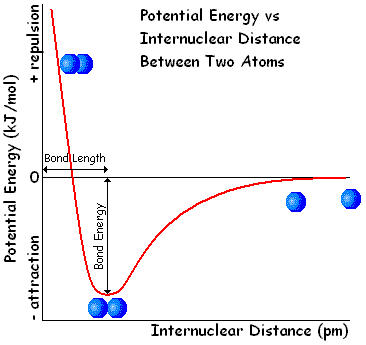
bond%20energy.GIF

I've read that it's related to the increase of the atoms' kinetic energy, but I'm having a hard time figuring out how and why that happens.
Also, why does the potential energy get negative values and why does it increase again as it passes a certain value (4,52 eV in hydrogen's case)?
I understand that the potential energy changes with the distance between the atoms but I'd like to know why it changes the way it does. And please explain this as good as you can, using whatever Maths you need. I just want to understand this whole situation.

Thank you very much. Diogo
 
Chemistry news on Phys.org
First you need to know that such potential energy form is a result of the electron density being in a certain configuration. That means, if the electronic density is in another configuration the potential energy curve will have a different form. In the picture above, the electron state is said to be in bonding state because it allows for the two atoms to bind together to form an equilibrium arrangement (this corresponds to the minimum in that curve). Usually in such bonding state, most electrons are found in the volume in between the two nuclei. That's why they can bring those nuclei closer. However, if the two nuclei gets too close past its equilibrium, the repulsive force between them will start to dominate and at some point (when the curve cross the x axis) they will break. As is mentioned in the beginning, different electron density can lead to different potential curve. One worth to mention is the so-called repulsive state where there is small chance to find electrons in the region between the nuclei so that there is no way the repulsive force between them can be compensated. The form of the corresponding potential curve exhibits a monotonically decreasing function (thus, no minimum/equilibrium) toward an asymptotic value when the internuclear distance approaches infinity.
 
  • Like
Likes   Reactions: mishaq504 and diogo_sg
blue_leaf77 said:
First you need to know that such potential energy form is a result of the electron density being in a certain configuration. That means, if the electronic density is in another configuration the potential energy curve will have a different form. In the picture above, the electron state is said to be in bonding state because it allows for the two atoms to bind together to form an equilibrium arrangement (this corresponds to the minimum in that curve). Usually in such bonding state, most electrons are found in the volume in between the two nuclei. That's why they can bring those nuclei closer. However, if the two nuclei gets too close past its equilibrium, the repulsive force between them will start to dominate and at some point (when the curve cross the x axis) they will break. As is mentioned in the beginning, different electron density can lead to different potential curve. One worth to mention is the so-called repulsive state where there is small chance to find electrons in the region between the nuclei so that there is no way the repulsive force between them can be compensated. The form of the corresponding potential curve exhibits a monotonically decreasing function (thus, no minimum/equilibrium) toward an asymptotic value when the internuclear distance approaches infinity.
Thank you for your fast reply. I understand your explanation (except the final part — why would that function be that way?). Though I'm failing to get in what way your explanation answers my questions.
 
So...when the atoms are quite far apart it's gravitational attraction at work ... If you hold a ball above the ground it has potential energy , release it and it falls , the potential energy being converted to kinetic energy (velocity) ...it's the same with these atoms , apart the energy is potential and this is reduced the closer they get together , it has to go somewhere and is seen in the increased velocity of the atoms.
When the atoms get very close the two positive nuclei "see" one another and repel, this accounts for the upward movement in the graph (moving right to left) so first they pull together by gravity, then push apart , like two N pole magnets , just as when you push two N pole magnets together there is stored potential energy , so if two atoms become very close there is a force wanting to push them apart , this explains the increase in potential energy on the graph.
 
  • Like
Likes   Reactions: diogo_sg
oz93666 said:
So...when the atoms are quite far apart it's gravitational attraction at work ...
Huh? I always thought that gravitational attractions were too weak to even matter in the atomic scale. That's what I have read in several places, at least.
oz93666 said:
If you hold a ball above the ground it has potential energy , release it and it falls , the potential energy being converted to kinetic energy (velocity) ...it's the same with these atoms , apart the energy is potential and this is reduced the closer they get together , it has to go somewhere and is seen in the increased velocity of the atoms.
When the atoms get very close the two positive nuclei "see" one another and repel, this accounts for the upward movement in the graph (moving right to left) so first they pull together by gravity, then push apart , like two N pole magnets , just as when you push two N pole magnets together there is stored potential energy , so if two atoms become very close there is a force wanting to push them apart , this explains the increase in potential energy on the graph.
Thank you. I get all this well. But why does the potential energy (PE) fall to negative values as the kinetic energy (KE) increases? Shouldn't it reach zero and stop decreasing?
Also, as the atoms reach a stable state, their KE falls to zero, right? Because they wouldn't be moving. If so, shouldn't their PE rise? Why does it remain so low?
 
  • Like
Likes   Reactions: diogo_sg
BvU said:
Correct. Electromagnetic forces are what keeps atoms & molecules busy.
https://en.wikipedia.org/wiki/Intermolecular_force
Then, which interaction(s) draw atoms closer to each other in order to form a molecule? If it isn't gravity, what is it? Can electromagnetic forces pull them together?
 
google http://ph.qmul.ac.uk/sites/default/files/CM_PHY108_Lecture2_Interatomic%20Forces1b.pdf , covalent bond, etc.
 
Last edited by a moderator:
Yes there are errors in my first post concerning gravity..
diogo_sg said:
...why does the potential energy (PE) fall to negative values as the kinetic energy (KE) increases? Shouldn't it reach zero and stop decreasing?
This negative value -4.75 is the energy required to separate them to infinity , they have -ve potential energy , they're stuck together ..
This excelent 3 min video explains all ...
 
  • #10
So, let me see if I'm getting this right:

Two atoms are drawn to each other by attractive forces between their nuclei and their electrons. When the atoms are separated, their PE is zero. As they get closer, their PE decreases — it is transformed into KE, which will increase as the atoms are pulled together. When the atoms reach a certain distance, which gives them the stability they need, they form a molecule — this is when the attractions and the repulsions become stable and the PE gets as low as possible. At that point, they will start vibrating (why?) and the values of their PE, KE and internuclear distance will be constantly changing (and is the energy preserved?), with the PE having negative values (I'm still not quite getting why that happens — is it because of the stability of the molecule i.e. the balance between repulsions and attractions? If it is, why does it get to negative values instead of reaching zero and stopping decreasing?). From that point on, if the two atoms get even closer, their PE will increase (and what about their KE?) because the repulsions between the two nuclei will become more and more intense (what about electronic repulsions? Will the electrons move to opposite zones of the electronic cloud in order to lower repulsive forces between them?) (and shouldn't the PE stop growing as it reaches zero? Because at that point is when the molecule breaks, so there shouldn't be any PE left — we would be back to the beginning state, correct?).

What do you think?
 
  • #11
Generally, when you form a very stable bond (stable bonds have very deep potential energy wells), the energy gets released as heat (e.g. think of the explosions that result when some chemical reactions occur).

As for why the PE is negative, remember that the potential energy values don't matter. It's only the changes between potential energy values that matter. We arbitrarily define the state where PE = 0 to be the case where the two atoms are completely isolated from each other. So here, the negative value of the potential energy just means that bonded atoms have a lower potential energy than unbonded atoms. Why is this? Well, as others have mentioned, atoms attract each other (do you understand the nature of these attractive forces?). In other words, the atoms exert forces on each other. As the atoms move closer together, these forces are doing work and, because the force is acting in the same direction as the movement, the work decreases the potential energy.
 
  • Like
Likes   Reactions: diogo_sg
  • #12
Ygggdrasil said:
Generally, when you form a very stable bond (stable bonds have very deep potential energy wells), the energy gets released as heat (e.g. think of the explosions that result when some chemical reactions occur).
I didn't quite get what "very deep potential energy wells" means. As for the rest, I think I get it. So, when a molecule is formed, there is a decrease of the PE between the atoms, because the PE is transformed into KE. Then, as the molecule becomes stable (as it stops?), it will release some energy as heat.
Ygggdrasil said:
As for why the PE is negative, remember that the potential energy values don't matter. It's only the changes between potential energy values that matter. We arbitrarily define the state where PE = 0 to be the case where the two atoms are completely isolated from each other. So here, the negative value of the potential energy just means that bonded atoms have a lower potential energy than unbonded atoms.
Ah, that makes a lot more sense, yes. I wasn't looking at things that way, but now I get it.
Ygggdrasil said:
Why is this? Well, as others have mentioned, atoms attract each other (do you understand the nature of these attractive forces?). In other words, the atoms exert forces on each other. As the atoms move closer together, these forces are doing work and, because the force is acting in the same direction as the movement, the work decreases the potential energy.
Correct me if I'm wrong, but aren't those electrostatic interactions i.e. attractive forces between two opposite charges (a proton and an electron)?
Why does the direction of the force being the same as that of the movement lower the PE?
 
  • #13
diogo_sg said:
I didn't quite get what "very deep potential energy wells" means.
By deep, I mean values that are more negative.

So, when a molecule is formed, there is a decrease of the PE between the atoms, because the PE is transformed into KE. Then, as the molecule becomes stable (as it stops?), it will release some energy as heat.
Think of the potential energy curve as an actual landscape, and imagine rolling a ball down the PE curve. The ball will roll down to the minimum of the curve, but it's kinetic energy will carry it past the equilibrium and up the steep repulsive slope of the curve. The ball will eventually fall back down, and if no energy was lost, the ball will have enough momentum to carry it back out to where PE = 0. This happens a lot in intermolecular interactions—two molecules colliding in an unproductive reaction.

How a chemical bond forms is when your molecules have collided together and collide with a third molecule, transferring some of their kinetic energy to that molecule. Now, the total kinetic + potential energy of the system will not allow the two molecules to fly apart. If you think back to the rolling ball analogy, consider the effect of friction. Friction will cause the ball to lose some of its initial energy, so that when the ball rolls back up the initial slope, it cannot get to the original PE = 0 position, so it rolls back down and is trapped in the "potential energy well" formed by the intermolecular attraction. Just like the ball will roll back and forth in the PE well, the molecule will vibrate as the atoms move toward and away from each other as if connected by a spring. Further collisions with the surroundings will gradually remove energy from the system until the total energy of the system is close to the minimum PE energy on the potential energy curve. (For reasons related to quantum mechanics, the molecules never stop vibrating, leading to a "zero point energy").

Correct me if I'm wrong, but aren't those electrostatic interactions i.e. attractive forces between two opposite charges (a proton and an electron)?
Why does the direction of the force being the same as that of the movement lower the PE?
Yes. The forces are attractive, so if you consider the force of atom A pulling on atom B, the force exerted by atom A on atom B is toward atom A. If atom B moves in that direction (toward atom A), the potential energy will decrease. Moving atom B away from atom A (in the direction opposite to the force vector) requires an external input of work (which then raises the potential energy of the system).
 
  • Like
Likes   Reactions: diogo_sg and Greg Bernhardt
  • #14
diogo_sg said:
why would that function be that way?
Quantum mechanics, in particular the Schroedinger equation decides it.
See this picture (I think these are the first/lowest two potential curves of H2)
I12-08-H2energy.jpg

The curve you have there is just one possibility of many others. In the picture above, apart from the bonding potential there is also repulsive potential which decreases monotonically with intermolecular distance. You can also see the corresponding electronic arrangement for each curves. The lower (bonding) state can form bonds because electrons are more likely to occupy the region between the two nuclei. For repulsive potential, the electrons prefer to reside in places away from the middle region so that the repulsive forces between nuclei always prevails, no bond is possible in this case.
 
  • Like
Likes   Reactions: diogo_sg
  • #15
More thoughts on -ve potential energy ... when we look at the graph we could slide that horizontal line down and define zero potential energy as the lowest point ... that would make more sense , particularly if the world was only made of hydrogen atoms ... but convention has determined zero is when atoms are far apart ...in that way we have a measure of bonding energy , and can compare the bonding energy of different compounds ...Have I got that right ?
 
  • Like
Likes   Reactions: diogo_sg
  • #16
Excellent answers all ... this is just my 2-cents worth... Think of two elements being attracted to one another like the ends of a stretched spring (i.e., without exceeding it's elastic limit) ... The resistance forces are directed toward the center of the spring... This is 'High Potential Energy of Attraction' ... as the tension is released, less force is required to keep the ends of the spring apart ... This is releasing or reduction of the 'Potential Energy of Attraction' (an exothermic process, hence the negative trend of the graph tracing as the ends come closer together) ... As the tension continues to be released, there will come a point at which the coiled spring can be placed on a surface and the ends will no longer be attracted to one another (or, repelled by one another for that matter)... This is the minimum in the Attraction/Repulsion Potential Energy vs Separation Distance of the potential energy diagrams and represents the condition when two elements stabilize at their natural bond lengths. At this point, the 'Potential Energy of Attraction (& Repulsion)' = 0. If compressing the spring ends, resistance forces act away from the spring's center and result in a rapid increase in Repulsion Potential Energy as the ends come closer together, or in atoms due to nuclear +charge/+charge repulsion. This would be the rapid increase in Potential Energy as the nuclear centers are pushed closer together. Such is one of the primary reasons nuclear fusion requires such extremely high energies to initiate the fusion process;i.e., +/+ repulsion of nuclei H-isotopes.
 
  • Like
Likes   Reactions: diogo_sg

Similar threads

Replies
14
Views
3K
Replies
2
Views
3K
Replies
4
Views
2K
  • · Replies 2 ·
Replies
2
Views
2K
  • · Replies 4 ·
Replies
4
Views
15K
  • · Replies 6 ·
Replies
6
Views
5K
  • · Replies 1 ·
Replies
1
Views
2K
  • · Replies 6 ·
Replies
6
Views
3K
Replies
32
Views
4K
  • · Replies 26 ·
Replies
26
Views
2K