Why does the set in Ross' completeness axiom example lack a minimum?

2 replies · 2K views · last reply
Joppy
MHB
Messages
282
Reaction score
22
I was reading through the early chapters of Ross' book on analysis in the section covering the completeness axiom. See below.

View attachment 6384

Followed by a few examples.

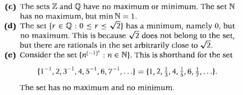
View attachment 6385

I'm confused as to why in the example (e), the set does not have a minimum.

I can understand that it does not have a maximum, but it seems there should be a maximum. What am i not understanding?

EDIT: The full pdf can be found https://issuu.com/juanjosesanchez22/docs/ross_sequenses.
 
Attachments
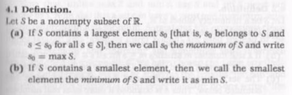
  • Printed definition 4.1 from a real analysis text: a nonempty subset S of R has a maximum s0 if s0 is in S and s is at most s0 for all s in S, written max S; part (b) defines the minimum of S as its smallest element, written min S.
    snip1.PNG
    34.7 KB · Views: 151
  • Printed text from a textbook listing set examples: (c) Z and Q have no max or min, N has no max but min N = 1; (d) {r in Q: 0 <= r <= sqrt 2} has minimum 0 but no maximum; (e) {n^(-1)^n : n in N} = {1, 2, 1/3, 4, 1/5, 6, 1/7, ...} has no maximum and no minimum.
    snip2.PNG
    29.5 KB · Views: 181
It's one of those many situations in which the numbers can get arbitrarily close to something (in this case, zero), but can't actually get there. Ask yourself this: is there any natural number which, when plugged into the formula $n^{(-1)^n}$, gives you zero? But you can see from the progression that every other number is getting smaller and smaller, closer and closer to zero.
 
Ackbach said:
It's one of those many situations in which the numbers can get arbitrarily close to something (in this case, zero), but can't actually get there. Ask yourself this: is there any natural number which, when plugged into the formula $n^{(-1)^n}$, gives you zero? But you can see from the progression that every other number is getting smaller and smaller, closer and closer to zero.

Ah how silly of me! For some reason i was (very foolishly) focusing on the index of numbers in the set... Thanks.