Why Does Titan Have an Atmosphere While Other Large Moons Don't?

  • Context: High School 
  • Thread starter Thread starter zuz
  • Start date Start date
Click For Summary

Discussion Overview

The discussion centers on the reasons why Titan, a moon of Saturn, possesses a significant atmosphere while other large moons in the solar system do not. Participants explore various factors such as moon size, orbital distance, and the influence of parent bodies on atmospheric retention, as well as the implications of gravity and surface temperature on gas retention.

Discussion Character

  • Exploratory
  • Technical explanation
  • Debate/contested

Main Points Raised

  • Some participants suggest that the absence of atmospheres on large moons can be attributed to a combination of moon diameter, orbital distance, and the characteristics of their parent bodies.
  • It is proposed that moons around Jupiter experience strong magnetic interactions that strip away their atmospheres, while Titan, being a Saturnian moon, is less affected.
  • Others note that smaller moons lack sufficient gravity to retain an atmosphere, and this is compounded by local surface temperature conditions.
  • A participant discusses the potential for gas species to escape a moon's atmosphere based on their molecular weight and the moon's escape velocity, leading to a gradual loss of atmospheric gases over time.
  • There is mention of the possibility of gas influx from outgassing processes, either from the moon's surface or from its parent planet, although the significance of this mechanism is questioned.
  • Some participants highlight that Titan's atmosphere is primarily nitrogen, with no significant presence of oxygen, suggesting a lack of processes that would produce oxygen over time.
  • One participant raises a speculative idea about creating a subsurface atmosphere on a moon by drilling and filling it with gases, while another provides calculations related to the depth required for an Earth-like atmosphere.

Areas of Agreement / Disagreement

Participants express multiple competing views regarding the factors influencing atmospheric retention on moons, and the discussion remains unresolved with no consensus on the primary reasons for Titan's unique atmosphere.

Contextual Notes

Some claims depend on specific assumptions about gravitational effects, surface temperatures, and the processes that produce or deplete atmospheric gases, which are not fully explored or agreed upon in the discussion.
zuz
Messages
100
Reaction score
36
Why don't other large moons in our solar system have atmospheres like Titan?
 
Astronomy news on Phys.org
I think you will find an intersection of criteria between moon diameter, its orbital distance and the nature its parent body that explains a lot of the absences, though maybe not all.

Many of the larger moons are around Jupiter, which has very strong magentic interations with its moons and tends to strip away the atmosphere. Many have a thin tenuous atmosphere clinging to them.

Titan is a Saturnian moon, and so is less affected by its parent (orbit 1.2M mi).
Triton is a Neptunian moon, so has managed to retain an atmo (orbit 220,000mi).

Below a certain size, most minor moon will have virtually no atmo simply because they lack the gravity to hang into it.

This is just a rough description - a more detailed correlation between moon radius, orbital distance and parent body should put most of them into place.

Of course, Earth's Moon remains an outlier in this explanation , as it is orbiting a small, rocky body - not giant, active Jupiter - and I don't think it's close enough to have an atmo interact with Earth (at least in modern times). I suspect here there is a fourth effect in play - our Moon could not hold onto its atmo like other outer system moons because of its proximity to the sun in the inner system.


Here's a list of moons by size:
https://thesolarsystem.fandom.com/wiki/List_of_natural_satellites_by_size

If my understanding is correct, you could go down this list one-by-one and strike off any moon that meets any of these criteria:
- Jovian
- in close orbit near one of the other gas giants
- near the sun (inner system)
- less than some diameter (only the first dozen or so moons are > 1,000km).

If I'm lucky, you'll be left with a very short list moons that do still have an atmo.

I welcome correction by our more well-informed astro members.
 
Last edited:
  • Like
Likes   Reactions: russ_watters and sophiecentaur
zuz said:
Why don't other large moons in our solar system have atmospheres like Titan?
what research have you done on this? What have you found so far?
 
  • Like
Likes   Reactions: sophiecentaur and DaveC426913
How about them neutron stars? They have an atmosphere of superheated carbon plasma that is 2 millimeters thick.
 
Last edited:
The surface of a moon is not a good place to live. It is not exactly windswept, more likely it is UV sterilised. Maybe drill a hole down several kilometres, then fill the hole with a blend of xenon and oxygen. That should retain a subsurface atmosphere, with sufficient pressure and oxygen that you can breathe.
 
DaveC426913 said:
Below a certain size, most minor moon will have virtually no atmo simply because they lack the gravity to hang into it.
This would then depend on a combination of gravity and (local) surface temperature.

For each potential gas species (i.e. from its molecular weight) one can compare its Maxwell-Boltzmann speed distribution for the ambient surface temperature and compare it with the escape speed of the moon in question to see how large a fraction of the gas will have escape speed. This out-flux will lead to an exponentially decaying amount of surface gas, with bigger escape speed fractions meaning faster decay. Over time nearly all gasses are going to "boil off" most moons unless the flux is balanced by an influx of new gas, e.g. due to out-gassing from surfaces rocks or from within.

Also, I assume that gas influx on a moon in principle can also be due to out-gassing from the parent planet (or a close sibling moon), but I am not aware if this in practice is a significant or even observable mechanism for any of the solar system moons.
 
Thank you.
 
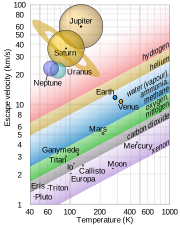
Regarding comparing escape speed and surface temperature for various gasses I found this nice diagram:
https://en.wikipedia.org/wiki/Atmosphere#Compositions

(Click diagram for big version)

Note that color bands indicate what kind of gas the planet or moon in question can expect to gravitationally hold on to and not that the gas necessarily is present. For example, Titan has no atmospheric oxygen (it has 94% nitrogen), but since it gravitationally could retain some oxygen it then must mean that over time there has been no significant gaseous oxygen producing process on Titan.

Also, the sharp edges of the color bands in the diagram does not indicate there is a sharp limit where on one side the gas can be fully retained and on the other it all escape, but as mentioned earlier, it more indicates that as you go down or to the right on the graph the rate of loss for that particular gas increase. So well below the color band of a gas, only trace amounts of the gas should be expected to be present (if at all).
 
Last edited:
  • Like
  • Informative
Likes   Reactions: russ_watters and berkeman
Filip Larsen said:
but since it gravitationally could retain some oxygen it then must mean that over time there has been no significant gaseous oxygen producing process on Titan.
I agree it's unlikely but given how reactive oxygen is, that isn't necessarily true. It could be a modest amount that is reacting to something.
 
  • #10
phinds said:
I agree it's unlikely but given how reactive oxygen is, that isn't necessarily true. It could be a modest amount that is reacting to something.
True, I should probably have said net production of oxygen.

My point was just to emphasize to the OP that just because, say, oxygen could potentially be gravitationally bound it doesn't mean there will be any oxygen present unless there over time has been a process or a set of processes with the net result that oxygen was produced or released. For example, as I understand it, on Titan the high amount of atmospheric N2 is likely to have originated from the NH3 ammonia compounds abundantly present, but at the same time the also abundantly present amount of (solid/liquid) H2O has apparently not given rise to any significant amount of atmospheric O2.
 
  • #11
Filip Larsen said:
Regarding comparing escape speed and surface temperature for various gasses I found this nice diagram:
https://en.wikipedia.org/wiki/Atmosphere#Compositions

(Click diagram for big version)

Note that color bands indicate what kind of gas the planet or moon in question can expect to gravitationally hold on to and not that the gas necessarily is present. For example, Titan has no atmospheric oxygen (it has 94% nitrogen), but since it gravitationally could retain some oxygen it then must mean that over time there has been no significant gaseous oxygen producing process on Titan.

Also, the sharp edges of the color bands in the diagram does not indicate there is a sharp limit where on one side the gas can be fully retained and on the other it all escape, but as mentioned earlier, it more indicates that as you go down or to the right on the graph the rate of loss for that particular gas increase. So well below the color band of a gas, only trace amounts of the gas should be expected to be present (if at all).
Thanks, That helps explain a lot.
 
  • #12
Hornbein said:
How about them neutron stars? They have an atmosphere of superheated carbon plasma that is 2 millimeters thick.
that's quite a tense atmosphere!
 
  • #13
Baluncore said:
The surface of a moon is not a good place to live. It is not exactly windswept, more likely it is UV sterilised. Maybe drill a hole down several kilometres, then fill the hole with a blend of xenon and oxygen. That should retain a subsurface atmosphere, with sufficient pressure and oxygen that you can breathe.
I did some rough calculations based on the Barometric Formula (https://en.wikipedia.org/wiki/Barometric_formula)
to find out how deep a chasm would need to be, on the Moon, to have a Earth-like atmosphere at the bottom. I used 0.3 nPa and 1/6 Earth gravity, and assumed a constant temperature all the way down. The answer came out at about 600km. That depth of chasm may not be impossible with the Moon's low gravity and a solid mantle.

But, if the pressure at the top is 0.3nPa, that's very little and there would be very little leakage if it was a bit greater. The rocks in the chasm walls would likely emit gas, many kms of them, so some gas loss would be sustainable. Xenon is sedative btw, how about just using the gas emissions, and have some O2 in a bubble at the bottom.

If there was a huge chasm along the Moon's equator and it was straight enough, the sun would shine down to the bottom, and plants could make O2 there
 
Last edited:
  • #14
Al_ said:
Xenon would make you unconscious btw,
Does the Moon outgas any significant amount of xenon?
Is xenon any more narcotic than any other gas - at a given concentration - such as N2, CO2, argon or krypton?
 
  • #15
DaveC426913 said:
Does the Moon outgas any significant amount of xenon?
Is xenon any more narcotic than any other gas - at a given concentration - such as N2, CO2, argon or krypton?
Yes, Xenon has been used medically for surgery. I don't know if Moon rocks emit Xenon particularly , but I think its likely they emit some gases. Based on Earth rocks, and science done about other planets.
 
  • #16
Al_ said:
Yes, Xenon has been used medically for surgery. I don't know if Moon rocks emit Xenon particularly , but I think its likely they emit some gases. Based on Earth rocks, and science done about other planets.
It appears the Moon does not outgas any significant amount of xenon.

My point though was questioning whether xenon itself is characteristically narcotic. There are several gasses that are narcotic, but I suspect it may have more to do with the concentration of an inert gas, rather than any particular property of xenon. The choice of xenon in surgery may be because - of the several gases that have a narcotic effect - it is perhaps the safest, or has some other advantageous property.

This is an aside though.


Updated: OK, my suspicion was wrong. xenon is characteristically an anaesthetic, unlike the others:

"Unlike nitrous oxide (N2O), argon, or krypton, xenon has anesthetic potency under normal conditions..."
 
Last edited:
  • #17
Al_ said:
I don't know if Moon rocks emit Xenon particularly , but I think its likely they emit some gases.
Astronauts reported that moon dust on their suits and moon rocks stowed away for return to Earth stunk!
 

Similar threads

  • · Replies 4 ·
Replies
4
Views
3K
  • · Replies 1 ·
Replies
1
Views
2K
  • · Replies 1 ·
Replies
1
Views
2K
  • · Replies 7 ·
Replies
7
Views
2K
  • · Replies 6 ·
Replies
6
Views
3K
  • · Replies 27 ·
Replies
27
Views
3K
  • · Replies 16 ·
Replies
16
Views
5K
  • · Replies 5 ·
Replies
5
Views
6K
  • · Replies 4 ·
Replies
4
Views
3K
  • · Replies 4 ·
Replies
4
Views
2K