Math Amateur
Gold Member
MHB
- 3,920
- 48
- TL;DR
- I am reading Tej Bahadur Singh: Elements of Topology, CRC Press, 2013 and am focused on the notions of limit points and closure in a topological space ... and I need help with understanding Singh's proof of Theorem 1.3.7 ...
I am reading Tej Bahadur Singh: Elements of Topology, CRC Press, 2013 ... ... and am currently focused on Chapter 1, Section 1.2: Topological Spaces ...
I need help in order to fully understand Singh's proof of Theorem 1.3.7 ... (using only the definitions and results Singh has established to date ... see below ... )
Theorem 1.3.7 reads as follows:

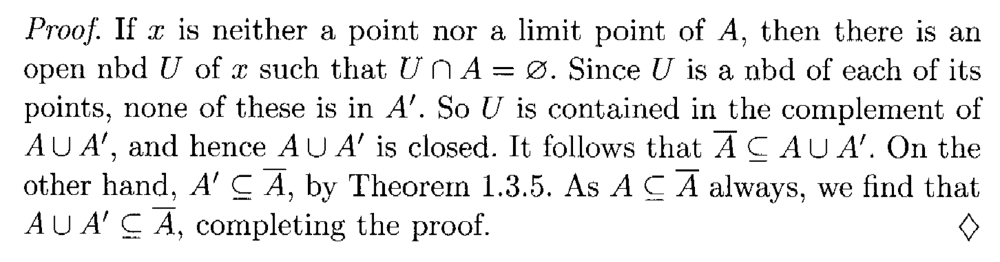
In the above proof by Singh we read the following:
" ... ... So ##U## is contained in the complement of ##A \cup A'##, and hence ##A \cup A'## is closed. It follows that ##\overline{A} \subseteq A \cup A'## ... ... "My question is as follows:
Why does ##U## being contained in the complement of ##A \cup A'## imply that ##A \cup A'## is closed ... and further why then does it follow that ##\overline{A} \subseteq A \cup A'## ... ... Help will be appreciated ...
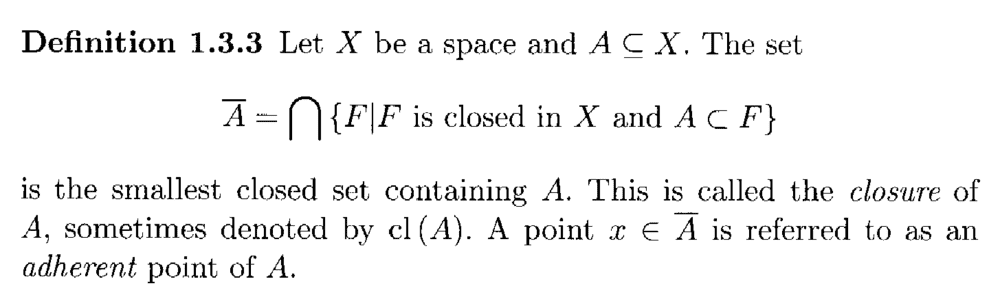
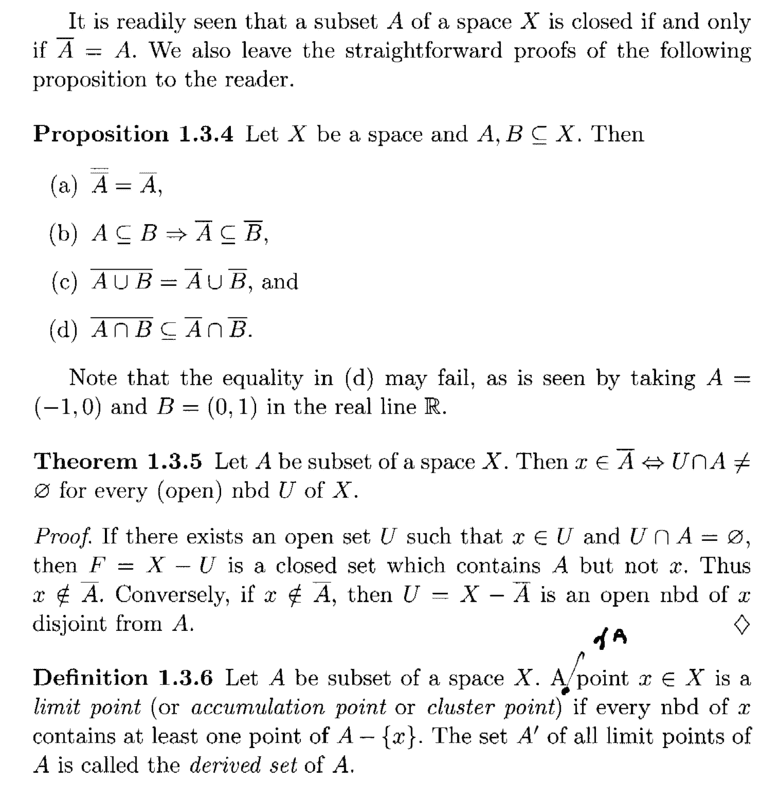
Peter==========================================================================================It is important that any proof of the above remarks only rely on the definitions and results Singh has established to date ... namely Definition 1.3.3, Proposition 1.3.4, Theorem 1.3.5 and Definition 1.3.6 ... which read as follows ... :
Hope that helps ...
Peter
I need help in order to fully understand Singh's proof of Theorem 1.3.7 ... (using only the definitions and results Singh has established to date ... see below ... )
Theorem 1.3.7 reads as follows:
In the above proof by Singh we read the following:
" ... ... So ##U## is contained in the complement of ##A \cup A'##, and hence ##A \cup A'## is closed. It follows that ##\overline{A} \subseteq A \cup A'## ... ... "My question is as follows:
Why does ##U## being contained in the complement of ##A \cup A'## imply that ##A \cup A'## is closed ... and further why then does it follow that ##\overline{A} \subseteq A \cup A'## ... ... Help will be appreciated ...
Peter==========================================================================================It is important that any proof of the above remarks only rely on the definitions and results Singh has established to date ... namely Definition 1.3.3, Proposition 1.3.4, Theorem 1.3.5 and Definition 1.3.6 ... which read as follows ... :
Hope that helps ...
Peter