sparkle123
- 172
- 0
This is an excerpt from my textbook. Could someone please help me understand why the line I highlighted in yellow is true? Thanks! :)
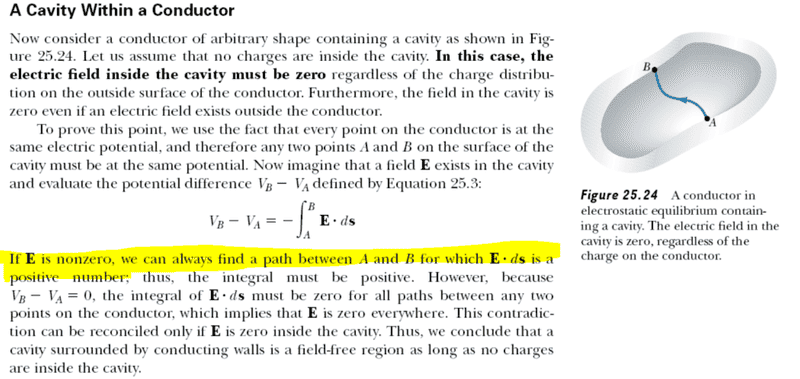
kuruman said:Suppose E is non-zero and in fact looks as shown in the drawing. Then if you chop the path along the line from A to B in many, say 1000, small pieces ds, you can calculate 1000 dot products E.ds each of which is equal to Eds and positive because the cosine of the angle between E and ds is +1. Now if you add 1000 positive numbers, what do you end up with?
The statement is "... we can always find a path ..." I have found such a path. It is the one in which E is always parallel to ds.mathfeel said:I don't think one can assume that this path drawn on the textbook necessarily follows some unknown field line. Along the curve, the E field might not might not be parallel to dS.
If there is a charge, yes you are right. However, the textbook clearly states "Let assume that no charges are inside the cavity." You cannot change the assumptions then claim that the argument is no good.mathfeel said:Anyway, I think this particular argument of the textbook is not very good. What if there is a some charge in the cavity? In this case, electric field is clearly not zero. Yet the potential difference between A and B is still zero.