Why Is Bloch's Theorem Derived Using Complex Methods?

  • Context: Graduate 
  • Thread starter Thread starter Happiness
  • Start date Start date
  • Tags Tags
    Derivation Theorem
Click For Summary
SUMMARY

The discussion centers on the derivation of Bloch's Theorem using complex methods, specifically the solutions satisfying the equation ##\psi(x+l)=\lambda\,\psi(x)##. The argument emphasizes that the probability density ##|\psi(x)|^2## must remain constant across indistinguishable positions, leading to the conclusion that ##\lambda=e^{iKl}##, where ##|λ|^2=1##. The justification for using this form is rooted in symmetry, as the periodic potential requires identical expectation values for all dynamical variables across each period. The conversation questions the necessity of the lengthy derivation process for obtaining the phase factor ##e^{iKl}## and whether the conditions stated are sufficient or necessary.

PREREQUISITES
  • Understanding of quantum mechanics principles, particularly wave functions
  • Familiarity with Bloch's Theorem and its implications in solid-state physics
  • Knowledge of periodic potentials and their effects on electron behavior
  • Basic grasp of complex numbers and their role in quantum mechanics
NEXT STEPS
  • Study the derivation of Bloch's Theorem in detail, focusing on symmetry arguments
  • Explore the implications of periodic potentials on wave functions in solid-state physics
  • Learn about the Wronskian determinant and its applications in quantum mechanics
  • Investigate the relationship between phase factors and expectation values in quantum systems
USEFUL FOR

Physicists, particularly those specializing in quantum mechanics and solid-state physics, as well as students seeking to deepen their understanding of Bloch's Theorem and its derivation methods.

Happiness
Messages
686
Reaction score
30
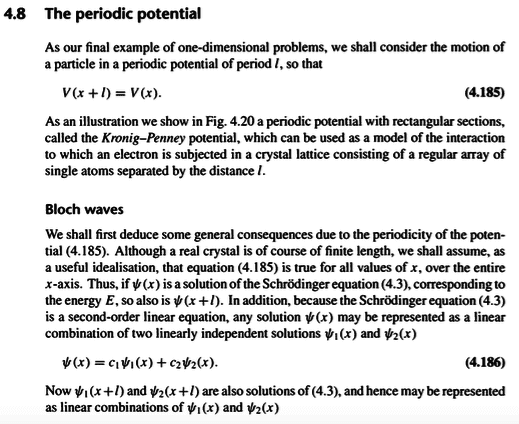
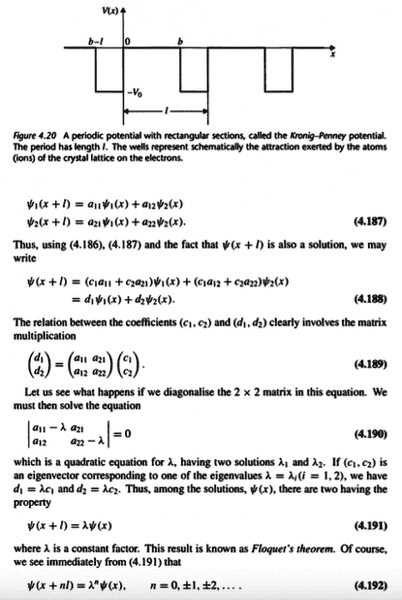
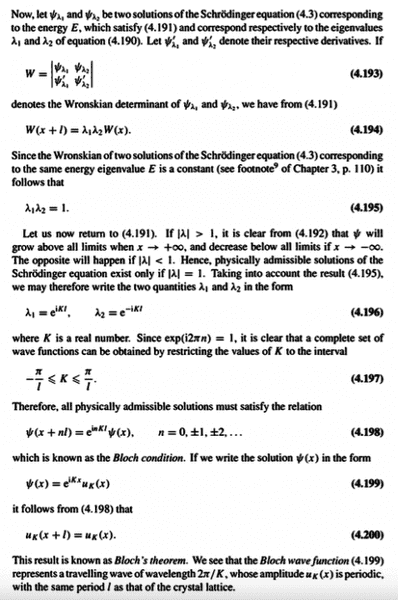
Why are the solutions satisfying ##\psi(x+l)=\lambda\,\psi(x)## (4.191) the only physically admissible solutions? (##l## is the period of the periodic potential.)

We may argue that the probability of finding an electron at ##x##, ##|\psi(x)|^2##, must be the same at any indistinguishable position:

##|\psi(x+l)|^2=|\psi(x)|^2##

This implies

##\psi(x+l)=\lambda\,\psi(x)##
##|\lambda|^2=1##
##\lambda=e^{iKl}##, which is the same as (4.196)

It seems that we can get (4.196) in a shorter way this way as compared to how it is done below by using the characteristic equation of matrix ##a## and the Wronskian determinant.

So it seems that the book justifies (4.191) in a different way from the argument using probability.

EDIT: I realize the probability argument does not justify the use of (4.191) either. Rather, it is justified by symmetry: Since the potential is periodic, the expectation values of all dynamical variables must be identical in every period. The only way this can happen is when (4.191) and (4.196) are true.

Still, it's unclear why the book uses such a long way to derive (4.196), without justifying the use of (4.191).
Screen Shot 2015-12-20 at 2.47.38 am.png

Screen Shot 2015-12-20 at 2.48.03 am.png

Screen Shot 2015-12-20 at 2.48.17 am.png
 
Last edited:
Physics news on Phys.org
Happiness said:
Still, it's unclear why the book uses such a long way to derive (4.196), without justifying the use of (4.191).
View attachment 93523
It has been always my question that what is the reason for using such a long way to drive Bloch Theorem. However I thought this long way is to obtain the phase factor ##e^{iKl}##. Could you please specify exactly how it can be obtained from symmetry considerations?
 
hokhani said:
It has been always my question that what is the reason for using such a long way to drive Bloch Theorem. However I thought this long way is to obtain the phase factor ##e^{iKl}##. Could you please specify exactly how it can be obtained from symmetry considerations?

Since the potential is periodic, every cell (of length ##l##) is indistinguishable from each other and the expectation values of all dynamical variables must be identical in every cell. The sufficient conditions are that (4.191) and (4.196) are true (because wave functions that differ by a constant phase factor have the same expectation values).

But I wonder if they are the necessary conditions too (ie., if two wave functions have the same expectation values of all dynamical variables, then they must differ by a constant phase factor).
 
Last edited:

Similar threads

  • · Replies 10 ·
Replies
10
Views
2K
  • · Replies 3 ·
Replies
3
Views
1K
  • · Replies 24 ·
Replies
24
Views
3K
  • · Replies 1 ·
Replies
1
Views
2K
  • · Replies 4 ·
Replies
4
Views
3K
  • · Replies 7 ·
Replies
7
Views
3K
  • · Replies 12 ·
Replies
12
Views
6K
  • · Replies 1 ·
Replies
1
Views
2K
  • · Replies 8 ·
Replies
8
Views
3K
  • · Replies 0 ·
Replies
0
Views
1K