Why is the expectation value of the commutator not zero in method 1?

  • Thread starter Thread starter alizeid
  • Start date Start date
  • Tags Tags
    Qm Value
Click For Summary

Homework Help Overview

The discussion revolves around the expectation value of the commutator in quantum mechanics, specifically in the context of polarized photons represented in different bases. The original poster attempts to understand discrepancies in their calculations using two methods to extract the expected value of a |+45> polarized photon in the HV basis.

Discussion Character

  • Exploratory, Assumption checking, Conceptual clarification

Approaches and Questions Raised

  • Participants question the origin of a minus sign in the calculations and the nature of the operators involved. There is also a focus on the definition of the |45> state and its relation to the HV basis, with some participants expressing confusion over the expectation value of the commutator being zero.

Discussion Status

The discussion is active, with participants providing guidance on the need for clarity regarding the definitions used in the problem. Some participants assert that the expectation value of the commutator should not be zero, while others argue that it must be zero for the given state, indicating a divergence in interpretations.

Contextual Notes

There is a lack of information regarding the textbook being referenced, which is noted as crucial for understanding the problem. Additionally, the distinction between states and operators is under discussion, which may affect the interpretation of the problem.

alizeid
Messages
14
Reaction score
0
Poster has been reminded (again!) to use the Template when starting schoolwork threads.
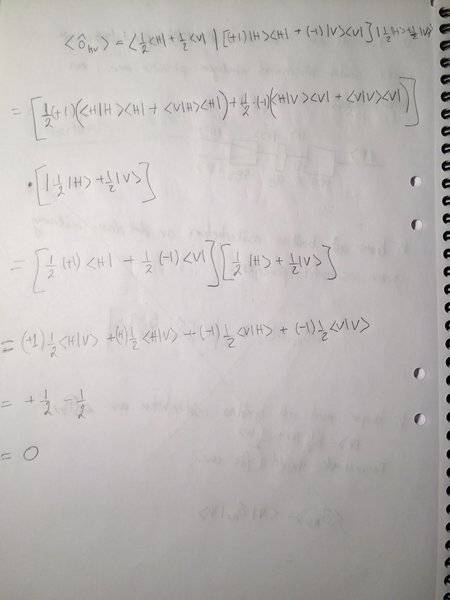
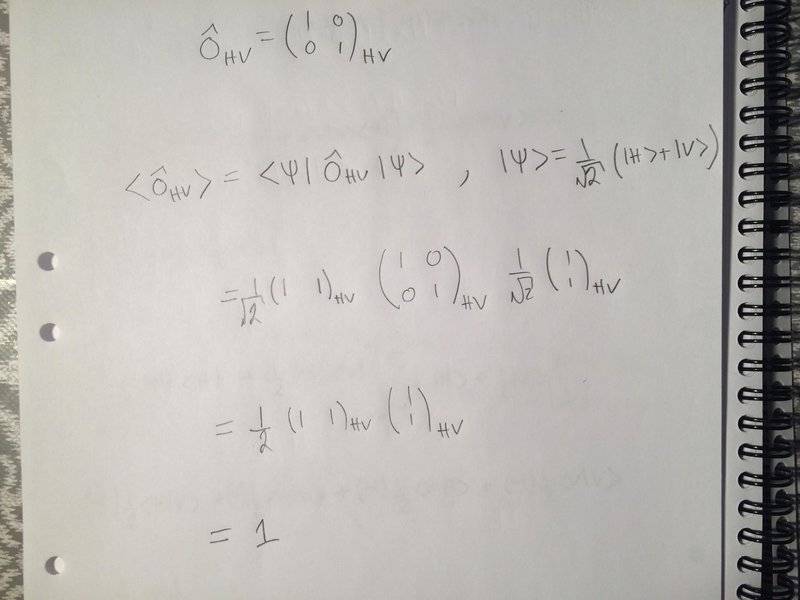
I'm trying to extract the expected value of a |+45> polarized photon in the HV- base. I do it in two ways, one is correct and the other I get wrong answer. What am I doing wrong in the first method that is wrong?

method 1
ali2.jpg


method 2
ali1.jpg


thanks in advance
 

Attachments

  • ali2.jpg
    ali2.jpg
    35.6 KB · Views: 686
  • ali1.jpg
    ali1.jpg
    20.5 KB · Views: 673
Physics news on Phys.org
You computed the expectation value of different operators. Where did the minus sign come from in your second method?

Also, please type out your expressions instead of attaching them as images.
 
Orodruin said:
You computed the expectation value of different operators. Where did the minus sign come from in your second method?

Also, please type out your expressions instead of attaching them as images.
why are they different operators? according to the book, they are the same
 
Then you either copied the book wrong or the book is wrong.
 
alizeid said:
why are they different operators? according to the book, they are the same
The real problem is

2.PNG


I get the expectation value of the commutator to zero, even for operator | 45>. This can not be correct. I can not solve this problem, can you help me?
 

Attachments

  • 2.PNG
    2.PNG
    22.3 KB · Views: 328
The problem formulation is of little use unless you define the ##|45\rangle## basis in terms of the HV one and define what is meant by ##\mathcal P_{HV}##. Since you have not told us what textbook you are using and we most likely will not have direct access to it, this is crucial information.
alizeid said:
even for operator | 45>
##|45\rangle## is a state, not an operator.
 
Orodruin said:
The problem formulation is of little use unless you define the ##|45\rangle## basis in terms of the HV one and define what is meant by ##\mathcal P_{HV}##. Since you have not told us what textbook you are using and we most likely will not have direct access to it, this is crucial information.

##|45\rangle## is a state, not an operator.

5.PNG


4.PNG
 

Attachments

  • 5.PNG
    5.PNG
    7.3 KB · Views: 302
  • 4.PNG
    4.PNG
    16.5 KB · Views: 330
So what is the problem?
 
Orodruin said:
So what is the problem?

The expectation value of the commutator should NOT be zero. the commutator do not commut therefore the answer is wrong
 
  • #10
alizeid said:
The expectation value of the commutator should NOT be zero. the commutator do not commut therefore the answer is wrong
No it isn’t. In fact, the expectation of the commutator must be zero for the given state! Anything else would violate the uncertainty relation.
 

Similar threads

  • · Replies 5 ·
Replies
5
Views
2K
Replies
3
Views
1K
Replies
10
Views
2K
  • · Replies 2 ·
Replies
2
Views
1K
  • · Replies 2 ·
Replies
2
Views
993
Replies
22
Views
3K
  • · Replies 7 ·
Replies
7
Views
3K
  • · Replies 8 ·
Replies
8
Views
1K
  • · Replies 7 ·
Replies
7
Views
1K
  • · Replies 4 ·
Replies
4
Views
2K