Why is the first term zero in the Virial Theorem derivation?

Click For Summary

Discussion Overview

The discussion revolves around the derivation of the Virial Theorem, specifically addressing a step in the derivation where a term is claimed to be zero. Participants are exploring the implications of Newton's Third Law and the symmetry of forces in this context.

Discussion Character

  • Technical explanation
  • Conceptual clarification
  • Debate/contested

Main Points Raised

  • One participant seeks clarification on how Newton's Third Law leads to a specific term being zero in the derivation of the Virial Theorem.
  • Another participant explains that the terms involving forces between pairs of particles cancel each other due to their equal magnitude and opposite signs.
  • A further contribution suggests that the cancellation occurs because the forces from one particle to another and vice versa are equal and opposite, leaving only the diagonal terms, which are zero since a particle does not exert a force on itself.
  • Another participant challenges the understanding by stating that the summation should consider the components of the forces along the position vector connecting the two particles, rather than summing the forces directly.
  • A participant questions why a second term is not also zero, suggesting that if one term goes to zero, the other should as well, and notes that the sign change occurs when indices are exchanged.

Areas of Agreement / Disagreement

Participants express differing views on the treatment of the terms in the derivation, with some agreeing on the cancellation due to symmetry and others questioning the reasoning behind the non-zero status of a second term. The discussion remains unresolved regarding the conditions under which these terms are considered zero.

Contextual Notes

There are limitations in the discussion regarding the assumptions made about the symmetry of forces and the specific conditions under which terms are considered zero. The treatment of vector components and the implications of index exchanges are also points of contention.

rexregisanimi
Messages
42
Reaction score
6
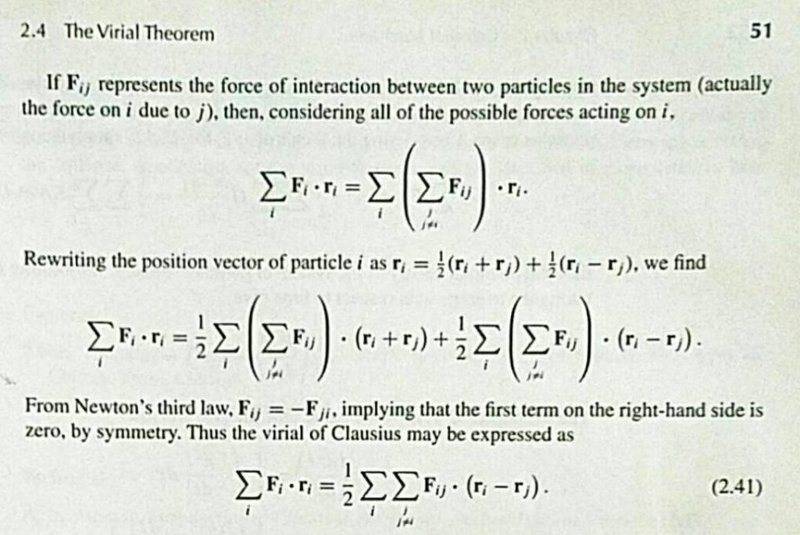
Hello everyone! I am reviewing the derivation of the Virial Theorem from an introductory Astrophysics book (Carroll and Ostlie's) and found a step I couldn't follow. I've attached a photo of the step.

Can anyone explain how Newton's Third Law brings about eqn 2.41? I don't see how that first term in the right side previous to eqn 2.41 goes to zero. What symmetry is being referenced?
1482184447251.jpg
 
Last edited:
Mathematics news on Phys.org
Consider the ##ij##-th term
$$
\mathbf F_{ij} \cdot (\mathbf r_i + \mathbf r_j)
$$
and the ##ji##-th term
$$
\mathbf F_{ji} \cdot (\mathbf r_j + \mathbf r_i) = -\mathbf F_{ij} \cdot (\mathbf r_i + \mathbf r_j)
$$
The two terms has equal magnitude but opposite sign, so they will cancel. The same is true for other pair of terms connected by interchanging the indices.
 
So, in other words, the top triangular part of the F_ij matrix cancels with the bottom triangular part because of the Third Law; this leaves the diagonals only which are zero because a particle will not exert a force on itself. Is that correct?
 
You actually don't sum the vector F_ij, instead you are summing over the component of F_ij along the position vector of the central point in the line connecting the two particles.
 
Thank you for your replies.

Why then isn't the second term zero? If we're just concerned about those values, shouldn't both terms go to zero?
 
rexregisanimi said:
Thank you for your replies.

Why then isn't the second term zero? If we're just concerned about those values, shouldn't both terms go to zero?
When you exchange the indices, the vector ##\mathbf r_i - \mathbf r_j## also changes sign.
 

Similar threads

  • · Replies 3 ·
Replies
3
Views
2K
  • · Replies 5 ·
Replies
5
Views
2K
  • · Replies 26 ·
Replies
26
Views
6K
  • · Replies 1 ·
Replies
1
Views
3K
  • · Replies 150 ·
6
Replies
150
Views
23K
  • · Replies 5 ·
Replies
5
Views
29K
  • · Replies 6 ·
Replies
6
Views
14K
Replies
15
Views
41K
  • · Replies 39 ·
2
Replies
39
Views
7K
  • · Replies 7 ·
Replies
7
Views
4K