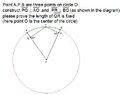
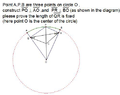
I assume that $A$, $B$ and $O$ are meant to be fixed, but that $P$ varies, and the aim is to show that the length $QR$ is independent of the position of $P$.
[sp]
Let $C$ be the midpoint of $OP$, let $r$ be the radius of the circle, and let $\alpha$ be the angle $AOB$. The circle with centre at $C$ and diameter $OP$ has radius $\frac12r$ and passes through $Q$ and $R$ (because of the right angles). The angle $QCR$ is $2\alpha$. By dropping a perpendicular from $C$ to $QR$, you see that $QR = 2CR\sin\alpha = r\sin\alpha.$ That depends only on $r$ and $\alpha$ and so is independent of the position of $P$.[/sp]