Why is there an arrow mediating a process in a Feynman diagram?

Click For Summary
SUMMARY

The discussion centers on the Møller scattering process, where two electrons exchange a virtual photon, not emitting any photons, to maintain charge and Lorentz invariance. The participants clarify that the QED Lagrangian does not support a photon-photon-electron vertex, as such a configuration would violate fundamental conservation laws. The correct interpretation involves electron-electron-photon vertices, ensuring compliance with charge conservation and Lorentz invariance. Misunderstandings regarding the role of virtual particles in mediating interactions are addressed, emphasizing the importance of adhering to established quantum electrodynamics principles.

PREREQUISITES
  • Understanding of Quantum Electrodynamics (QED)
  • Familiarity with the concepts of virtual particles and scattering processes
  • Knowledge of charge conservation and Lorentz invariance
  • Basic grasp of Feynman diagrams and their interpretation
NEXT STEPS
  • Study the QED Lagrangian, focusing on the term ##i e \bar{\psi} \gamma^\mu A_\mu \psi##
  • Learn about the implications of virtual particles in quantum field theory
  • Research the principles of charge conservation and Lorentz invariance in particle interactions
  • Explore advanced Feynman diagram techniques and their applications in particle physics
USEFUL FOR

Physicists, students of quantum mechanics, and anyone interested in the intricacies of particle interactions and quantum field theory will benefit from this discussion.

Phys12
Messages
351
Reaction score
42
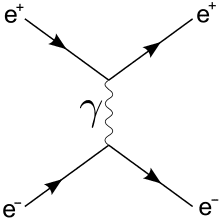
In the following Møller scattering process, two electrons enter, exchange a photon and then leave (and if I understand this correctly, we say that both of the electrons emitted a photon).
220px-Bhabha_scattering_t-channel.svg.png

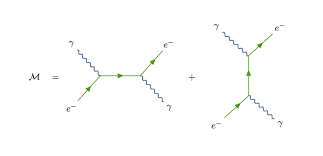
However, in this case:
images.png

We have an electron scattering off a photon, but the interaction happens by an exchange of electron, is that correct? Why is it not the case that photon mediates the interaction between the photon and the electron since photons are the mediators of the EM force?
 

Attachments

  • 220px-Bhabha_scattering_t-channel.svg.png
    220px-Bhabha_scattering_t-channel.svg.png
    1.9 KB · Views: 923
  • images.png
    images.png
    1.5 KB · Views: 1,073
Physics news on Phys.org
That would violate charge and Lorentz invariance in both vertices.
 
Also;
Phys12 said:
we say that both of the electrons emitted a photon).
No. The electrons exchanged a (virtual) photon. There is no emission of photons.
 
Orodruin said:
That would violate charge and Lorentz invariance in both vertices.
Can you please elaborate on how exactly that will violate charge and Lorentz invariance?
 
Phys12 said:
Can you please elaborate on how exactly that will violate charge and Lorentz invariance?

Take a photon-photon-electron vertex. You could have the time-ordering such that:
  • electron spontaneously is destroyed/annihilated and 2 photons "come out"
  • electron and photon interact and 1 photon comes out
Even as a virtual process (ie. at least one internal line coming out of the vertex), charge is destroyed, which is non-sensical.

The more technical explanation is of course, that there is simply no term in the QED Lagrangian which would generate such diagrams.
 
protonsarecool said:
Take a photon-photon-electron vertex.

There is no such vertex in the diagrams shown in the OP. The vertices in those diagrams all have two electron lines and one photon line meeting at them, so they are electron-electron-photon vertices, not photon-photon-electron vertices.

protonsarecool said:
there is simply no term in the QED Lagrangian which would generate such diagrams.

The single electron-electron-photon vertex in itself is fine; it is directly generated by the ##i e \bar{\psi} \gamma^\mu A_\mu \psi## term in the QED Lagrangian. The issue is that this vertex can only occur if the photon line that comes from it is an internal line, not an external one, because a diagram that had three external lines, two electron and one photon, would violate charge conservation and Lorentz invariance.
 
PeterDonis said:
There is no such vertex in the diagrams shown in the OP. The vertices in those diagrams all have two electron lines and one photon line meeting at them, so they are electron-electron-photon vertices, not photon-photon-electron vertices.
Right, i have no idea how i could see any such diagrams in the OP. Guess i was tired. OP, please forget that i said anything.
 
PeterDonis said:
There is no such vertex in the diagrams shown in the OP.
But the OP explicitly asks why those diagrams look the way they do instead of being mediated by a photon propagator. A photon propagator would imply a photon-photon-electron vertex instead of the normal QED vertex. The ”new” vertex would violate charge (net charge one) and Lorentz invariance (half-integer spin). I believe post #5 is completely appropriate for the OP.
 
Orodruin said:
But the OP explicitly asks why those diagrams look the way they do instead of being mediated by a photon propagator. A photon propagator would imply a photon-photon-electron vertex instead of the normal QED vertex. The ”new” vertex would violate charge (net charge one) and Lorentz invariance (half-integer spin). I believe post #5 is completely appropriate for the OP.
Oh yeah. At first when the photon-photon-electron vertex was brought up, it threw me off too. Now that I see it as something shown to prove why it wouldn't make sense, I can see why you'd have a virtual electron mediating the process.
 

Similar threads

  • · Replies 3 ·
Replies
3
Views
2K
  • · Replies 5 ·
Replies
5
Views
3K
  • · Replies 3 ·
Replies
3
Views
1K
  • · Replies 7 ·
Replies
7
Views
2K
  • · Replies 12 ·
Replies
12
Views
3K
  • · Replies 21 ·
Replies
21
Views
3K
  • · Replies 1 ·
Replies
1
Views
2K
  • · Replies 7 ·
Replies
7
Views
2K
  • · Replies 8 ·
Replies
8
Views
3K
  • · Replies 1 ·
Replies
1
Views
1K