Why is this definite integral a single number?

  • Context: High School 
  • Thread starter Thread starter mcastillo356
  • Start date Start date
  • Tags Tags
    Calculus
Click For Summary

Discussion Overview

The discussion revolves around the nature of definite integrals, specifically why they yield a single numerical value despite being associated with geometric quantities like area. Participants explore definitions, mathematical properties, and implications of integrals in various contexts, including calculus and geometry.

Discussion Character

  • Technical explanation
  • Conceptual clarification
  • Debate/contested
  • Mathematical reasoning

Main Points Raised

  • Some participants reference the fundamental theorem of calculus, stating that a definite integral represents a difference between two numbers, thus resulting in a single number.
  • Others introduce the Darboux integral, explaining that the upper and lower sums of a function lead to real numbers, and the equality of these sums defines the integral as a single real number.
  • There are comments on the relationship between definite integrals and geometric areas, emphasizing that while integrals are pure numbers, areas involve units and dimensions.
  • Some participants discuss the algebraic interpretation of integrals and differentiation, questioning the necessity of infinitesimals and limits in these concepts.
  • Concerns are raised about the clarity of mathematical notation, particularly in LaTeX formatting, which can lead to misunderstandings in expressions.

Areas of Agreement / Disagreement

Participants express various viewpoints on the nature of definite integrals and their relationship to geometric areas. There is no consensus on a singular interpretation, as some emphasize the mathematical definitions while others focus on the geometric implications.

Contextual Notes

Some discussions touch on the limitations of algebraic perspectives in understanding calculus concepts, highlighting the necessity of limits and analytical definitions in the context of integration and differentiation.

mcastillo356
Gold Member
Messages
658
Reaction score
361
TL;DR
Been searching backwards in my textbook, but can't find it; I mean, the reason. I will provide a solved exercise
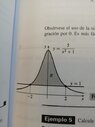
EXAMPLE 4 Find the area of the region ##R## lying above the line ##y=1## and below the curve ##y=5/(x^2+1)##.

Solution The region ##R## is shaded in Figure 5.24. To find the intersections of ##y=1## and ##y=5/(x^2+1)##, we must solve these equations simultaneously:

##1=\frac{5}{x^2+1}##

so ##x^2+1=5##,##x^2=4##, and ##x=\pm 2##

The area of the region ##R## is the area under the curve ##y=5/(x^2+1)## and above the ##x##-axis between ##x=-2## and ##x=2##, minus the area of a rectangle of width 4 and height 1. Since ##\tan^{-1}x## is an antiderivative of ##1/(x^2+1)##,

##A=\int_{-2}^2 \frac{5}{x^2+1}\ ,dx-4=2\int_0^2\frac{5}{x^2+1}\ ,dx-4=10\tan^{-1} x\left. \right |_0^2-4=10\tan{-1} 2-4## square units.

Observe the use of even symmetry (Theorem 3(h) of Section 5,4) to replace the lower limit of integration by 0. It si easier to susbstitute 0 into the antiderivative than -2.

THEOREM 3 Let ##f## and ##g## be integrable on an interval containing the points ##a##, ##b## and ##c##. Then

(...)

(h) The integral of an even function over an interval symmetric about zero is twice the integral over the positive half of the interval. If ##f## is an even function (i.e., ##f(-x)=f(x))##, then

##\int_{-a}^a f(x)\ ,dx=\int_0^a f(x)\ ,dx## IMG_20230525_104235.jpg
Attempt: It is not explicited the unit
 
Physics news on Phys.org
What is your question? The one in the title? And if so, why did you add the example?

If ##F(x)## is the anti-derivative of ##f(x)## then ##\displaystyle{\int_a^b\,f(x)\,dx=F(b)-F(a)}.## This is the fundamental theorem of calculus. The LHS is a definite integral and the RHS is a difference between two numbers, hence again a number.

The answer to your question is the fundamental theorem of calculus.
 
  • Like
  • Informative
Likes   Reactions: bhobba and mcastillo356
This is a consequence of the definition of the Darboux integral.

The upper and lower sums of a real-valued function with respect to a partition are real numbers by closure of addition and multiplication. The lower integral, as the supremum of the lower sums, is a real number by the least upper bound axiom; the upper integral, as the infimum of the upper sums, is a real number by the same axiom. A function is integrable if and only if these two numbers are equal, in which case the value of the integral is that number.
 
  • Like
Likes   Reactions: PeroK, bhobba and mcastillo356
mcastillo356 said:
The area of the region ##R## is the area under the curve ##y=5/(x^2+1)## and above the ##x##-axis between ##x=-2## and ##x=2##, minus the area of a rectangle of width 4 and height 1. Since ##\tan^{-1}x## is an antiderivative of ##1/(x^2+1)##,

##A=\int_{-2}^2 \frac{5}{x^2+1}\ ,dx-4=2\int_0^2\frac{5}{x^2+1}\ ,dx-4=10\tan^{-1} x\left. \right |_0^2-4=10\tan{-1} 2-4## square units.

Not the answer to the question you asked, but a comment on your LaTeX. The very last number in your solution should be ##10\tan^{-1}2 - 4##. Omitting the '^' symbol makes what you wrote 10 tan -12 -4.
 
  • Like
  • Informative
Likes   Reactions: bhobba and mcastillo356
Hi, PF

Mark44 said:
Not the answer to the question you asked, but a comment on your LaTeX. The very last number in your solution should be ##10\tan^{-1}2 - 4##. Omitting the '^' symbol makes what you wrote 10 tan -12 -4.
Perfect.

fresh_42 said:
What is your question? The one in the title?
Got it. I quote "Calculus, 7th ed, R. Adams & C. Essex"

(...) while the definite integral is a pure number, an area is a geometric quantity that impllicitly involves units. If the units along the ##x-## and ##y-##axes are, for example, metres, the area should be quoted in square metres (##m^2##). If units of length along the ##x-##axis and ##y-##axis are not specified, areas should be quoted in square units.

pasmith said:
This is a consequence of the definition of the Darboux integral.

The upper and lower sums of a real-valued function with respect to a partition are real numbers by closure of addition and multiplication. The lower integral, as the supremum of the lower sums, is a real number by the least upper bound axiom; the upper integral, as the infimum of the upper sums, is a real number by the same axiom. A function is integrable if and only if these two numbers are equal, in which case the value of the integral is that number.
Thanks! A point of view of Darboux I haven't noticed until now. Dense and precise.

Greetings!
 
  • Like
Likes   Reactions: bhobba
mcastillo356 said:
Got it. I quote "Calculus, 7th ed, R. Adams & C. Essex"
(...) while the definite integral is a pure number, an area is a geometric quantity that implicitly involves units. If the units along the ##x##− and ##y##−axes are, for example, meters, the area should be quoted in square meters (##m^2##). If units of length along the##x##−axis and ##y##−axis are not specified, areas should be quoted in square units.

You can look at it as $$
\int_a^b y\;dx=[y\cdot x]_{x=a}^{x=b}=(b-a)\cdot y=\underbrace{\int_{from\,[m]}^{to\,[m]}}_{\text{limits of width}} \underbrace{\,height\,[m]}_{=y} \cdot \underbrace{change \;in\;}_{=d} \underbrace{width\,[m]}_{=x} = area\,[m^2]$$
This is the simplest example and everything else are piecewise generalizations such that in the end, we get arbitrary integrals, up to integral curves (flows) through vector fields. It is a long way from width times height to meteorology!

Differentiation is accordingly. ##\dfrac{d\,xy}{dy}=x## and we can say "change of area divided by change of width is the height" (pretending the latter is constant as in the integral).
 
  • Like
Likes   Reactions: bhobba
Hi, PF, @fresh_42

fresh_42 said:
$$
\int_a^b y\;dx=[y\cdot x]_{x=a}^{x=b}=(b-a)\cdot y=\underbrace{\int_{from\,[m]}^{to\,[m]}}_{\text{limits of width}} \underbrace{\,height\,[m]}_{=y} \cdot \underbrace{change \;in\;}_{=d} \underbrace{width\,[m]}_{=x} = area\,[m^2]$$

Is it possibly to see it entirely with algebra? Some subjects like dimensional analysis, differentiation, integration, are showed together. Very interesting.

fresh_42 said:
Differentiation is accordingly. ##\dfrac{d\,xy}{dy}=x## and we can say "change of area divided by change of width is the height" (pretending the latter is constant as in the integral).

##\dfrac{d\,xy}{dy}=x## makes me wonder. Why did it takes to get infinitesimals?.

fresh_42 said:
This is the simplest example and everything else are piecewise generalizations such that in the end, we get arbitrary integrals, up to integral curves (flows) through vector fields. It is a long way from width times height to meteorology!

I've browsed Google without success. Vector fields are related with meteorology, but how do I link it all together?
 
mcastillo356 said:
Is it possibly to see it entirely with algebra? Some subjects like dimensional analysis, differentiation, integration, are showed together. Very interesting.
It is an analytical concept and the definitions require limits. For a purely algebraic point of view, you would first have to establish such an environment so that the terms make sense. You can consider a differentiation as a derivation (no typo!) or a differential operator, but the corresponding integral operator uses an integral in its definition, i.e. again an analytical term.

mcastillo356 said:
##\dfrac{d\,xy}{dy}=x## makes me wonder. Why did it takes to get infinitesimals?
The infinitesimal notation - in this context - is more of a reminder not to forget that we deal with limits (change of) rather than having a meaning of their own.
$$\left. \dfrac{d}{d\,x}\right|_{x_0}f(x)=\left. \dfrac{d\,f}{d\,x}\right|_{x_0} =\displaystyle{\lim_{h \to 0}}\dfrac{f(x_0+h)-f(x_0)}{h}.$$
You cannot discuss them separately. Best you can get is Weierstrass's formula
$$
f(x_0+h)=f(x_0)+ \underbrace{\left(\left. \dfrac{d}{d\,x}\right|_{x_0}f(x)\right)}_{=D_{x_0}f}\cdot h + r(h)
$$
where all the infinitesimal quantities, all limits, anything going to zero, all those are put into the correction term ##r(h)## which is required to converge faster to zero than ##h## does, and ##D_{x_0}f## is merely a linear function and not the quotient of infinitesimals.

In other contexts, especially in physics, ##dx## can also mean a basis vector of the cotangent space or a differential, a Pfaffian form. These cases do not use quotients of ##d## expressions and can thus be explained without limits, or better: with hidden limits since we still use tangents.
mcastillo356 said:
I've browsed Google without success. Vector fields are related with meteorology, but how do I link it all together?
That was more of a rhetorical statement. Meteorology is full of (tangent) vector fields. You see at least one whenever you see a weather forecast, often literally with drawn vectors. Yet, the way from a bunch of secants converging to a tangent up to the theorem of the hedgehog as we call the hairy ball theorem is long, or to meteorology.

Here (pretty much at the beginning) is a list of 10 perspectives on the differentiation process:
https://www.physicsforums.com/insights/journey-manifold-su2mathbbc-part/
and I didn't even use the word slope.

You have to go this way if you study physics, at least the first steps to cotangent spaces and differential forms. If you want to study physics on a deeper level, then you will probably need pushforwards and pullbacks, too.
 
Last edited:
  • Like
Likes   Reactions: bhobba and mcastillo356
Hi, PF, @fresh_42, I think I got it:

fresh_42 said:
You can look at it as $$
\int_a^b y\;dx=[y\cdot x]_{x=a}^{x=b}=(b-a)\cdot y=\underbrace{\int_{from\,[m]}^{to\,[m]}}_{\text{limits of width}} \underbrace{\,height\,[m]}_{=y} \cdot \underbrace{change \;in\;}_{=d} \underbrace{width\,[m]}_{=x} = area\,[m^2]$$
It is as simple as I didn't think until now. The only obstacle is the fact that in dimensional analisis both height and width have the same expression: ##[L]##: Area=##[L]^2##.
I truly thank the quote, that so precisely makes the path between the definite integral (a pure number), and the area, a dimensional quantity
fresh_42 said:
Differentiation is accordingly. ##\dfrac{d\,xy}{dy}=x## and we can say "change of area divided by change of width is the height" (pretending the latter is constant as in the integral).
Just perfect.

Unfortunately, I cannot discuss any of the other grounds mentioned in the thread, but I can say that my doubt is solved.

Thanks!
 
  • #10
Just thanks to Fresh about the answers to what seems a simple question but is surprisingly subtle. A study of real analysis would help a lot. It becomes more intuitively obvious using infinitesimals. I am working on a surprising update to my insights article on infinitesimals and a supplement to an Algebra 2 Text that gives a calculus introduction using infinitesimals.

To the OP these days the rigorous treatment of calculus using infinitesimals is known to be logically equivalent to calculus using limits. The choice of which you use is just personal taste.

Thanks
Bill
 
  • Like
Likes   Reactions: mcastillo356
  • #11
Strange a bit that a direct answer has not been appeared in the thread.

Why is the definite integral a single number?​


By definition
 
  • #12
You can always take it to be a function of the endpoints:$$I(a,b) = \int_a^b f(x) \ dx$$Where $$I: \mathbb R \times \mathbb R \rightarrow \mathbb R$$
 
  • Like
  • Love
Likes   Reactions: bhobba and mcastillo356
  • #13
PeroK said:
You can always take it to be a function of the endpoints
Yes, and a linear functional on the space of Riemann integrable functions, etc.
But I believe that it would be nice to mention the definition first. Riemann sums, tagged partitions you know.
 
  • Like
Likes   Reactions: PeroK
  • #14
wrobel said:
Yes, and a linear functional on the space of Riemann integrable functions, etc.
But I believe that it would be nice to mention the definition first. Riemann sums, tagged partitions you know.

See post #3.
 
  • Like
Likes   Reactions: mcastillo356 and wrobel
  • #15
PeroK said:
You can always take it to be a function of the endpoints:$$I(a,b) = \int_a^b f(x) \ dx$$Where $$I: \mathbb R \times \mathbb R \rightarrow \mathbb R$$
Sorry for the delay, the truly reason is that I didn't understand the mapping of the cartesian product into the real numbers.
 
  • #16
pasmith said:
This is a consequence of the definition of the Darboux integral.

The upper and lower sums of a real-valued function with respect to a partition are real numbers by closure of addition and multiplication. The lower integral, as the supremum of the lower sums, is a real number by the least upper bound axiom; the upper integral, as the infimum of the upper sums, is a real number by the same axiom. A function is integrable if and only if these two numbers are equal, in which case the value of the integral is that number.
Darboux is equivalent to Riemann, the path I'm following. But easier.
 
  • #17
mcastillo356 said:
Sorry for the delay, the truly reason is that I didn't understand the mapping of the cartesian product into the real numbers.
Differentiation and therefore integration, too, has many different perspectives, depending on what you regard as variables. In the case of integration, we have the function ##f(x)##, the integration variable ##dx##, and the integration limits ##a## and ##b##. E.g.:

##f\longmapsto \int f(x)\,dx## is a functional or an integral operator, the machine that integrates.

##x\longmapsto \int_0^x f(t)\,dt ## is a function in one variable ##x##, the area under the graph between ##0## and ##x##.

##(a,b)\longmapsto \int_a^b f(x)\,dx## is a function in two variables, the machine that computes those (oriented) areas.

In higher dimensions, we also get directions.
 
  • Like
Likes   Reactions: mcastillo356 and bhobba
  • #18
mcastillo356 said:
Sorry for the delay, the truly reason is that I didn't understand the mapping of the cartesian product into the real numbers.
Take any two real numbers ##a, b## and compute the integral ##I(a, b)## and you get a real number. That's a mapping, no? Note that in this case we take ##f## to be a fixed function.
 
Last edited:
  • Like
Likes   Reactions: mcastillo356 and bhobba
  • #19
mcastillo356 said:
Sorry for the delay, the truly reason is that I didn't understand the mapping of the cartesian product into the real numbers.
Note that it's more usual to take ##[a, b]## to be a fixed interval and, as @wrobel says, view the integral as a linear functional (which is a specific type of mapping) from the set of integrable functions to the real numbers. In this case, we have:
$$I: \mathbb L \rightarrow \mathbb R$$Where$$I(f) = \int_a^b f(x) \ dx$$This idea of using the definite integral as a linear functional has far-reaching applications in mathematical physics.
 
  • Like
Likes   Reactions: bhobba
  • #20
PeroK said:
, view the integral as a linear functional (which is a specific type of mapping) from the set of integrable functions to the real numbers. In this case, we have:
$$I: \mathbb L \rightarrow \mathbb R$$Where$$I(f) = \int_a^b f(x) \ dx$$This idea of using the definite integral as a linear functional has far-reaching applications in mathematical physics.
Fine. A quick look at Wikipedia has give me a good introduction. But I've noticed a background lack on algebraic structures.
Greetings
 
  • #21
mcastillo356 said:
Fine. A quick look at Wikipedia has give me a good introduction. But I've noticed a background lack on algebraic structures.
Greetings
The question "What is an integral?" can guide you through the entire curriculum of analysis. It reaches from simple calculations of areas and rotational volumes to complex analysis, measure theory, and differential geometry.
 

Similar threads

  • · Replies 6 ·
Replies
6
Views
3K
  • · Replies 4 ·
Replies
4
Views
4K
  • · Replies 2 ·
Replies
2
Views
3K
  • · Replies 27 ·
Replies
27
Views
2K
  • · Replies 2 ·
Replies
2
Views
2K
  • · Replies 11 ·
Replies
11
Views
2K
  • · Replies 1 ·
Replies
1
Views
3K
  • · Replies 3 ·
Replies
3
Views
3K
  • · Replies 5 ·
Replies
5
Views
2K
  • · Replies 1 ·
Replies
1
Views
3K