Why is this function constant in this interval?

Click For Summary

Discussion Overview

The discussion revolves around the conditions under which a function, particularly a force function, can be considered constant over specific intervals. Participants explore the implications of integrating such functions in the context of physics and mathematics, particularly focusing on the spring force and its behavior in relation to different variables.

Discussion Character

  • Exploratory
  • Technical explanation
  • Conceptual clarification
  • Debate/contested

Main Points Raised

  • Some participants question why the spring force can be assumed constant over the interval dy when it is typically considered constant over dx.
  • There is a proposal that the boundedness of the derivative of a function allows for the approximation of the function as constant in small intervals, using Taylor expansion as a reference.
  • One participant asserts that the relationship between variables x and y allows for the recasting of the function, suggesting that this connection is relevant to the discussion of constancy in intervals.
  • Another participant emphasizes that the existence of a definite integral does not necessitate that a function be constant in any particular interval, arguing that continuity is the key factor for integration.
  • Concerns are raised about the generalizability of assuming functions to be constant in various infinitesimal intervals, with participants seeking clarity on the conditions under which this assumption holds.

Areas of Agreement / Disagreement

Participants express differing views on the conditions under which a function can be considered constant in various intervals. While some agree on the relationship between variables affecting this assumption, others challenge the clarity and applicability of the concept of constancy in infinitesimal intervals.

Contextual Notes

Participants note that the discussion involves assumptions about the boundedness of derivatives and the continuity of functions, which are not fully resolved. The implications of these assumptions on the integration process and the behavior of functions in different contexts remain open to interpretation.

EddiePhys
Messages
144
Reaction score
6
This question has a little bit of physics in it, but it's mostly maths.

If I have force, or any function f(z), I was told that I can assume it to be constant only in the interval dz.

However, in this case, I had to calculate the work done by the spring force as a function of y
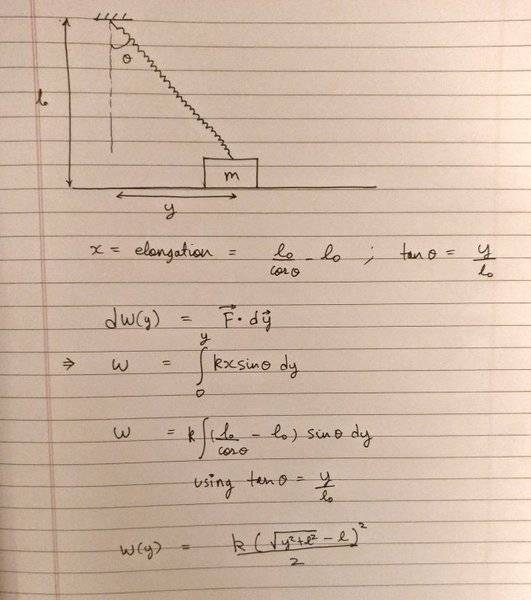
img_20170218_162826_01-min-jpg.113388.jpg


Over here, I assumed the spring force, which is a function of its elongation x (F = -kx) to be constant in the interval dy and integrated and this gave me the correct answer

I want to know why the error vanished over here. Shouldn't spring force only be constant in the interval dx and not dy?

I also want to know, in general, if I have a function, how to decide whether it is constant in some particular interval/in which cases the error will vanish as I take the limit and integrate. Or are forces/functions constant for any infinitesimal intervals such as Rdθ, dy/cosθ, dz etc etc.?
 
Physics news on Phys.org
EddiePhys said:
This question has a little bit of physics in it, but it's mostly maths.

If I have force, or any function f(z), I was told that I can assume it to be constant only in the interval dz.

However, in this case, I had to calculate the work done by the spring force as a function of y

img_20170218_162826_01-min-jpg.113388.jpg


Over here, I assumed the spring force, which is a function of its elongation x (F = -kx) to be constant in the interval dy and integrated and this gave me the correct answer

I want to know why the error vanished over here. Shouldn't spring force only be constant in the interval dx and not dy?

I also want to know, in general, if I have a function, how to decide whether it is constant in some particular interval/in which cases the error will vanish as I take the limit and integrate. Or are forces/functions constant for any infinitesimal intervals such as Rdθ, dy/cosθ, dz etc etc.?
It depends whether the derivative is bounded. If it is, we can approximate the function in the vicinity of a point using the Taylor expansion: f(x+dx)=f(x)+f'(x)dx+... So for small dx f(x+dx) is approximately f(x). But this will not work for x ln(x) in the vicinity of 0.
 
haruspex said:
It depends whether the derivative is bounded. If it is, we can approximate the function in the vicinity of a point using the Taylor expansion: f(x+dx)=f(x)+f'(x)dx+... So for small dx f(x+dx) is approximately f(x). But this will not work for x ln(x) in the vicinity of 0.

I understand that I can assume f(x) to be constant in the interval [x, x+dx), but in my case, I have assumed it to be constant in an unrelated interval [y,y+dy) and still gotten the correct answer. I want to know why, and if I can, in general, assume any function to be constant in any infinitesimal interval such as Rdθ, dy/cosθ, dz etc
 
EddiePhys said:
I understand that I can assume f(x) to be constant in the interval [x, x+dx), but in my case, I have assumed it to be constant in an unrelated interval [y,y+dy) and still gotten the correct answer. I want to know why, and if I can, in general, assume any function to be constant in any infinitesimal interval such as Rdθ, dy/cosθ, dz etc
It is not unrelated. x and y are directly related, so you can recast f as a function of y.
 
haruspex said:
It is not unrelated. x and y are directly related, so you can recast f as a function of y.

I don't understand how being able to recast f as a function of y is relevant.
Also, can I, in general, assume a force or function to be constant in any infinitesimal interval such as Rdθ, dy/cosθ, dz etc
 
EddiePhys said:
I also want to know, in general, if I have a function, how to decide whether it is constant in some particular interval/in which cases the error will vanish as I take the limit and integrate.

The existence of a definite integral of a function does not require that the function be constant in any particular interval. The notion that a function ##f(x)## must be "constant" is small interval of length ##dx## in order for ##\int f(x) dx## to exist isn't a correct mathematical statement. The correct statement is that if ##f(x)## is continuous in the closed interval ##[a,b]## then ##\int_a^b f(x) dx## exists and can be computed, in the usual way, by using an antiderrivative. (See "The Fundamental Theorem of Calculus".)

A person trying to formulate an intuitive explanation of what "continuous" means to a child might resort to using the words that ##f(x)## is "constant" in each "infinitesimal" interval of length ##dx##, but that is a mangled description of the actual meaning of "continuous".
 

Similar threads

  • · Replies 4 ·
Replies
4
Views
3K
  • · Replies 3 ·
Replies
3
Views
2K
  • · Replies 1 ·
Replies
1
Views
3K
  • · Replies 28 ·
Replies
28
Views
4K
  • · Replies 4 ·
Replies
4
Views
2K
Replies
3
Views
2K
  • · Replies 1 ·
Replies
1
Views
3K
  • · Replies 20 ·
Replies
20
Views
4K
  • · Replies 13 ·
Replies
13
Views
2K
  • · Replies 11 ·
Replies
11
Views
2K