Why can I assume the force to be constant in this interval?

Click For Summary

Discussion Overview

The discussion revolves around the assumptions made when considering forces, particularly the spring force, as constant over certain intervals during integration. Participants explore the conditions under which such assumptions are valid and the implications for calculating work done by forces in different contexts.

Discussion Character

  • Exploratory
  • Technical explanation
  • Conceptual clarification

Main Points Raised

  • One participant questions why the spring force, which depends on elongation, can be treated as constant over an interval dy when it is typically assumed to be constant only over dx.
  • Another participant suggests that if dz is infinitesimally small and the function is continuous, one can assume it to be at its segment maximum, minimum, or average without significantly affecting the integral value.
  • A participant mentions the basics of calculus, indicating that a finite step in x leads to a change in y, and that the limit of work done assumes certain conditions are met as the step approaches zero.
  • There is a suggestion to consult a Calculus textbook for a more thorough understanding of when such assumptions are justified.

Areas of Agreement / Disagreement

Participants express uncertainty regarding the conditions under which forces can be assumed constant over different intervals. There is no consensus on the generality of these assumptions or the specific cases where errors might vanish.

Contextual Notes

Participants highlight the importance of continuity and the infinitesimal nature of intervals in determining the validity of assumptions about constancy. However, the discussion does not resolve the specific conditions or limitations of these assumptions.

EddiePhys
Messages
144
Reaction score
6
If I have force, or any function f(z), I was told that I can assume it to be constant only in the interval dz.

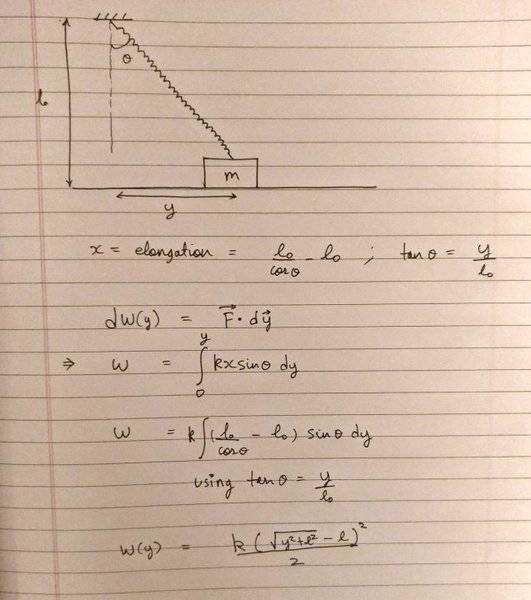
However, in this case, I had to calculate the work done by the spring force as a function of y
IMG_20170218_162826_01-min.jpg


Over here, I assumed the spring force, which is a function of its elongation x (F = -kx) to be constant in the interval dy and integrated and this gave me the correct answer

I want to know why the error vanished over here. Shouldn't spring force only be constant in the interval dx and not dy?

I also want to know, in general, if I have a function, how to decide whether it is constant in some particular interval/in which cases the error will vanish as I take the limit and integrate. Or are forces/functions constant for any infinitesimal intervals such as Rdθ, dy/cosθ, dz etc etc.?
 
Physics news on Phys.org
It is assumed that dz is infinitesimally small and that f is continuous within the z axis segment that dz spans. Then you can assume that the function is at it's segment maximum, minimum, average, or any of its segment values. The differences should be so small that it doesn't change the integral value significantly.
 
EddiePhys said:
If I have force, or any function f(z), I was told that I can assume it to be constant only in the interval dz.

However, in this case, I had to calculate the work done by the spring force as a function of y
Over here, I assumed the spring force, which is a function of its elongation x (F = -kx) to be constant in the interval dy and integrated and this gave me the correct answer

I want to know why the error vanished over here. Shouldn't spring force only be constant in the interval dx and not dy?

I also want to know, in general, if I have a function, how to decide whether it is constant in some particular interval/in which cases the error will vanish as I take the limit and integrate. Or are forces/functions constant for any infinitesimal intervals such as Rdθ, dy/cosθ, dz etc etc.?

You are touching on the very basics of Calculus here. Long story short: you start with a finite step in x (δx) and that gives you a change δy. The Limit of the value of the work done dW assumes (justifiably here) that θ doesn't change as δx →0
There has been loads and loads written about this sort of thing and, if you get a Calculus Intro textbook, you can find out when that sort of step is justified and when it's not. You could try posting a similar question on the Maths Forum and see if you get a better answer from a Mathematician who can sum it up in less than several pages of textbook.
 
sophiecentaur said:
You are touching on the very basics of Calculus here. Long story short: you start with a finite step in x (δx) and that gives you a change δy. The Limit of the value of the work done dW assumes (justifiably here) that θ doesn't change as δx →0
There has been loads and loads written about this sort of thing and, if you get a Calculus Intro textbook, you can find out when that sort of step is justified and when it's not. You could try posting a similar question on the Maths Forum and see if you get a better answer from a Mathematician who can sum it up in less than several pages of textbook.

Okay, I'll post it on a maths forum. Thanks!
 

Similar threads

  • · Replies 24 ·
Replies
24
Views
4K
  • · Replies 5 ·
Replies
5
Views
2K
  • · Replies 6 ·
Replies
6
Views
2K
  • · Replies 4 ·
Replies
4
Views
2K
  • · Replies 4 ·
Replies
4
Views
3K
  • · Replies 6 ·
Replies
6
Views
3K
  • · Replies 12 ·
Replies
12
Views
2K
  • · Replies 2 ·
Replies
2
Views
1K
  • · Replies 41 ·
2
Replies
41
Views
4K
Replies
26
Views
4K