Why is this Hubble plot linear for Omega=2 closed universe?

Click For Summary
SUMMARY

The discussion centers on the linear relationship observed in the Hubble plot for a closed universe with density parameter ##\Omega = 2##. The key finding is that this linearity arises from a crucial cancellation in the equations governing a matter-dominated universe, specifically in the equation derived from John Peacock's "Cosmological Physics". The resulting relationship, $$D_L = \frac{cz}{H_0}$$, indicates that the slope of the line in the plot corresponds to the Hubble constant, approximately 70 km/s/Mpc. This conclusion is supported by the mathematical derivations presented in the discussion.

PREREQUISITES
  • Understanding of cosmological parameters, specifically density parameter ##\Omega##.
  • Familiarity with the Friedmann-Lemaître-Robertson-Walker (FLRW) metric.
  • Basic knowledge of redshift and luminosity distance in cosmology.
  • Ability to interpret mathematical equations in the context of cosmological models.
NEXT STEPS
  • Study the implications of different values of ##\Omega## on cosmic expansion models.
  • Learn about the derivation and significance of the Friedmann equations.
  • Explore the concept of luminosity distance and its applications in observational cosmology.
  • Review John Peacock's "Cosmological Physics", particularly section 3.4 on observations in cosmology.
USEFUL FOR

Astronomers, cosmologists, and physics students interested in the mathematical foundations of cosmological models and the implications of density parameters on the universe's expansion.

Bandersnatch
Science Advisor
Messages
3,597
Reaction score
3,248
TL;DR
I'm trying to get an intuitive understanding of how different expansion models show up on the Hubble plot and I can't wrap my head around the linearity of this one.
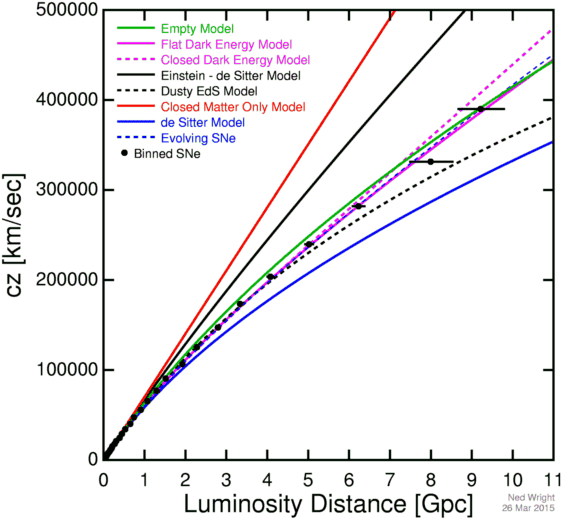
On Ned Wright's pages one can find this graph:
242895

plotting some supernova data against different expansion models.
The main thing here that gives me a pause is the linear relationship for the closed universe with ##\Omega##=2 (red line). There doesn't seem to be any weird scaling involved. What is it, then, about this particular density that makes the plot of redshift vs this particular distance measure linear?
A reference to a non-obscure textbook or an online resource should suffice and will be appreciated, but patient explanations are more than welcome.
 
Space news on Phys.org
Bandersnatch said:
The main thing here that gives me a pause is the linear relationship for the closed universe with ##\Omega##=2 (red line). There doesn't seem to be any weird scaling involved. What is it, then, about this particular density that makes the plot of redshift vs this particular distance measure linear? A reference to a non-obscure textbook or an online resource should suffice and will be appreciated, but patient explanations are more than welcome.

I can run through the math, but I can't give any real intuition for the ##\Omega = 2## matter-only case.

Below, I reference and use stuff from section 3.4 "Observations in Cosmology" in John Peacock's book "Cosmological Physics". This section is freely available on Ned Wright's website,
http://ned.ipac.caltech.edu/level5/Peacock/Peacock_contents.html
Equation (3.78),
$$R_0 S_k \left( r \right) = \frac{2c}{H_0}\frac{z \Omega + \left( \Omega - 2 \right) \left( \sqrt{1 + z \Omega} - 1\right)}{\Omega^2 \left( 1 + z \right)},$$
applies to a matter-dominated universe, and where ##S_k \left( r \right)## is the standard FLRW spatial metric given by (3.10)

When ##\Omega = 2##, a crucial cancellation in the second term in the right numerator occurs, and this becomes
$$\begin{align}
R_0 S_k \left( r \right) &= \frac{2c}{H_0}\frac{z \Omega }{\Omega^2 \left( 1 + z \right)} \nonumber \\
&= \frac{c}{H_0}\frac{z}{1 + z} \nonumber .
\end{align} $$
Combining this with equation (3.91) for luminosity distance,
$$D_L = \left( 1 + z \right) R_0 S_k,$$
gives
$$D_L = \frac{cz}{H_0},$$
and
$$cz = H_0 D_L .$$
Hence, when ##cz## is plotted versus luminosity distance, the slope of the resulting straight line is
$$H_0 \approx 70 ~ \frac{\rm{km} / \rm{s}}{\rm{Mpc}} = 70000 ~\frac{\rm{km} / \rm{s}}{\rm{Gpc}},$$
which is consistent with values on the vertical and horizontal axes of the figure.
 
  • Like
Likes   Reactions: Bandersnatch

Similar threads

  • · Replies 17 ·
Replies
17
Views
3K
  • · Replies 9 ·
Replies
9
Views
3K
  • · Replies 7 ·
Replies
7
Views
3K
  • · Replies 55 ·
2
Replies
55
Views
11K
  • · Replies 13 ·
Replies
13
Views
4K
  • · Replies 8 ·
Replies
8
Views
4K
  • · Replies 10 ·
Replies
10
Views
5K
  • · Replies 1 ·
Replies
1
Views
3K
  • · Replies 46 ·
2
Replies
46
Views
12K
  • · Replies 10 ·
Replies
10
Views
4K