Math Amateur
Gold Member
MHB
- 3,920
- 48
I am reading James Munkres' book, Elements of Algebraic Topology.
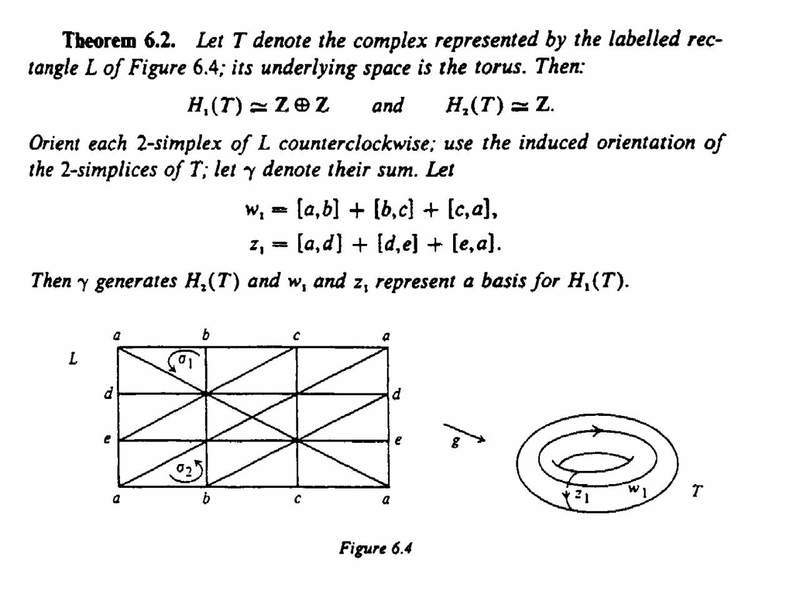
Theorem 6.2 on page 35 concerns the homology groups of the 2-dimensional torus.
Munkres shows that H_1 (T) \simeq \mathbb{Z} \oplus \mathbb{Z} and H_2 (T) \simeq \mathbb{Z}.
After some work I now (just!) follow the proof that H_1 (T) \simeq \mathbb{Z} \oplus \mathbb{Z} but I need some help to understand a point in the proof of H_2 (T) \simeq \mathbb{Z}.
Munkres' argument to show H_2 (T) \simeq \mathbb{Z} is as follows:
-----------------------------------------------------------------------------
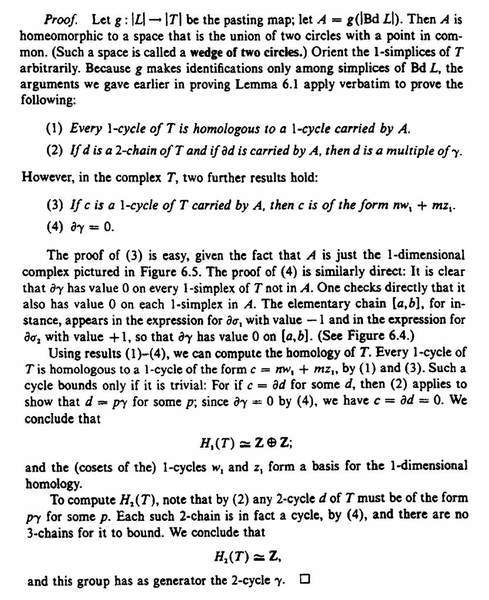
To compute H_2 (T), note that by (2) any 2-cycle d of T must be of the form p \gamma for some p. Each such 2-chain is in fact a cycle,by (4) , and there are no 3-chains for it to bound. We conclude that
H_2 (T) \simeq \mathbb{Z}
and this group has as generator the 2-cycle \gamma.
------------------------------------------------------------------------------------------------
I do not fully understand why any 2-cycle d of T must be of the form p \gamma for some p.
Can someone please explain exactly why this follows?
Would appreciate some help.
-----------------------------------------------------------------------------
To give members of the Physics Forums the context of the post above, the text of Theorem 6.2 and its proof follow:
Some of my thoughts ... ...
Basically, to show that any 2-cyclce of L (i.e. T) os of the form $$ p \gamma $$, we have to show the following:
If d = \sum_i n_i \sigma_i where \partial d = 0 then d = p \gamma.
We have, of course that \gamma = \sum_i \sigma_i
Note that we have that if d is a 2-chain of L and if \partial d is carried by A then d is a multiple of \gamma.
Munkres defines 'carried by' in the following text taken from page 31:

Hope someone can help.
Peter
Theorem 6.2 on page 35 concerns the homology groups of the 2-dimensional torus.
Munkres shows that H_1 (T) \simeq \mathbb{Z} \oplus \mathbb{Z} and H_2 (T) \simeq \mathbb{Z}.
After some work I now (just!) follow the proof that H_1 (T) \simeq \mathbb{Z} \oplus \mathbb{Z} but I need some help to understand a point in the proof of H_2 (T) \simeq \mathbb{Z}.
Munkres' argument to show H_2 (T) \simeq \mathbb{Z} is as follows:
-----------------------------------------------------------------------------
To compute H_2 (T), note that by (2) any 2-cycle d of T must be of the form p \gamma for some p. Each such 2-chain is in fact a cycle,by (4) , and there are no 3-chains for it to bound. We conclude that
H_2 (T) \simeq \mathbb{Z}
and this group has as generator the 2-cycle \gamma.
------------------------------------------------------------------------------------------------
I do not fully understand why any 2-cycle d of T must be of the form p \gamma for some p.
Can someone please explain exactly why this follows?
Would appreciate some help.
-----------------------------------------------------------------------------
To give members of the Physics Forums the context of the post above, the text of Theorem 6.2 and its proof follow:
Some of my thoughts ... ...
Basically, to show that any 2-cyclce of L (i.e. T) os of the form $$ p \gamma $$, we have to show the following:
If d = \sum_i n_i \sigma_i where \partial d = 0 then d = p \gamma.
We have, of course that \gamma = \sum_i \sigma_i
Note that we have that if d is a 2-chain of L and if \partial d is carried by A then d is a multiple of \gamma.
Munkres defines 'carried by' in the following text taken from page 31:
Hope someone can help.
Peter
Attachments
-
 Theorem 6.2 - Part 1 - Page 35 - Munkres - Elements of Algebraic Topology.jpg40.6 KB · Views: 798
 -
 Theorem 6.2 - Part 2 - Page 35 - Munkres - Elements of Algebraic Topology.jpg62.2 KB · Views: 759
 -
 Definition of Carried By and Homologous - Munkres page 31 - Elements of Algebraic Topology.jpg21.1 KB · Views: 701
Last edited: